Commentary Prepared by Dr. Julia Lenaghan, Ashmolean Museum
C 111
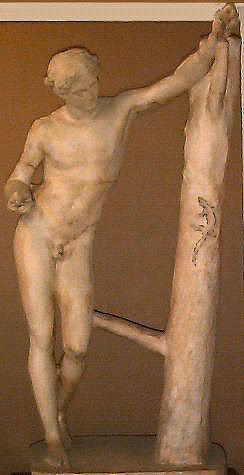
Apollo Sauroktonos Attributed to Praxiteles. Vatican
Roman period statue of a young Apollo watching a lizard that he is about to kill. Generally considered to be a copy of a statue made by Praxiteles around 350 BC.
Marble
Statue
1.67 m
From Rome. Found on the Palatine in the Villa Magnani in 1777 with another less well preserved statue of the same type.
Italy, Vatican, Galleria delle Statue, 750
Roman statue probably based on an original dated ca.350 BC
Preservation:Restorations on the head of the statue include a large part of the right side of the face and skull; the nose; the left ear; and a portion of the neck and throat. Restorations on the body of the statue include great the left arm and the left hand; the right forearm with the strut; the right lower leg and half of the thigh; the left lower leg; both feet; and the base. The tree trunk from the height of the left elbow to the tail of the lizard and the lower branch are also restorations.
Description:The statue depicts a pre-pubescent boy leaning against a tree and watching a lizard that crawls up the trunk of the tree. The boy stands with his weight over his right leg; his right hip projects in a smooth curve. The left shin trails behind and the heel of the left foot, which is almost in line with the right foot, is raised. The upper body leans toward the left and the raised left arm rests against a tree trunk support. The lowered right arm bends at the elbow; the upper arm rests by the side and the forearm projects forward. The hand grasps a no longer extant object. A strut runs from the outer left thigh diagonally downwards to the tree trunk.
The head turns to the left. The face has a long oval shape with regular features. The eyebrows and nose form two virtually perpendicular lines. The mouth is small with slightly parted lips, the upper of which has a central overhang. Below it is a broad projecting chin. The long hair, rendered in distinct locks, frames the brow in a triangular manner. It has a central part and is combed backward off the brow. It is held in place by a broad flat fillet that runs around the head just above the ears. After passing under the fillet the hair is collected and knotted at the nape of the neck. On both sides of the head over the ears, two locks of hair are pulled out behind the fillet.
Discussion:The Vatican statue is one of at least 20 extant replicas of a statue of Apollo Sauroktonos (“Lizard Slayer”) thought to have been made by Praxiteles in ca.350 BC (see also cat.no.C 112). Two Roman authors, Pliny the Elder and Martial, both make reference to such a statue.
Pliny (NH 34.70) writes that “Praxiteles also made a youthful Apollo called in Greek the lizard-slayer because he is waiting with an arrow for a lizard creeping towards him”. This passage is generally accepted as a reference to the original work that the Vatican statue and other replicas copy. Martial (Apophoreta 14.172) also makes reference to a youthful boy “Sauroktonos” laying in wait for a lizard.
The statue resembles the Knidian Aphrodite (cat.nos.C 172-175), assuredly assigned to Praxiteles, and the Hermes from Olympia (cat.no.C113), also certainly related to Praxiteles. As is the case with the Knidian Aphrodite, an additional support forms an integral part of the composition and the intended viewing angle is frontal. The pose of the statue is reminiscent of the Hermes.
The original function (cult or votive) of the statue and the meaning of the action (reference to the Python, reference to the end of some type of blight, reference to a tree not a lizard, etc.) have remained open to scholarly debate. Because of numismatic evidence and the large number of Italic copies, Corso suggested that the original statue was a cult statue at Apollonia ad Ryndacum (Asia Minor) which was subsequently brought to Rome by the general Lucullus when he defeated Mithridates there in 73 BC.
Only recently has the Praxiteleian attribution been questioned. Two American scholars, Ridgway and Ajootian, have suggested that the original statue may not be by Praxiteles and may date to the Hellenistic or Roman period. Ridgway finds the effeminate forms, the peculiar activity, and the hairstyle more in keeping with Hellenistic compositions.
Ajootian, essentially assuming the same argument, goes so far as to suggest that Pliny confused sculptors and intended Pasiteles, not Praxiteles. Pasiteles worked in Rome in the late second and first centuries BC. A statue group, known as the Ildefonso group, is often ascribed to him and one of the two figures actually is a loose copy of the “Sauroktonos” type.
Julia Lenaghan
Bibliography:W. Amelung,
Die Skulpturen des vaticanischen Museums II (Berlin 1908) 450-452 no.264 pl.49
catalogue entryW. Helbig (H. von Steuben),
Führer durch die öffentlichen Sammlungen klassischer Altertumer in Rom II (4th edition) (Tübingen 1966) 91-92 no.125
catalogue entry, copy of the Sauroktonos of Praxiteles which was probably made for a cult of Apollo the lizard slayer(O. Palagia),
"Apollo" Lexicon Iconographicum Mythologiae Classicae II (Zurich 1984) 199 no.81
catalogue entry on Saurkotonos type, presented as by Praxiteles, ca.350 BC, to be interpreted as a reference to the Python(E. Simon),
"Apollon/Apollo" Lexicon Iconographicum Mythologiae Classicae II (Zurich 1984) 378-379 no.53b
entry on the Vatican statue and discussion of the Sauroktonos type, considers the tree to be a more iconographically important detail than the lizardS. Settis (ed.),
Camposanto Monumentale di Pisa. Le Antichità II (Modena 1984) 165-167
summary of research on Sauroktonos typeA. Corso,
Prassitele: Fonti epigrafiche e letterarie. Vita e opera I (Rome 1988) 83-84
suggests that the statue was originally at Apollonia ad Ryndacum and perhaps brought to Rome in 73 BCL. Todisco,
Scultura greca del IV secolo (Milan 1993) 73-74 no.127
considers the Vatican statue to be a copy of a work by Praxiteles dated no later than 350 BCB. S. Ridgway,
Fourth-Century Styles in Greek Sculpture (London 1997) 265 and 334
questions the attribution of the type to Praxiteles and to the fourth century BCA. Ajootian,
"Praxiteles", Personal Styles in Greek Sculpture (Cambridge 1998) 116-122
suggests that the Apollo Sauroktonos type is by Pasiteles and emphasizes the type's Roman associations