Commentary Prepared by Dr. Julia Lenaghan, Ashmolean Museum
C 091
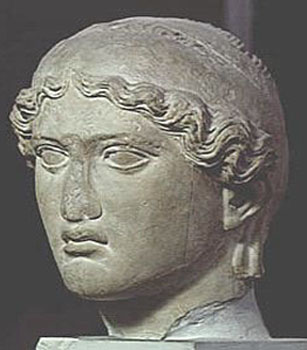
Hertz Head (Head of Nike). Palazzo Venezia, Rome
Marble
Head
33 cm
Acquired from an art dealer in Rome. The head is, therefore, from Italy.
Italy, Rome, Palazzo Venezia
Preservation:The entire nose, the lower lip, and the bust with part of the neck are restored; these have been removed in the cast. There is a break from the upper part of the right cheek through the upper part of the head. The bands behind the ears, the ears, the brow, the lids, and the upper lip are all battered. The left cheek seems to have been smoothed by a modern restorer.
Description:The head depicts a female head with long hair wrapped in a broad hair band. One strip of the hair band runs directly above the forehead and downwards above the ears. Another strip of the hair band runs in front of the crown and downwards. The two strips merge at the back of the head behind the ears. There they cover a broad area of the projecting roll up hair as well as the roots; no hair appears below the hair band at the back of the head. The two ends of the hair band are somehow loose and dangle on both sides behind the ear.
The hair itself is rendered in defined wavy locks that fall naturally from the crown. At the back of the head the two sections of hair are visible between the crown and the hair band. The first section is the hair near the top of the head which falls naturally downwards. It is separated from the hair that is rolled upwards by a distinct horizontal groove. On the top of the head there are two sections of hair visible, one at the crown and one between the strips. Around the face, the hair, emerging from the lower strip, is symmetrically arranged in regular waves. The hair has a central part which forms a small peak. The foremost locks descend downwards from this part, then move to the sides, rise slightly, then fall again, and are then pulled backward. The hair at the temples is also wavy and pulled backwards around the ears, which are not covered. The hair has greater volume in the area of the temples.
The face has a full oval shape. The brow is broad and flatly horizontal. The projecting eyebrows are virtually horizontal with a small rise over the outer portion of the eye. The eyes are large and open. The right eye appears to be larger and set closer to the nose. Above the upper eyelid is a deeply engraved line over which the flesh between the eyebrow and the eyelid hangs. The inner line of the upper eyelid does not continue past the intersection with the lower lid. The mouth, below a long nose, is small from side to side and perhaps shorter on the left side. The lips are full, finely shaped, and seem to splay outwards. The upper lip features a dip at the center and the lower outline of the lower lip has a slight rise at the center. The cheeks are broad and heavy and end in round projecting chin.
Discussion:The Hertz head repeats a head type that is known in two other copies, one in the Vatican (Chiarmonti 1589) and one from the Areopagus in Athens (found in 1970). The head type with its wrapped head band resembles the fragment of the back of the head of the Nike of Paionios from Olympia. In fact, Treu reconstructed the face of Paionios’ Nike on the basis of the Hertz type.
Yet, the Hertz head type differs from the Nike of Paionios in three ways. The Hertz type does not tilt downward and looks to the left rather than the right. Behind the ears of the Hertz type are flat ends of the head band rather than the beginning of the roll of hair. Also the herm in the Vatican shows that the statue on which the head belonged wore a peplos that was fastened on both shoulders so closely to the neck that the outer upper area of the shoulder was exposed. This peplos is in no way like that of the Nike of Paionios which was fastened on only one shoulder. It has, however, been pointed out that this is a typical manner in which Nikai wear their peplos on account of their wings.
Thus, the Hertz head type is generally considered to copy another work by Paionios or someone close to him and probably to have been another Nike. Since we know that Paionios made two gold Nikai as akroteria for the Temple of Zeus at Olympia and perhaps the Messenian dedication at Delphi (again by Paionios) was also a Nike, this idea that the Hertz type represents another Nike of Paionios is plausible. Yet sculpture at Olympia and Delphi was not generally copied.
Amelung noted the similarity of the head type to that of the “Herculaneum-Tivoli Amazon” (cat. C 90) which is dated ca. 440 BC. He pointed out the great resemblance in the strands of hairs around the temples and ear, the brow, the eyebrows, and the mouth; though unnoted by Amelung, the full face is also similar. Harrison further adds that the form of the head with the forehead that makes corners at the junction with the profiles is generally dated about the middle of the fifth century. Stylistically the head would seem to pre-date the Nike of Paionios by about twenty to thirty years.
Harrison believes that the Nike head represented by the Hertz type is actually that of the Nike held in the hand of the Athena Parthenos for primarily four reasons. The size, which is slightly bigger than the head of the Nike of Paionios, accords well with what we know of the height of the Parthenos’ Nike. The assymetry of the face and the turn to the left are suitable for the Nike which would have turned toward Athena and would not have been viewed frontally. The lack of clarity of the wrapping of the hair band might be because the original statue wore a wreath (as the Nike of the Athena Parthenos did) which in part obviated the necessity to depict accurately the cloth. The drapery reproduced on the Vatican copy of the Hertz type shows a high rounded neck line and has solid, neither transparent nor soft, folds. Both of these details correspond to the drapery reproduced on the Varvakeion statuette. In addition, Harrison adds that the ends of the head band hanging behind the ears would have made a solid backdrop for earrings and that during repairs made to the Parthenos after a fire in the 130s copyists would have gotten an opportunity to review all aspects of Pheidias’ Athena. Paionios, a sculptor of the next generation, might well have cited or had in mind the Athena Parthenos.
Although Harrison’s argument is appealing, it certainly cannot be proven. One point that does emerge from it and that should perhaps be given more attention is that the Hertz head type seems stylistically to be a few decades earlier than the Nike of Paionios. In conclusion, about the Hertz head type we can that it very likely depicted a Nike and probably was made about 440 BC.
Bibliography:W. Amelung,
"Weiblicher Kopf" (RM 9 1894) pp.162-169
full publication of the head, considers it to be from same workshop, even by same hand as Nike of PaioniosW. Helbig (W. Fuchs),
Führer durch die öffentlichen Sammlungen klassicher Altertumer in Rom I(4th ed) (Tübingen 1963) pp.262-263 no.343
head type is from a Nike which is post-Pheidian, ca. 420 BCT. Hölscher,
"Nike der Messenier und Naupaktier in Olympia" (JdI 89 1974) p.74 footnote 6
probably from a statue similar to that of the Nike of Paionios, probably a NikeE. Harrison,
"Two Pheidian Heads: Nike and Amazon" The Eye of Greece: Studies in the Art of Athens (Cambridge 1982) pp.53-65
considers the "Hertz" head type to represent the Nike held in the hand of Pheidias' Athena Parthenos