Commentary Prepared by Dr. Julia Lenaghan, Ashmolean Museum
C 072
Marsyas of Myron's Athena and Marsyas Group. Vatican
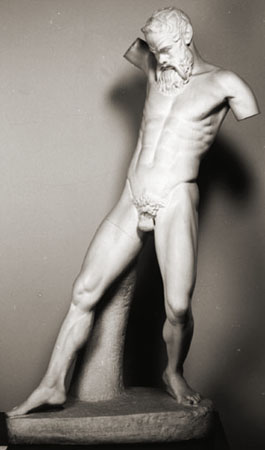
First century statue of the satyr Marsyas stepping back and looking down at the flutes dropped by Athena. Based on a model of the mid-fifth century BC attributed to Myron. Erected in the city of Rome and almost assuredly accompanied by a statue of Athena.
Marble
Statue
1.71 m with plinth, 1.56 m without plinth
From Rome. Found on the Esquiline at Via Quattro Cantoni nos. 46-48 with other sculpture. (see Interpretation, for more details)
Italy, Vatican, Museo Gregoriano Profano, 9974
A Roman (First Century) Copy of the mid Fifth Century (ca. 445 BC) Statue
Preservation:Both ears, the left shin, and the front of the right foot with part of the plinth are restorations. The original left shin and the front of the right foot have probably been found among the fragments in the Vatican. The arms, which had been restored, were removed in 1925; the flat surfaces of the arms stumps with holes and the marble patches on the right shoulder belong to the removed modern restoration.. The head is broken through the neck. It was found a day after the statue but certainly belongs to the statue. Also broken are the left upper thigh, the left foot, and the right shin below the knee and above the ankle. The tail, which is not completely preserved, is broken in two places. There is a trace of a worked away strut on the outer side of the left thigh and the surface of the support directly under the tail was reworked in antiquity. Presumably there was once a long horse-like tail. On the top of the plinth are two ancient cuttings, the one is in front of the left foot and the other is about 22 to 23 centimeters towards the middle. These were perhaps for a flute. The body has been cleaned with acid which has ruined the ancient surface. The head has instead been cleaned mechanically; this shows especially on the left profile. The plinth has been engraved MUNIFICENTIA PII IX PONT MAX 1824 C.C. 31.
Description:
The statue depicts an extremely muscular satyr who recoils in surprise. The weight of the figure rests on the tensed left leg which faces front. The heel of the left foot is raised indicating the impermanence of the moment. The right leg is turned so that the viewer sees the inner side of it. It extends to the right with all of its muscles tensed. Only the toes of the fully extended foot touch the ground. A trunk-like support with a rough claw chisel finish is attached to the under side of the right thigh.
The upper body follows the turn of the legs and is, therefore, visible to the frontally stationed viewer at an angle. It, moreover, leans back wards. The beginning of the right arm is raised and the beginning of the left arm is lowered and pulled back from the body. The head looks downward; the chin is tucked against the sternum.
The body is slight and rendered with lean wiry musculature. This is especially visible around the abdominal area. At the center of the upper part of the buttocks springs a tail, which was once long and at some pointed shortened.
The head features medium length hair and a full moustache and beard. The hair consists of wavy locks. At the crown the the back part of the hair falls down the back and the front part of the hair is combed forward. The hair around the face, however, is pushed back. The hair stays close to the skull and leaves the ears uncovered. The beard and moustache are fuller than the hair of the head. Their locks are intertwined and wavy. The ends of the beard which turn in slight different directions lie on the chest.
The brow is tall and has two sets of arched furrows which spring from the nose on both sides. The eyebrow runs almost parallel to the furrows above it. The eyes are small. The bridge of the nose is deeply set. The nostrils are round and flared. The mouth, mainly hidden by the facial, hair is open and dips downwards at the corners.
Discussion:This statue is the best preserved example of a statue type is known in a total of seven copies. These copies are this complete statue in the Vatican, two torsos (Vatican from Castelgandolfo and the Getty), three heads (Barracco, Capitoline Antiquarium from the Circus of Maxentius, Capitoline Storerooms) as well as piece from Spain (published A. Balil, Bvallod 44 1978 pp.385-389).
The statue has been identified as Marsyas and as the second statue of an Athena-Marsyas group. The Athena statue is also known in several copies (cf. cat. C 71). The group, which shows Athena having dropped the flutes and an excited Marsyas ready to pick them up but warned by Athena, has been reconstructed from comparable depictions of Athena and Marsyas in other artistic genres. The two so appear on a red-figure oinochoe in Berlin that is dated ca. 450-445 (LIMC II p.1014 no.618), on imperial coins from Athens, and in the relief decoration of a neo-Attic marble krater. In addition, two literary references have been associated with the Marsyas statue. Pliny the Elder in his Natural Histories (N.H. 34.57) mentions statues made by the sculptor Myron of Athena and Marsyas who admires the flutes. Pausanias (1.24.1) reports having seen on the Athenian Akropolis a statue group that depicted Athena striking Marsyas for having picked up the flutes that she discarded. Thus, scholars have imagined that the statues referred to by these authors are the same and that the re-appearing Athena and Marsyas design can be traced back to statues of Myron erected on the Acropolis. This hypothesis has been generally accepted since it accords with stylistic, archeological, and historical considerations (cf. cat. C 71).
The Vatican statue itself was found in a particular context. Found with the statue were some blocks in the process of being worked as well as seven other statues. All of the statues found depicted subjects of the Dionysian genre; four depicted satyrs, two nymphs, and one Dionysos. The room whence this statuary came featured marble revetment behind which was brickwork with stamps dated to 134. Thus, in the most recent publication (Daltop and Oehler) it has been concluded that the building initially had another purpose and was only secondarily used as a sculptor’s workshop. The workshop would likely have been at earliest Antonine. Because the sculpture found in the building pre-dates the Antonine period, it has been suggested that the workshop was located in a horti or garden on the Esquiline and was involved in repairing and making new statues for a nymphaeum or bath in the garden, for which Dionysian statuary would be appropriate.
This theory explains the ancient reworking of the tail. It also eliminates the need to date the Vatican Marsyas to the second century. Fuchs’ had already dated the statue to the first century on account of the type of undecorated support used and the rendering of the hair which differs from other copies in that the hair hangs together as a unit. The simple plinth also attests to an early date. Scholars who had given it a later date were misled by the context and by the acid washing of the surface which has blurred the details.
Bibliography:W. Helbig (W. Fuchs),
Führer durch die öffentlichen Sammlungen klassicher Altertumer in Rom I(4th ed) (Tübingen 1963) pp.764-767 no.1065
thorough discussion, dates copy to the late first century ADG. Daltrop,
Il gruppo minoriano di Atene e Marsia nei Musei Vaticani (Vatican City 1980) pp.14-19 and 41 no.1
considers the statue to be Hadrianic, compares it with other replicasG. Daltrop and P.C. Bol,
Athena des Myron (Frankfurt 1983) pp.29-33 and 75 no.1
full discussion of the statue, dated to the Hadrianic periodP. B. Rawson,
The Myth of Marsyas in the Roman Visual Arts (Oxford 1987) p.189 A1a
discussion of group with replica (incomplete) list,
"Europe" Lexicon Icongoraphicum Mythologiae Classicae IV (Zurich 1988) pp.341-343
statement about the statue group and other works of Myron(A. Weiss),
"Marsyas" Lexicon Iconographicum Mytholigiae Classicae VI (Zurich 1992) p.369 no.11
calls the statue an Antonine copyC. Vorster,
Vatikanische Museen. Museo Gregoriano Profano ex Lateranense. Römische Skulpturen des später Hellenismus der Kaiserzeit I. Werke nach Vorlagen und Bildformeln des 5. und 4. Jahrhunderts v. Chr. (Mainz 1993) pp.21-24 no.3 figs.11-12, 14, 16-20
full discussion of find location and appropriate placement for statue, dates to first century AD