Commentary Prepared by Dr. Julia Lenaghan, Ashmolean Museum
C 252
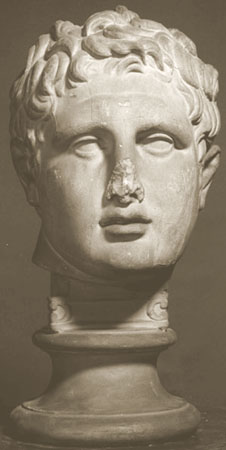
Head of the Apoxyomenos, possibly by Lysippos. Vatican
Head from a Roman statue of an athlete scraping himself. Possibly a version of an original created by Lysippos in ca.320 BC
Marble
Head from a statue
From Rome. Found in Trastevere in 1849 in the excavations of Luigi Canina. It was excavated in a street then called Vicolo delle Palme and now called Vicolo dell’Atleta amidst the debris of a late imperial building. A bronze horse now in the Conservatori and the hindquarters of a bronze bull were found at the same time. The statue was acquired by the Vatican Museum and put into the Braccio Nuovo. It has since been moved to a small room off the Belvedere court.
Italy, Vatican, Museo Pio Clementino, Gabinetto dell' Apoxyomenos, 1185
Roman statue (early Imperial) based on an original dated ca. 320 BC
Preservation:The following parts of the head have been restored: The lower half of the nose, a portion of the right upper eyelid, the left ear and few locks of hair above and below it. In the Ashmolean Cast the restored nose has been removed. The surface is cleaned and bleached. In 1994 the statue was re-conserved and the previous restorations were replaced, reset, or removed.
Description:The head looks slightly toward the right. The face has a broad round shape. The lower portion of the brow projects forward. The eyes are small, closely and deeply set, and framed tightly by the eyebrows. The mouth is small from side to side and the lips are parted. Between the bottom lip and the chin is a very narrow recession. The chin itself is small, especially in comparison with the full cheeks.
The hair is unparted and rendered in tousled well-defined short locks. Over the center of the brow three locks spring upwards. At the crown of the head the hair spreads in a starfish pattern. The hair does not cover the ears but there are long side burns.
Discussion:For a full discussion on the statue, see cat.no. C 133. The head of the Vatican Apoxymenos is mainly noted for its small size. Also noted are its roundness and the smallness of the eyes which give the statue a certain pathos.
J. Lenaghan
Bibliography:W. Amelung,
Die Skulpturen des vaticanischen Museums I (Berlin 1903) 86-88 no.67 pl.11
catalogue entryJ. Inan,
Roman Sculpture in Side (Ankara 1975) 83-85 no.28
publication of the only other copy of the typeK. Moser van Filseck,
Der Apoxyomenos des Lysipp (Bonn 1988) 20-51
thorough discussion of Vatican statue and other associated statuesL. Todisco,
Scultura greca del IV secolo (Milan 1993) 126 no.274
brief entry, considers the statue to be a Tiberian period copy of an original by Lysippos dated ca.320 BCP. Moreno (ed),
Lisippo. L’Arte e la fortuna (Monza 1995) 196-197, 201 no.4.29.4
discussion and catalogue entry with most up to date discussion of conservationB. S. Ridgway,
Fourth-Century Styles in Greek Sculpture (London 1997) 306 and 308
impressive statue the model of which should date to the end of the fourth century, impossible to determine the original sculptorC. Edwards,
"Lysippos" Personal Styles in Greek Sculpture (Cambridge 1998) 137-138 figs.73-77
discusses motion of statue, believes that it accords well with Pliny's description of Lysippos' art