Cast Gallery catalogue number: C251
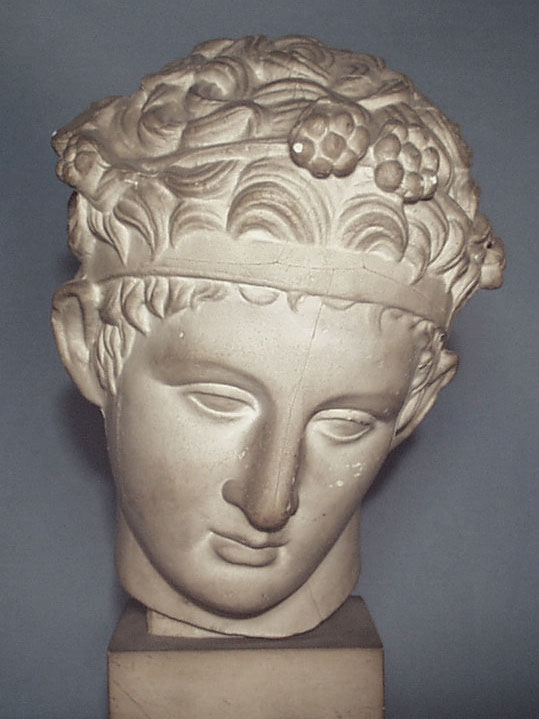
Head of Praxitelean boy Satyr.
- Plaster cast: Height: 37 cm.
- Copy of a head from a marble statue.
- The statue:
- is of a type known as the Pouring Satyr.
- is probably based on a statue made by Praxiteles around 370 BC.
- is now in Dresden, Albertinum und Staatliche Kunstsammlungen, Skulpturensammlung.
Detailed Record
Commentary Prepared by Dr. Julia Lenaghan, Ashmolean Museum
C 251
Head of Pouring Satyr. Dresden
Head of a Roman period statue that follows a type known as the "Pouring Satyr." Generally considered to be based on a statue made by Praxiteles around 370 BC.
Marble
Head from a statue
From Castel Gandolfo.
Germany, Dresden, Albertinum und Staatliche Kunstsammlungen, Skulpturensammlung, 100
Roman statue based on an original dated ca.370 BC
Description:The head, featuring short hair, turns towards the left hand. A fillet decorated with leaves runs around the head twice, once across the brow and once nearer to the crown. The hair is short and tousled with distinct locks, some of which escape out from under the fillet across the brow. The ears, uncovered by the hair, are pointed and like those of an animal. The face is oval and the forehead, divided into brow and hair by the fillet, seems excessively high. The eyebrows arch and there is a broad space between them and the upper eyelid. The mouth is small and the chin recedes.
Discussion:This cast presents the head of the "Pouring Satyr" statue in Dresden. The original model for the "Pouring Satyr" is usually thought to be a work of the sculptor Praxiteles and to date to the second quarter of the fourth century BC. For more on this statue and the debates concerning it, see cat. no. C 110.
The "Pouring Satyr" is known in about 30 Roman period copies. The head of this example from Dresden has been much restored and does not best represent the original model. The head of a statue in Palermo is considered a better example. In general, the head of the statue type features the only satyr-like element on the statue-- the pointy animal ears. Were it not for these ears, one would identify the statue as a servant boy pouring a drink, rather than a satyr.
J. Lenaghan
Bibliography:P. Herrmann,
Verzeichnis der Antiken Originalbildwerke der Staatlichen Skulpturensammlung zu Dresden (Berlin 1925) 31 no.100
guide book entryP. Gercke,
Satirn des Praxiteles (1968 1968)