Commentary Prepared by Dr. Julia Lenaghan, Ashmolean Museum
C 246
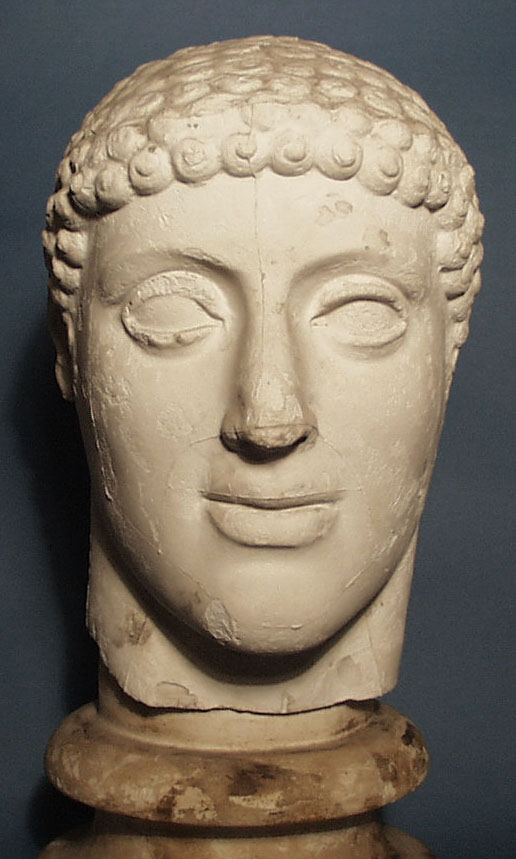
Head of Harmodios from Tyrannicide Group; Naples
Marble
Statue
The group was allegedly found at Hadrian's Villa in Tivoli. This, however, turns out to be probably false.
Italy, Naples, Museo Archeologico Nazionale, 6009
Roman period statue based on an original statue of 480-470 BC
Preservation:The head is well preserved and is made of the same piece of marble as the body to which it is still attached. Unlike the other copies of this head type, there are no indications here on the crown or the back of the head for supports which would connect the head to the right forearm.
Description:The head portrays a beardless male. The head has a blocky inorganic shape; it is formed of virtually unmodelled planes. The brow is low; the cheeks are broad and smooth; the nose is straight; the eyebrows arch slightly; the eyelids are heavy and sharply set off; the eyeballs bulge outwards; the mouth is short from side to side; the lips are full and slightly parted; the partition is wider at the center of the mouth than at the corners; the chin is large, round, and not projecting; and the ears are naturalistically rendered. The hair sits on the head like a cap. Each lock is rendered as snail curl. These snail curls are neatly arranged in rows from front to back.
Discussion:The head of Harmodios is preserved in two other copies, one in the Metropolitan Museum of New York (no.26.60.1) and the other in the National Museum in Rome (inv.80722). These two copies allow us to reconstruct the position of the right arm. For a discussion of the complete Tyrannicide group to which the head of Harmodios belongs, see Harmodios and Aristogeiton, the Tyrannicides. Naples (cat.no. C 5.)
The similarity of the Harmodios head to that of the so-called “Kritios” boy is the reason for the latter’s name. Certainly, the two heads have much in common, particularly in profile. The shape of the head of the Kritios’ boy, however, is longer and thinner; the lips are less full; and the hair is entirely different. Thus, many scholars (Robertson) believe that there is no reason to assign the two heads to the same hand. The head of the Delphi charioteer also has similar facial features and a similar profile and has therefore, often been considered an Attic work. A marble head of a warrior or hero in the Kerameikos (Knigge) provides a third work with the same stylistical construction and features.
It is almost impossible to judge whether any one of these heads was sculpted by the same artist. It suffices to say that all the works date to approximately the same chronological period and artistic movement.
Bibliography:S. Brunnsaker,
The Tyrant Slayers of Kritios and Nesiotes (Stockholm 1971) pp.62-67 no.H 1 pls.1-3 and 13-15 figs.1-3
catalogue entry of the statue to which this head belongsM. Robertson,
A History of Greek Art (Cambridge 1975) pp.175-176
information on the TyrannicidesU. Knigge,
"Ein Jungslingskopf von Heiliger Tor in Athen" (AM 98 1983) pp.46-47
W-H. Schuchhardt and C. Landwehr,
"Statuenkopien der Tyrannemorder-gruppe" (JdI 10 1986) pp.85-126
,
Le Collezioni del Museo Nazionale di Napoli I,2 (Rome 1989) pp.156-157 no.13