Commentary Prepared by Dr. Julia Lenaghan, Ashmolean Museum
C 230
Townley Aphrodite. London
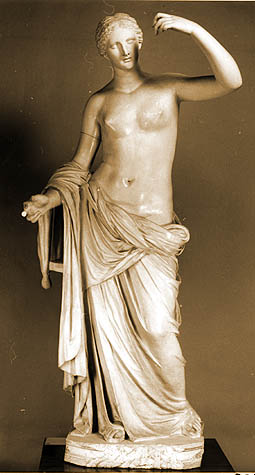
Roman period statue of a half naked Aphrodite that uses a fourth century statue as model. Sometimes said to be a copy of the fourth century BC ‘Phryne’ at Delphi by Praxiteles. Found in the Baths at Porta Marina in Ostia which were begun under Trajan (98-117)
Marble
Statue
2.11 m
From Ostia. Found in 1775 by Gavin Hamilton in the baths at Porta Marina (also known as the Terme della Marciana) (called in antiquity Terme Maritime, a name given in the modern period to another bath complex in Ostia).
United Kingdom, London, British Museum, 1574
Roman statue based loosely on an original of the fourth century
Preservation:The left arm has been restored from the shoulder down and the right forearm from the elbow down. The drapery on the right forearm is restoration. The tip of the nose, a piece of the left thigh, some toes, and some of the edges of drapery folds have also been restored. The plinth has been inserted into an ancient molded base.
Description:The over life-size statue depicts a woman who, facing forwards, wears a heavy mantle draped around her lower body and sandals. She has regular features, no signs of age, and long hair.
The figure stands with its weight over its right leg. The right foot points straight out. The left leg is bent and the lower leg trails behind. The heel of the left foot is significantly raised; only the toes and ball of the foot touch the ground. The left shoulder is raised and the right lowered. The right arm rests at the side and bends at a slightly greater than 90 degree angle. The forearm would have projected forward from the body. The torso bends to its right; the left side of the torso stretches upward and the right side indents more sharply at the waist. The head tilts to its right and looks down to its left. The neck is long and has bulges of flesh. The shoulders are proportionately small in comparison to the lower body and the breasts are small and pointed. The body is softly rendered; there is no muscle definition.
The mantle is draped around the lower body. Its bottom hem touches the feet and the ground; its bunched upper border runs from the right hip to just below the left hip, revealing a small glimpse of the left side of the pubic region. One lateral edge of the drapery is held in some way at the right side of the body. The material is then pulled around the back of the body and comes forward again at the left hip. The rolled material of the upper border unravels as it moves from the left hip to the right hip. Its bottom edge spills out in a triangular apron that extends over the right thigh. The excess material was probably draped over the extended right forearm, in much the same way as the statue has been restored. The drapery pulls around the non-weight bearing left leg in U-shaped folds that outline the shape of the leg. The shape of the right leg is entirely concealed by the heavy material. The folds, especially on the right side, have markedly flat surfaces and, in fact, the effect of the entire lower body is flat. The folds at the back of the statue are only summarily rendered.
The head is small and has hair that is rendered in long, slightly wavy, frizzy locks. The hair is parted in the center and pulled back off the face to a bun at the back of the head. It covers the tops of the ears. Chiselled channels, running parallel to each other, define the individual locks. They originate at the hairline around the brow and that slant diagonally down toward the back of the head. .
The face is oval in shape. It has a high forehead and the central part of the hair is set particularly high. The hairline gives an emphatic triangular shape to the brow both because of the high part and because of the diagonal backward path of the locks. The eyes are wide set and large. The orbitals are heavy and give the impression that the eyebrows slant downwards. The upper eyelids are heavy and the flesh below the lower lid sinks slightly. The cheeks are otherwise smooth and rounded. The mouth is small with perfectly shaped lips. The upper lip has a gentle dip at the center and the lower lip is full and rolls outward. A horizontal indentation below the lower lip marks the beginning of the chin. The round chin is small from side to side and projects.
Discussion:The statue in the British Museum was found in Ostia in a Roman bath complex excavated by Gavin Hamilton at the end of the eighteenth century. It is a Roman period creation and is known as the Townley Aphrodite (or Venus) after its first owner.
The statue is an over life-size representation of the goddess Aphrodite that is based upon famous statues of the fourth century BC. These original statues are known to modern scholars in Roman copies, the best examples of which are the "Aphrodite of Arles" (cat.no. C 180-181) and the "Venus of Capua", (cat.no. C 184). The manner of dress and drapery, the position of the upper body, and the head type all clearly derive from the original models of the "Aphrodite of Arles" or the "Venus of Capua" type. The Townley statue is almost the mirror image of the Arles type. Even though there are no other true copies of the type of the "Townley Aphrodite", many scholars have considered it to be a copy of a work by Praxiteles since the Arles type is often assigned to Praxiteles. More specifically, these scholars suggest that the Townley statue was a copy of Praxiteles’ Phryne-Aphrodite at Delphi. The attribution of both the Arles type and the Townley statue are, however, entirely speculation. The half-draped Aphrodite type, which seems to have been initially created in the fourth century BC, was extremely popular in the Hellenistic and Roman periods. It was continually reinterpreted and revised. The Venus de Milo (cat.no. B 148) provides a significant example of a later variation of the type.
The Townley statue was found in a bath complex at Ostia (the baths at Porta Marina) that was begun under Trajan and finished in the Hadrianic period. Brick stamps and a large portrait head of Marciana, Trajan’s sister, establish the date. The complex was repeatedly refurbished throughout the third century and its last refurbishment occurred in the fourth century. The statue was likely to have been part of the original decoration and is best considered second century AD interpretation of a well-known Aphrodite type.
J. Lenaghan
Bibliography:A.H. Smith,
A Catalogue of Sculpture in the Department of Greek and Roman Antiquities, British Museum III (London 1904) 28-29, no. 1574
catalogue entryA. Delivorrias,
"Aphrodite" Lexicon Iconographicum Mythologiae Classicae II (Zurich 1984) 65, no. 546
brief entry with bibliography and summary of opinionsA. Corso,
Prassitele: Fonti epigrafiche e letterarie. Vita e opera II (Rome 1990) 51-54, 71-74
analyses of ancient sources, argues that statue represents Phryne at DelphiL. Todisco,
Scultura greca del IV secolo (Milan 1993) 71, fig. 117
re-states the opinion of Furtwängler, the Ostia statue derives from an Aphrodite-Phryne made by Praxiteles and set up in Delphi ca. 350 BC