Commentary Prepared by Dr. Julia Lenaghan, Ashmolean Museum
C 217
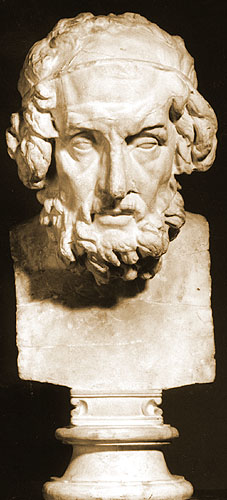
Herm of Homer in the "Hellenistic Blind Homer" Type. Paris
Roman period portrait of Homer, following the "Hellenistic Blind Homer" type made ca. 200 BC.
Marble
Herm
54 cm
From Rome. Found on the Via Merulana (built into a garden wall of Palazzo Caetani). Acquired from the Palazzo Caetani by Cardinal Albani and then part of the Capitoline collection. In 1797 it was taken to Paris.
France, Paris, Louvre, Ma 440
Roman version, possibly first century AD, of a model created ca. 200 BC
Preservation:Restorations include: the tip of the nose; a lock at the right temple and half of the neighboring lock in front of the right ear; the front half of the left ear and the section of hair in front of the ear that includes the circlet, and continues upwards until almost the top of the head; and a lock of beard hair on the right side of the chin. The sides of the herm have been widened and the lower edge of the front side evened with plaster. The circlet is damaged. The head at some point broke from the herm; the line of the break is visible around the neck. There is also a diagonal crack through the herm. The hair of both the head and beard have root marks. The back of the head is darker than the front, presumably stained when a cast was made. (The Ashmolean cast is taken from a modern bronze replica; it places the head on a modern bust and significantly changes the angle of the head.)
Description:The herm depicts a gaunt faced, bearded, old man who wears a thin circlet in his hair. The face is long, the beard unruly, and the hair receding.
The brow is tall and merges with the bald front portion of the head. It features one horizontal furrow, some lines of contraction over the base of the nose, and remarkably arched creases above and echoing the eyebrows. The eyebrows are highly arched and below them a flap of skin hangs over the deep eye socket. The eyes are small within the sockets and have a heavy upper eyelid; they seem almost half-closed. The cheekbones project and the cheeks are sunken. These details in conjunction with the deep hollows of the eye sockets create many articulated surfaces and grooves on the face, including deep naso-labial folds. The mouth seems shapely; although only a small portion of the upper lip is visible under the moustache, the lower lip is full and finely formed with as small rise at the center of the lower edge. Under the lower lip a small indentation is visible before the chin protrudes. The full beard is rendered in impressionistic tufts, covers the sides of the face, begins low on the chin, and extends below the chin.
The hair on the head is rendered in a similar fashion. A thin circlet, which is round in section, goes around the head at a level just above the ears. At the back of the head the hair falls regularly in layers of slightly wavy hair that are clamped to the head under the circlet. From the ears to the front of the head, the hair is brushed forward. Two large long voluminous locks emerge out from under the circlet in front of each ear. The locks are pushed in front of the ears towards the face and thus leave the ears uncovered. The front of the head is bald except for a lightly rendered square lock that lies immediately under the circlet.
Discussion:The Louvre herm bears a portrait of a bearded old man with small half-closed eyes. The portrait type is reproduced in at least twenty-five Roman period copies and has been identified for centuries as Homer. Commonly referred to as the "Hellenistic Blind Homer" type, it is thought to have been created in the second century BC.
Since the Renaissance this well-known portrait type has be identified as Homer. This denomination, however, cannot be definitively proven. There are two alleged proofs. First, a head of the type was said to have been found on the Via Ostiense in Rome at the same time as a headless herm inscribed Homer. Yet there is no assurance that the head found was indeed a head of the "Hellenistic Blind Homer" type; the head cannot be traced and the herm no longer exists. Second, a herm in garden of Cardinal Cesi apparently bore the head type and again an inscription for Homer. There is no visual record of this herm, which no longer exists (the head is in the Capitoline collection). Nonetheless no scholar has questioned the identification. The eyes are half-closed; the figure wears a thin hair band that marks him as a having an exalted heroicized status; the long hair and beard are worn in an old-fashioned, quasi-divine, manner; and the portrait was frequently copied. These details seem strikingly appropriate for the famous poet of the pre-Archaic period who the ancients sometimes called blind.
Scholars are also in agreement about the Hellenistic date of the original model. The technical and stylistic details of the type, especially the dissolution of surface planes, the variety of textures, and the hyper-realism, are typical of the late third and early second centuries BC. The body of the original Hellenistic statue cannot be recreated, though some scholars believe that the head belonged to a seated statue.
The portrait type has inspired such artists and thinkers as Goette, Raphael, Rubens, and Rembrandt. All viewers, both scholars, artists, and the general public tend to see beauty and elegance in the contrasting depiction of a decrepit physical state and a struggling glorious active mind. It is easy to imagine that the portrait evinced the same reaction in Roman viewers and sculptors.
The Louvre version of the "Hellenistic Blind Homer" Type is dated by Boehringer to the first century AD. It is not an especially remarkable copy of the type.
Julia Lenaghan
Bibliography:R. and E. Boehringer,
Homer. Bildnisse und Nachweise (Breslau 1939) 73-90, 114-117, no. 9, figs. 77-79
full catalogue entry with annotated bibliography beginning with Bellori, excellent history of scholarship on typeG.M.A. Richter,
Portraits of the Greeks I (London 1965) 51, no. 11, figs. 79-80
catalogue entry in Hellenistic Blind Homer list, entirely dependent on Boehringer,
Hommes e dieux de la Grèce (Brussels 1982) 137-138, no. 77
catalogue entry on Paris HomerR. von den Hoff,
Philosophenporträts des Früh-und Hochhellenismus (Munich 1994) 45, 107-108
general comments and dates around 200 BCP. Zanker,
The Mask of Socrates (Berkeley 1995) 166-171
interpretation of Hellenistic Blind Homer type, also relies on Boehringer