Commentary Prepared by Dr. Julia Lenaghan, Ashmolean Museum
C 197
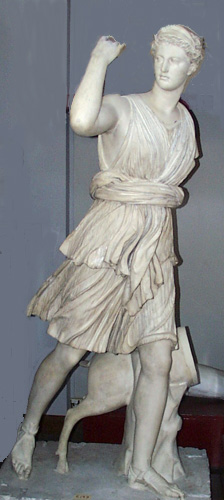
Artemis of Versailles. Louvre
Roman statue of a running Artemis (Diana). Based on a model (either fourth century BC or Hellenistic) that was extremely popular in the Roman period. The model resembles that of the Apollo Belvedere and has been associated, probably incorrectly, with the fourth century sculptors Leochares and Praxiteles.
Marble
Statue
2.11 m
Attested at Fontainebleau in 1556; brought to France during the reign of François I. Said to have been found at Nemi, but this information is not reliable and may derive only from the fact that there was a sanctuary of Diana at Nemi.
France, Paris, Louvre, Ma 589
Roman (Hadrianic) version of a model dated either to ca. 340 BC or to the Hellenistic period
Preservation:The statue was restored several times; once already by the year 1585-1586, a second time around 1602 by Barthélemy Prieur, and a third time by Lange in the early 1800s. The modern parts of the statue include the nose, both ears, a portion of the neck, the right hand with half of the forearm, the left hand and left arm to the deltoids, the tip of the left toe, the right foot, the upper part of the right leg, both ends of the quiver, small pieces of drapery, and small areas of the hair.
Description:The statue depicts a young female who runs to her left. She wears a diadem, a short dress belted by a rolled mantle, and a quiver out of which she is pulling an arrow. A deer, also running to its left, accompanies her.
Rushing forward, the statue rests its weight on the left leg. The left leg is neither frontal nor in profile; it turns outward at a 45 degree angle. The right leg trails behind and is also visible in the three-quarter view. Only the toes of the right foot touch the ground. Together the legs create a forward diagonal movement that begins at the back left (viewer’s) of the plinth and moves forward to the front right (viewer’s) of the plinth. The body follows this same diagonal motion. The left arm remains lowered by the side. The right arm is raised and bent at a 45 degree angle over itself in such a way that the right hand is able to pluck an arrow from the quiver strapped on the back. The right upper arm follows an axis that is exactly opposite to the motion of the legs. It moves from the viewer’s right forward toward the left. The head turns toward this arm and follows its same motion; it too moves in a direction exactly opposite that of the body. The legs and lower portion of the body are long and the upper body appears short. The neck also seems long and the head small.
The figure wears a diadem, quiver, a short dress, a rolled garment, and complicated sandals. The diadem is visible at the front of the brow between the ears. It rises in an arch. The quiver is strapped behind the back so that upper end of the quiver reaches the right shoulder and the lower end extends to the left waist. The broad flat strap is visible both on the front and back of the body; it runs from the right shoulder to the left side of the waist.
The dress is sleeveless and its upper edge has been folded down. The crease of the fold becomes the upper border and is brought together at the shoulders; the actual upper hem crosses the body at the level of the upper thighs. The bottom hem of the garment crosses the body just above the knees. The center of the neckline hangs away from the body; a portion of the bottom hem over the left knee is blown up so that the inside of the material is visible; and all of the material blows diagonally backward against the forward motion of the body. Large folds, for instance, trail off the body around the right thigh. The material of the dress is particularly fine and crinkly. This is indicated by the numerous shallow vertical folds.
The mantle is rolled and used as a belt. One end hangs between the legs; from there it is pulled up to the left shoulder. It then passes diagonally behind the back from the left shoulder to the right waist. It wraps completely and tightly around the waist, passing over the initial portion that was pulled up to the left shoulder. When the rolled material reaches the right side of the waist again, it is tucked under itself. The end spills downward, next to the other end. This end of the material, however, does not reach as far down as the other end.
The sandals are complicated. They feature an elegant slender sole that has a pronounced niche between the big and second toes as well as a series of interlacing straps. The principal straps go across the upper foot at the base of the toes, run along the interior of the foot from the ankle to below the big toe, and rise from the heel to the front of the ankle. The straps are tied at the front of the ankle. The heel features volute decoration and there is a decorative leaf over the top of the foot which extends from between the large and second toe to the ankle.
The face of the figure has long narrow oval shape. It has an exceedingly tall smooth brow. The eyebrows arch evenly, and the eyes are deep set with a high arching heavy upper eyelid. Below the eyes the hollow of the eye sockets is articulated. The nose is straight and not long. The mouth is short from side to side and open. The channel that divides the lips follows a high arch. The upper lip has a central dip, above which the groove leading to the center is defined. The lower lip pouts outward over the chin. The chin is long and round.
The hair is long, thick, and wavy. It parts over the center of the brow and is pulled back off the face above the ears which remain uncovered. It is also pulled up from the nape of the neck. It is gathered and tied high up on the back of the head. The hair is rendered more carefully at the sides and front of the head than it is at the top and back. Irregular channels of various depths and weights define the locks, which appear rough, heavy, and untamed.
Behind the figure’s left leg is a tree trunk support. Behind the tree trunk support is a deer. The hind legs of the deer, which touch the ground, are located between the legs of the striding figure. The position of the hind right leg of the deer echoes that of the lower right leg of the figure.
Discussion:The Artemis of Versailles, which has been known to scholars since the sixteenth century, depicts the virginal goddess Artemis as a running huntress. The statue is a Roman, possibly Hadrianic, copy of an earlier statue which has been dated either to ca. 340 BC or to ca. 100 BC. The basic format was the most popular manner in which to depict the hunting Artemis in the Roman period.
Two significant facts about the Artemis of Versailles have shaped all scholarly discussions; 1) the type exists in numerous copies and variations and 2) the statue resembles the Apollo Belvedere (cat. no. C 122). There are a total of about fifteen Roman period marble versions of the type, which has been named after this statue, the "Artemis of Versailles" type. Although these versions show variations in detail and size, they appear to depend on one single model. The most important copies are a statue from Leptis Magna, now in Tripolis, and a statue found in 1970 in Perge. In addition to the works grouped under the "Artemis of Versailles" type, there are a multitude of representations of Artemis that show even greater variation and depend only in a more general sense on the model.
Scholars have long noted that Artemis of Versailles resembles in stance and other details the Apollo Belvedere. Both move in one direction and look in the other; the position of the head and the type of sandals are similar in both statues; and the facial features and hair of both are rendered in the same way. The two statues were often thought to be pendants showing the fraternal pair Apollo and Artemis. This theory is now mainly rejected since the Artemis exists in numerous copies and the Apollo is known in only one statue and possibly cast fragments from Baiae. Even if not pendants, many scholars still assert that the two were made by the same sculptor. A passage in Pausanias has been used to identify the Apollo as that made by the sculptor Leochares, although this cannot be proved, and thus, the Artemis is frequently said to be by Leochares.
Simon and others would, however, prefer to interpret the statue as the Artemis Brauronia on the Acropolis made by Praxiteles; this statue is mentioned by Pausanias (1.23.7) and has been not entirely convincingly identified with the Artemis of Gabii type (cf. cat.no. C 179). Simon argues that the statue stylistically belongs to the period of Praxiteles and that the dress and diadem have particular connections to the cult of Artermis at Brauron. Also, the Praxitelean statue was said to be of marble and Simon believes that the stag (or at times dog) at the feet of the statue was an integral part of the original model conceived to give the statue support and thus, indicating that the original was a marble statue.
Pfrommer has most recently proposed that the "Artemis of Versailles" type does not rely on a fourth century model but rather a model of the Hellenistic period. The same type of proposal is now generally accepted in the case of the Apollo Belvedere. Pfrommer’s argument revolves primarily around the fact that the most recently discovered version of the type, the Artemis of Perge, corresponds exactly to the Louvre statue. In particular it repeats the position of the head and the exact footwear, thus confirming that both of these details derive from the original model. Both of these details, considered to be stylistically later than the fourth century BC, had previously been considered alterations made by Roman copyists since the Leptis version of the Artemis showed a less turned head and other versions showed different footwear. Pfrommer shows that the particular type of sandal worn by the Louvre and Perge type and presumably by the original model should not date before 200 BC. He also believes that the crinkly drapery which turns up at the knee and hangs off the neck ought to date to the Hellenistic period. Whereas one might imagine a Hellenistic re-adaptation of a fourth century model and that some copyists followed the fourth century model and others followed the Hellenistic model, Pfrommer is able to discern no indication among the Roman versions that there were ever two different models. They all seem, even when they vary, to depend on one model, which he believes must have been a Hellenistic creation.
Julia Lenaghan
Bibliography:H. Marwitz,
"Antiken der Sammlung Hermann Bünemann, München" (AntPl 6 1967) 53-54
provides replica listS. Favier,
"A propos de la restauration par Barthélemy Prieur de la ‘Diane a la biche’" (RLouvre 20 1970) 71-77 figs.1-2
brief discussion of restorations of statueL. Kahil,
"Artemis" Lexicon Iconigraphicum Mythologiae Classicae II (Zurich 1984) 645, no. 250
entry which repeates traditional connection to Leochares and the Apollo BelvedereE. Simon,
"Artemis/Diana" Lexicon Iconigraphicum Mythologiae Classicae II (Zurich 1984) 805-806, no. 27
illustrated entry with replica list, suggests original should be connected with statue of Artemis Brauronia by PraxitelesM. Pfrommer,
"Leochares? Die hellenistischen Schuhe der Artemis Versailles" (IstMitt 34 1984) 171-182, pl. 29.1
argues on basis of stylistic details, mainly shoes, that Artemis of Versailles type was an original creation of the Hellenistic period, after 200 ADB. S. Ridgway,
Hellenistic Sculpture I: The Styles of ca. 331-200 BC (Bristol 1990) 93-95
accurate summary in English of the research to date, avoids making any conclusionsL. Todisco,
Scultura greca del IV secolo (Milan 1993) 105-106, fig. 228
entry with bibliography, considers it to derive from Hellenistic prototypeC. Rolley,
La sculpture grecque II. La période classique (Paris 1999) 292-293, fig. 302
discussion with details about history of piece, argues for traditional connection with Apollo Belvedere