Commentary Prepared by Dr. Julia Lenaghan, Ashmolean Museum
C 192
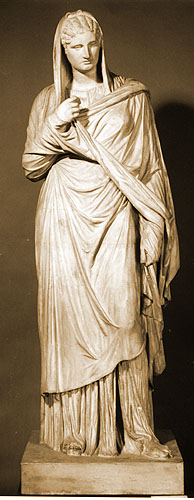
Large Herculaneum Woman. Dresden
Early Imperial statue of a draped woman which copies a statue made around 300 BC. The statue is famous because it was among the first finds from Herculaneum and because it represents the most commonly used statue type for portrait statues of woman in the Roman period
Marble
Statue
1.98 m
From Herculaneum. Found between 1709 (when D’Elboeuf bought land in Resina) and 1712 with two statues in the "Small Herculaneum" type (cf. C 193), possibly in the theater. The statue was acquired in 1736, along with the other two statues, by King August III of Poland from the estate of Prince Eugen in Vienna, cousin and patron of D’Elboeuf. August put them on display at the Albertinum in Dresden. In 1945 the statue was taken to St. Petersburg but returned to Dresden in 1958
Germany, Dresden, Albertinum und Staatliche Kunstsammlungen, Skulpturensammlung, 326
Early Imperial Roman statue based on an original dated ca. 300 BC
Preservation:The statue is missing small areas of folds and portions of the fingers. The front part of the left foot and the front left edge of the plinth are also missing. The Ashmolean Cast shows a restored left foot. The statue is broken through the throat and the thighs. There are also several smaller less significant breaks.
Description:The statue depicts a draped woman. It wears an outer garment that covers the head and most of the body. An inner garment appears around the front of the neck and below the bottom hem of the outer mantle which runs from just under the right knee to the left knee. On its feet are sandals.
The right arm, bent at a 45 degree angle, folds across the body and the left arm rests by the side of the body. The weight rests upon the right leg and the right hip curves outward from under the wrapped right arm. Both hands hold the outer mantle; the right hand above the right breast and near the center of the chest, the left hand next to the right thigh.
The mantle creates several pronounced fold patterns. The most striking of these is the triangular structure formed by the rolled right edge of the mantle and the material adjacent to it. The rolled right edge moves from the right hand near the center of the chest to the left wrist on left side of the body near the thigh. The rolled material adjacent to this edge moves diagonally from the right elbow on the right side of the body to the left shoulder. Other prominent drapery lines include the vertical fold from the right hip to below the right knee; a diagonal fold from the right hip to the left knee; a round almost semi-circular fold that defines the lower edge of the stomach; and a short diagonal fold from the left hip to the middle of the fold that runs from the right hip to the left knee.
The head turns to the left and slightly downward. The hair is rendered in a “melon” hairstyle. The face is broad and square in shape. It is widest between the cheek bones. The forehead is tall and the eyebrows are long and slope downwards at their outer corners. The eyes are small, closely spaced, and deeply set. The mouth is small. The lips are parted by a groove which turns downward at its outer corners. The chin is small and round.
Discussion:This statue from Herculaneum, known as the “Large Herculaneum Woman”, is the namesake of one of the most often copied statues types in the Roman period. The statue, which appears to derive from a statue of the early Hellenistic period, was used repeatedly for the body portion of portrait statues of Roman women.
The statue was found during treasure hunt excavations undertaken secretly by an Austrian general D’Elboeuf between 1709-1712. It is thought to have come from a well that reached into the scaena frons of the ancient Theater. D’Elboeuf sent the statue and two smaller statues of another type (the "Small Herculaneum" type, see cat.no.C 193) to his cousin, Prince Eugen of Savoy in Vienna. These statues precipitated European interest in Herculaneum.
The Large Herculaneum woman and the Small Herculaneum, with which it was found, are frequently considered a pair that depended on originals made in the same workshop. Moreover, because some copies hold stalks of grain and poppies and because the Large statue is 20 cm bigger than the Small statue, scholars interpreted them to be based on statues, created ca. 300 BC, of Demeter, the mother, and Kore, her daughter. Because these statues existed in so many copies, they were thought to have had to have been created by a major artist. Thus, the original models were ascribed to Lysippos or Praxiteles or the school of Praxiteles. The statues popularity in the Roman period for portrait statues was assigned to the potentially applicable mother-daughter meaning of the original statues as well as the fame of the sculptor.
This theory is now mainly rejected. The statue types do not seem designed to carry attributes; the originals do not seem to have been necessarily created at the same moment by the same workshop; and they are infrequently paired, and when they are, it is certainly not in a one to one relationship. The original models are now thought to have represented a mortal woman, a priestess, heroine, or poetess. The popularity in the Roman period is probably because the type elegantly presented a respectable and modest woman as she really might have appeared.
The statue from Herculaneum differs from other Roman period copies of the type because it shows an ideal head with a melon hairstyle. The head type with a melon hairstyle does not appear on any other occasion in conjunction with the Large Herculaneum body type. The use of this head type at Herculaneum is thought to have been influenced by the similar head type that occurs on the statue of Small Herculaneum Type (cat.no. C 193) found with it. Since no particular head type appears more than once in conjunction with the Large Herculaneum body, it is impossible to reconstruct the appearance of the original head.
It remains open to debate whether the statue at Herculaneum was a portrait statue, a representation of a mortal mythical or heroic figure, or a representation of an immortal. In Italy in the early Imperial period, to which the Herculaneum statue belongs, contemporary women were usually portrayed with a specific physiognomy or at least with the hairstyle of the current fashion.
Julia Lenaghan
Bibliography:M. Bieber,
"The Copies of the Herculaneum Women" (PAPS 106 1962) 111-134
discusses the popularity of the Large Herculaneum type which she believes derives from an early Hellenistic statue representing DemeterI. Linfert-Reich,
Musen und Dichterinnenfiguren des vierten und frühen dritten Jahrhunderts (Cologne 1971) 53-57
full discussion of the Large and Small Herculaneum types, thinks the original was a poetess or simply a famous womanH-J. Kruse,
Römische wiebliche Gewandstatuen des zweiten Jahrhunderts n. Chr. (Göttingen 1975) 41-67
thorough discussion of the type,believes original dates shortly before 300 BC and represented a priestessK. Zimmerman, ed.,
Die Dresdener Antiken und Winckelmann (Berlin 1977) 33-35 pl.35
history, also upholds theory that the type originally represented Demeter and was created ca.300 by the school of PraxitelesB. Vierneisel-Schlörb,
Katalog der Skulpturen Band II: Klassische Skulpturen des 5 und 4 Jahrhunderts v. Chr. (Munich 1979) 440-441 footnote 4
bibliography with commentaryH. Wrede,
Consecratio in Formam Deorum: Vergöttlichte Privatpersonen in der römischen Kaiserzeit (Mainz 1981) 213-214 footnote 4
detailed note with full bibliography that argues against the identification of the original of the type with DemeterB. S. Ridgway,
Roman Copies of Greek Sculpture (Ann Arbor 1984) 101
succinct summary of evidence concerning the type, draws mainly on KruseM. Fuchs,
Untersuchungen zur Ausstattung römischer Theater in Italien und den Westprovinzen des Imperium Romanum (Mainz 1987) 31 E IV 1
catalogue entryB. S. Ridgway,
Hellenistic Sculpture I: The Styles of ca. 331-200 BC (Bristol 1990) 92-93
summary of research, believes the early Hellenistic original represented a mortal womanL. Todisco,
Scultura greca del IV secolo (Milan 1993) 133-134 no.291
considers the original to have been a work of the school of Praxiteles (ca.330-310 BC) and to have possibly represented a priestess.,
Die Antike in Albertinum (Mainz 1993) 30 no.13
catalogue entry with glossy color photographC. Parslow,
Rediscovering Antiquity (Cambridge 1995) 23-25
excavation historyJ. Trimble,
The Large and Small Herculaneum Types (University of Michigan 1999)
dissertation