Commentary Prepared by Dr. Julia Lenaghan, Ashmolean Museum
C 180
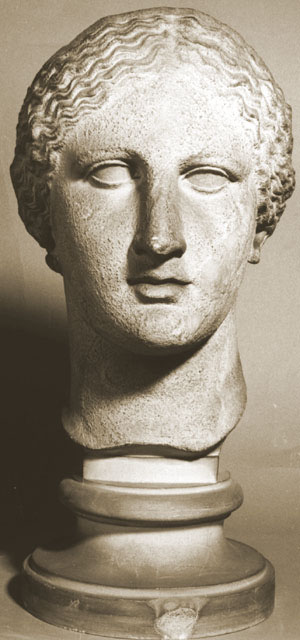
Broadlands Aphrodite. Boston
Roman period head of Aphrodite, following a model now known as the "Aspremont-Lynden/Arles" type. The model may have dated to the fourth century BC and is often associated with works of Praxiteles.
Marble
Head
37 cm
Purchased in Italy in 1764 for £ 5. Originally in the collection of Henry Temple, Second Viscount Palmerston (1739-1802) at Broadlands, Hampshire. Then passed to Lord Ronald Gower and E.P. Warren before being acquired by the Boston Museum.
United States, Boston, Museum of Fine Arts, 96.694
Roman head (early second century?) possibly based on an original of the fourth century BC
Preservation:The top of the head was worked separately and added. The two pieces were joined at the level of the fillet. Thus, the join surface slants diagonally backwards. The join surface is smooth and has a long rectangular groove for the insertion of tenon; this groove runs from the edge behind the right ear to near the edge in front of the left. The eye sockets and a scar on the left cheek have been filled with plaster. The lobe of the right ear seems broken. The carved surface is corroded.
Description:The over life-size head depicts a woman with ideal features, long bound hair, and a fillet. The head is asymmetrical; the part of the hair falls to the left of center, the left side of the face is set back, and the upper eyelids differ.
The face is a smooth oval with cheeks that taper to narrower chin. The brow is convex and is given a triangular shape by the framing hair. The eyebrows are fine low arches. The orbitals below the eyebrows are rendered as flat, slightly protruding bands. The eyes are large and framed by thin, sharply defined eyelids. On the right side, the upper eyelid overlaps the outer corner of the lower lid. Below the eyes the cheeks indent or deepen. The nose is straight, does not indent at the bridge, and has a thick ridge. The mouth is small and the lips are parted by a broad channel. The upper lip has a central dip and the fuller lower lip rolls outward. A horizontal indentation below the lower lips marks the beginning of the chin which is round and projecting. The neck is thick and features “Venus” lines.
The hair is long and parted down the center. It is pulled gently backward, covering the tops of the ears, and collected in a complicated bun at the nape of the neck. A fillet runs around the head at a level above the ears. The hair is rendered in long wavy strands that are defined by parallel engraved grooves of different weights.
Discussion:The Boston head, known as the Broadlands Aphrodite after its original owner, was purchased in Rome in 1764. It is over life-size and depicts a young adult female with regular facial features, long wavy hair, and a flat fillet. Because of its ideal beauty it and its resemblance to the head type of the Aphrodite of Cnidos (cat.no. C 172) and the Aphrodite of Arles, the Broadlands head has been identified as Aphrodite and its original model, called by modern scholars the "Aspremont-Lynden/Arles" type, has been associated with Praxiteles.
The "Aspremont-Lynden/Arles" type is known in a total of five heads. These are a bust found in the Roman theater at Arles, a damaged head in the Aspremont-Lynden collection in Vienna, the head from Italy in Boston (under discussion here), a head found near the Tower of the Winds in Athens, and a head found in Civitavecchia. The head from Arles is attached to shoulders that are cut diagonally so as to be fitted into a statue with drapery slipping off the shoulders. All of the heads are so similar that most scholars consider them to be based on the same model; a table of measurements by Lauter presents startling similar measurements. Lauter, however, points out that the Arles, Aspremont-Lynden, and Boston are all closely related and that the Athens and Civitavecchia, while identical to each other, differ from the other three in the turn of the head and in small details in the hair. Thus, he concludes that two different original models were being copied.
Because most scholars believe the hair and face of the "Aspremont-Lynden/Arles" to resemble closely the Knidian Aphrodite and the Aphrodite of Arles, the original model is generally dated to the fourth century BC. Moreover, the type is frequently discussed in conjunction with Praxiteles. Because Praxiteles is known to have made several statues of Aphrodite and of his courtesan model and lover Phyrne, scholars have conjectured about the possible original, suggesting, for instance, Praxiteles’ statue of Aphrodite purchased by Cos. The head type has also been hypothetically joined to various body types, for instance that of the Aphrodite Brazza (cat.no. B 85).
B.S. Ridgway, prior to Lauter’s discussion, questioned the fourth century date assigned to the original models of the Aphrodite of Arles and the "Aspremont-Lynden/Arles" Aphrodite. In addition to stylistic comments concerning the Aphrodite of Arles’ drapery, her arguments focused on the "Aspremont-Lynden/Arles" type’s triple-knot chignon and the coincidence of both types in probably Roman period theater decoration in Athens and Arles.
It does emerge that there are serious difficulties in the exact interpretation of these series of Roman heads of Aphrodite. Either the Roman copyists were, as Lauter has suggested, using two similar fourth century models or more probably they used models that were different interpretations of the same original work. It is impossible to know how important it was to them to follow the original exactly. Presumably, whether following a diluted interpretation or the original, the message to the viewer was the same. We should perhaps not be so willing to separate the Athens and Civitavecchia heads from the "Aspremont-Lynden/Arles" series.
Julia Lenaghan
Bibliography:F. Croissant,
"Une Aphrodite méconnue du début du IVe siècle" (BCH 95 1971) 65-107
discusses three supposed copies of the type, not Boston, and associates with the Brazza AphroditeB. S. Ridgway,
"Aphrodite of Arles" (AJA 80 1976) 153-154,
believes original work to have been late HellenisticC. Vermeule and M. Comstock,
Sculpture in Stone: The Greek, Roman, and Etruscan Collections of the Museum of Fine Arts Boston (Boston 1976) 103, no. 58
catalogue entry, doubts relationship to Aphrodite of Arles, suggests that the head was related to a draped statue made by Praxiteles and purchased by CosA. Delivorrias,
"Aphrodite" Lexicon Iconographicum Mythologiae Classicae II (Zurich 1984) 39, no. 260
brief discussion of Aspremont-Lynden/Arles type with replica list and catalogue entry with illustration for Boston headH. Lauter,
"Der Praxitelische Kopf Athen, National Museum 1762" (AntPl 19 1988) 21-29, especially 24, figs. 8-9
discussion of the heads identified as the Aspremont-Lynden/Arles type, traces two different types, dates the Boston head to the early second century AD.L. Todisco,
Scultura greca del IV secolo (Milan 1993) no. 110
associates the Aspremont-Lynden/Arles type with statue of Praxiteles purchased by Cos, ca. 360s BC