Commentary Prepared by Dr. Julia Lenaghan, Ashmolean Museum
C 179
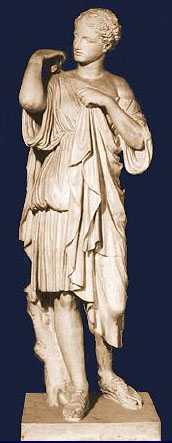
Artemis of Gabii, sometimes attributed to Praxiteles. Louvre
Roman period statue of Artemis. Traditionally considered to be a copy of a statue made by Praxiteles around 340 BC.
Marble
Statue
1.65 m
From Gabii. Formerly part of the Borghese Collection.
France, Paris, Louvre, Ma 529
Roman statue probably based on an original dated ca. 330 BC
Preservation:The following areas have been restored: The nose, part of the left ear, both hands with the ends of the mantle, left foot, part of left leg, and front part of the right foot.
Description:The statue depicts a young girl who is fastening a folded cloak (diplax) together on the right shoulder. Underneath the cloak which extends below the knee on the left side of the body, the girl wears a sleeved chiton that slips off the left shoulder. The short chiton extends only to the knees and is belted twice, once in the area of the waist and once under the breasts. The material of the chiton has been pulled out and blouses over the belt at the waist, entirely concealing the belt; this part of the material which falls over the belt is called a kolpos.
The figure stands with its weight over the right leg, behind and to the right of which is a tree trunk support. The left leg is withdrawn and the left heel is raised. The feet, which wear elaborate sandals, are narrowly spaced. The left arm is folded across the body and the hand holds a portion of the diplax between and just above the breasts. The right arm is raised and doubles over itself so that the hand lies in the area of the right shoulder where it is fastening the garment.
The head looks toward and beyond the right hand. It features wavy hair which is brushed back off the face, held by a single fillet, and gathered together at the back of the head, above the nape of the neck.
The face has slender oval shape. The hairline give the forehead a triangular frame. The eyebrows drop slightly at their outer corners. The eyes below them are defined by the high arch of the upper lid and the almost straight line of the lower lid. The mouth is small with down-turned corners and parted lips.
Discussion:The Louvre statue gives its name, the Artemis of Gabii, to a statue type which has traditionally been associated with a statue made by Praxiteles in the fourth century BC for the sanctuary of Artemis Brauronia on the Acropolis in Athens. This identification is based on little concrete evidence and is disputed.
The Louvre statue depicts a young girl who has been identified by almost all scholars as Artemis. Although the statue does not carry a bow, quiver, or deer, usual indicators, of Artemis, it does feature a short chiton, hair tied at the back of the head, and makes a gesture which is the compositional equivalent to pulling an arrow out of a quiver.
The statue type is known in three, possibly four other copies, all from Italy. These are a statue in Naples, one in the Villa Doria Pamphili, a fragment from the theatre in Lecce, and possibly a head in Copenhagen.
Pausanias (I.23.7) recalls that on the acropolis in Athens there was a sanctuary of Brauronian Artemis and that the image there was a work of Praxiteles. He writes “the image is a work of Praxiteles but the goddess derives her name from the parish of Brauron”. Inventory lists, especially IG II2 1514, found on the Acropolis cite three statues of Artemis, an old one, a stone one, and an upright one, as well as the clothing dedicated to them. The section of IG II2 1514 with this reference dates to 345/44 BC. The upright statue, which was in existence already by 345/44 BC, was assumed to be that made by Praxiteles and seen by Pausanias. The Artemis of Gabii was then identified as a copy of this statue.
It is now been shown that the inventory lists refer to items at the Sanctuary of Artemis in Brauron and not on the Acropolis in Athens. Of course, it is possible that a fourth century statue BC may have moved from Brauron to Athens by the time Pausanias was there in the second century AD. It has been pointed out, however, that not even a vague recollection of the Artemis of Gabii type in any form or media has been unearthed in the Sanctuary at Brauron.
Stylistically the Artemis of Gabii type has been frequently placed toward the end of the fourth century and according to Simon possibly even in the third. (This dating was often given as a reason against identifying the statue with Praxiteles’ Artemis Brauronia when the inventory lists were thought to refer to Athens and to give a date in the mid 340s). Moreover, the Artemis of Gabii type does not have a strong connection to other works by Praxiteles. Among the statues attributed to Praxiteles, the statue relates best to the Aphrodite of Knidos since its head resembles that of the Aphrodite (cat no.C 172). Yet, as Ridgway has pointed out that the head of the Knidia was much imitated and thus, such a resemblance does not indicate that the Artemis of Gabii was created by Praxiteles.
Iconographically the statue might be appropriate for the Sanctuary of Artemis Brauronia. At Brauron, Artemis was worshipped as a protectress of child birth and the cult was particularly attended to by girls between the ages of five and ten. It is known also that at Brauron, again not necessarily at Athens, clothing was dedicated to the goddess. This might be related to the action, the putting on of the cloak, shown in the Artemis of Gabii statue type. Moreover, the inner garment of the Artemis of Gabii slipping off the shoulder is an indication of both youth and nursing which, in turn, is associated with fertility and childbirth. Yet, the relationship of the sanctuary on the Acropolis in Athens to the cult at Brauron is unknown.
Julia Lenaghan
Bibliography:F. Studniczka,
Vermutung zur griechischen Kunstgeschichte (1884) 18 ff.
identifies the Louvre statue as a copy of the Artemis Brauronia of PraxitelesH. Süsserot,
Griechische Plastik des 4. Jh. v. Chr. (Frankfurt 1938) 184-195 pl.37
the original model of the statue dates 320-310 BC and thus cannot be the Artemis Brauronian by Praxiteles which must date 346/45 BC because of IG II2 1514J. Charbonneaux,
La sculpture grecque et romaine au Musée du Louvre (Paris 1963) 39-41 no.529
guide book remarks, accepts that it is the Brauronian Artemis by PraxitelesJ. Tréheux,
"Sur le nombre des statue cultuelles du Brauronion et la date de l’Artémis Brauronia de Praxitèle" (RA 1964) 1-6
points out the confusion on the inventory list inscriptions as to what is the date of the dedication of the clothing and what is the date of the statuesT. Linders,
Studies in the Treasure Records of Artemis Brauronia Found in Athens (Stockholm 1972) 15-16
discussion of lines of inscription relating to the statues of Artemis, notes that the inscriptions refer to Brauron and not AthensB. Vierneisel-Schlörb,
Katalog der Skulpturen Band II: Klassische Skulpturen des 5 und 4 Jahrhunderts v. Chr. (Munich 1979) 296 especially footnote 21 and 300 especially footnote 47
supports traditional idea that the statue is a copy of the Artemis Brauronia by Praxiteles made ca. 346/345 BCL. Kahil,
"Artemis" Lexicon Iconigraphicum Mythologiae Classicae II (Zurich 1984) 640-641 no.190
catalogue entry, considers the statue to be a copy of an original dated to 350-330 BC in a Praxiteleian spiritB. S. Ridgway,
Roman Copies of Greek Sculpture (Ann Arbor 1984) 53 especially footnote 31, pl.63
notes clothing of statue is best argument for identification with Praxiteles' Artemis of BrauronE. Simon,
"Artemis/Diana" Lexicon Iconigraphicum Mythologiae Classicae II (Zurich 1984) 801-816 no.2
catalogue entry, dates the original model of the statue to the early third century BC, ca. 300 BC, and considers it to have been a cult statue related to Artemis' role as Soteira.A. Corso,
Prassitele: Fonti epigrafiche e letterarie. Vita e opera I (Rome 1988) 148-149
suggests that a passage in Petronius' Satyricon (126) is related to the statue which he considers to represent a work by PraxitelesL. Todisco,
Scultura greca del IV secolo (Milan 1993) 72-73 no.111
gives the traditional dates for the original, ca.360-355 BC, which he attributes possibly to Praxiteles, notes that there are considerable doubts.B. S. Ridgway,
Fourth-Century Styles in Greek Sculpture (London 1997) 329 pl.77
no reason to attribute to Praxiteles, belongs at the end of the fourth centuryA. Ajootian,
"Praxiteles", Personal Styles in Greek Sculpture (Cambridge 1998) 124-126
succinct summary of the scholarly opinions with bibliography, notes iconographic details of dress