Commentary Prepared by Dr. Julia Lenaghan, Ashmolean Museum
C 173
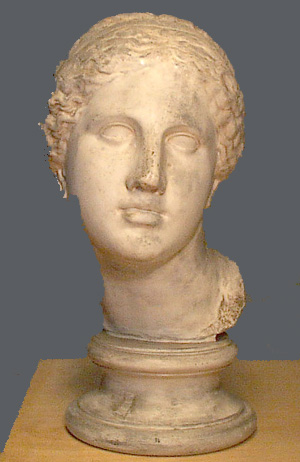
Kaufmann head. Louvre
Hellenistic or Roman head of Aphrodite with hair pulled back and bound by a fillet. Based upon a statue made by Praxiteles around 350 BC for the city of Knidos.
Marble
Head
35 cm
The head was found in Tralles in 1885. It was purchased by Kaufmann in Izmir with the mid section of a nude female statue. Although both were supposedly for the Berlin Museum, the head never entered the collection. After the World War II, it appeared in Switzerland, and was thereafter donated to the Louvre.
France, Paris, Louvre, 3518
Hellenistic or Roman rendition of an original dated ca. 350 BC
Preservation:The head is broken around the base of the neck with more of the adjoining body preserved on the left side. There are no restorations. A fragment of a statue body in the Berlin Museum appears to come from the same statue.
Description:The head depicts a female turning to her left. She has long wavy hair that is brushed off a soft young face. The face has an oval shape which narrows at the chin. It is asymmetrical because of the turn of the head. The brow is triangular. The eyebrows slant downwards at the outer corners. The nose is straight. The mouth is small with parted lips. The chin is pointed. The hair, rendered in thick crinkly strands is parted in the center. It is pulled backwards, covering the upper part of the ears, and is gathered in a bun at the back of the head. The hair in the bun is rendered in large chunky locks. A fillet encircles the head in two parallel paths.
Discussion:The beautiful Kaufmann head, generally dated to the second century BC, is a loose version of the head of an original marble statue of Aphrodite made by Praxiteles around 350 BC for the city of Knidos (see cat.no. C 172). If the head truly dates to the second century BC, it would be exceptional because it would be a Hellenistic and not a Roman period copy.
The Kaufmann head is known in two other replicas, one in Toulouse (see cat.no. C 174) and one in the Ny Carlsberg Glyptotek. These three heads differ from other extant versions of the Knidian Aphrodite in size, details of facial structure, the course of the fillet, and the rendering of the hair. Some scholars have, therefore, suggested that these replicas use as model a well-known Hellenistic statue based upon the Aphrodite of Knidos rather than the original Aphrodite of Knidos. It has even been suggested that this is the same Hellenistic statue on which the "anxious" (see discussion under cat.nos. C 172 and 175) body versions of the Knidian Aphrodite are based. The portion of the body, found with the Kaufmann head and now in Berlin, seems to follow the "anxious" type and thus, lends support to the theory.
Julia Lenaghan
Bibliography:J. Charbonneaux,
"L' Aphrodite de Cnide de la Collection Kaufmann" (Revue des Arts 1 1951) 175-176
remarks on the beauty and dateJ. Charbonneaux,
La sculpture grecque et romaine au Musée du Louvre (Paris 1963) 42
guide book remarksB. Vierneisel-Schlörb,
Katalog der Skulpturen Band II: Klassische Skulpturen des 5 und 4 Jahrhunderts v. Chr. (Munich 1979) 331-334
considers Kaufmann head and its replicas to derive from a Hellenistic revision of the Knidian Aphrodite of Praxiteles, perhaps even to derive from the same statue as the "anxious" copies of the body doA. Delivorrias,
"Aphrodite" Lexicon Iconographicum Mythologiae Classicae II (Zurich 1984) 51 no.395
brief catalogue entry on the Kaufmann headL. Todisco,
Scultura greca del IV secolo (Milan 1993) no.114
brief entry for headR. Özgan,
Die griechischen und römischen Skulpturen aus Tralleis (Bonn 1995) 54-57 Tr.21 pl.11
considers the head to be a Hellenistic rendition of Praxiteles' Knidian Aphrodite, dates it to the middle of the second century BC