Commentary Prepared by Dr. Julia Lenaghan, Ashmolean Museum
C 172
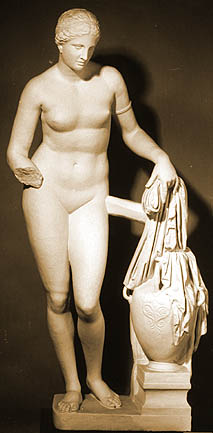
"Venus Colonna", Roman copy of the Aphrodite of Knidos. Vatican
Roman period statue of a nude Aphrodite who covers her pubic area with one hand and reaches for a mantle that rests on a hydria to her left. Generally considered to be the best preserved copy of a statue made by Praxiteles around 350 BC for the city of Knidos.
Marble
Statue
2.04 m with plinth
The provenance is unknown but is certainly Italian. The statue was in the Colonna collection in Rome in 1714 and was given to Pope Pius VI in 1718 with three other statues of Aphrodite. Immediately upon its entry into the Vatican collections it was restored. It is assumed that during that restoration its original head was swapped for a better preserved copy of the same original that came from one of the other three statues given by Colonna.
Italy, Vatican, Gabinetto delle Maschere, 812
Roman statue based on an original dated ca. 350 BC
Preservation:The statue is heavily restored. The head and body are both copies of the respective features of the same original model. Yet they are of different marbles and do not belong to the same copy. The head has been incorrectly set on the body. It should be inclined further downward and turned further to the left. On the head the nose and the throat with the lowest portion of the chin have been restored. Other restorations include the right forearm from below the elbow downwards, the left arm and hand (except at the socket which features a small piece of the arm band against the body and the tips of the fingers), the strut between the left thigh and the drapery, the right foot with the end of the right leg, the left lower leg from under the knee, the left foot, portion of the outer handle of the hydria, most of the block under the hydria with the drapery on it, and the plinth. There are round spots in the left upper arm and in the beginning of the right lower arm; these are the result of the dowelling of the restorers. There are plaster areas in the right and left thighs. On the left thigh there is a dark area where traces of the right hand were removed by restorers. The chin, an area in front of the right ear, and the right side of the face are chipped or abraded.
Description:The statue depicts a naked woman and to her left a hydria over which is draped a mantle. The woman’s legs are narrowly spaced and the weight rests over the right leg. The left foot, pointing outwards, is slightly withdrawn and the heel is raised. The right hip projects outward in a gentle curve and the upper body straightens over it. The right arm reaches downward and across the body; the hand would have been placed over the pubic area. The left arm, which has an arm bracelet in the area of the biceps, moves downward and to the left of the body. The left hand grasps a fringed mantle which rests on a hydria. The hydria, placed on a pedestal and a block, features scrolling floral decoration below the vertical handle.
The head of the statue follows the action of the left hand. The oval face features eyebrows that slope downward to the outer corners, a straight nose, and a small mouth with full slightly parted lips. The face is framed over the brow by a hairline which forms a peak at the center. The hair, rendered in thick strands and parted in the center, is pulled backwards, covering the upper part of the ears. It is gathered in a bun at the back of the head. Running around the head twice is a fillet.
Discussion:The Vatican statue is a copy of an original statue of Aphrodite made by Praxiteles around 350 BC for the city of Knidos. There are at least 60 copies and loose renditions of the statue preserved. They were made in various media and in various sizes from the late Hellenistic period through the Roman period. The Vatican copy is the largest of the copies and is thought by some to be the truest. It, however, has been heavily restored and is, in fact, a composite of a head and body from two different statues. Along with this statue Pope Pius VI acquired another copy of the Aphrodite of Knidos. That copy, now in the Vatican storerooms, featured a better preserved head and a more poorly preserved body. Thus, it seems that the eighteenth century restorers swapped the heads of the statues.
From literary sources, especially Pliny the Elder, we know that Praxiteles made a famous statue of a nude Aphrodite in marble for Knidos which had a sanctuary to Aphrodite Euploia (of the “fair voyage”). We learn from Pseudo-Lucian that this statue of Aphrodite held a hand in front of her genitals. In addition, Roman period coins from Knidos show a statue with a jar or hydria in a pose that corresponds to that of the Vatican statue and numerous other versions. These testimonials allow us to identify the general aspect of Praxiteles’ Aphrodite and connect it with a series of later copies and variations (of which the Vatican statue is one), even though the original statue of Praxiteles, taken to Constantinople in Late Antiquity, was destroyed in a fire in 476.
There are two principal uncertainties concerning the original statue; its iconography and its original setting. Although we know the general pose of the original statue, details such as the size of the hydria, the decoration of the hydria, the support of the hydria, and the position of the left hand, vary from copy to copy. The various copies have been traditionally subdivided into two types, those which seem in a world of their own and reach calmly toward the hydria at their side (for instance, the Venus Colonna) and those which feature younger less developed bodies and seem to anxiously pull the drapery in front of their body (for instance, the Aphrodite Braschi cat.no.C 175). Scholars continue to debate which of these two types best follows the original late classical model and which perhaps follows a late Hellenistic variation of the model. Crucial to these arguments are the fringe on the mantle, the size of the hydria, and the decoration of the hydria depicted in the Venus Colonna.
In regard to the original setting, the accounts of Pliny and Pseudo-Lucian are discordant. Pliny suggests that it was in a monopteros and Pseudo-Lucian in a building with a garden in front and a front and back entrance. Neither of these building types are thought to be appropriate to the mid fourth century date assigned to the statue and it is, therefore, assumed that the original setting was revamped in a later period. Interestingly the archaeologists have found a monopteros building at Knidos. It is clear, in any case, that the statue was intended to be viewed from the front.
Since the nineteenth century scholars have emphasized this statue’s importance as the first full-scale nude female figure. They interpreted the statue as a representation of Aphrodite exiting her bath. Caught by surprise, she covers her genitalia with her right hand and reaches for her mantle with her left hand. Some recent twentieth century scholars have stressed that this sense of modesty is a modern invention and has little to do with the ancient concept of Aphrodite. Pointing to a long history of Astarte figures in Asia Minor which emphasize female reproductive organs, these scholars now suggest that Praxiteles’ Aphrodite is actually pointing to her genitalia. Moreover, they assert that, since ancient authors refer to the womb as a jar and flowing water is often associated with sexuality, the gesture of pulling the drapery off the hydria might symbolically represent an untapping of sexuality and fertility rather than coy shyness.
Julia Lenaghan
Bibliography:G. Lippold,
Die Skulpturen des vaticanischen Museums III, 2 (Berlin 1956) 526-531 no.474 pls.238-240
detailed catalogue entryB. Vierneisel-Schlörb,
Katalog der Skulpturen Band II: Klassische Skulpturen des 5 und 4 Jahrhunderts v. Chr. (Munich 1979) 324
considers the Venus Colonna to be the best replica of the Knidian AphroditeA. Delivorrias,
"Aphrodite" Lexicon Iconographicum Mythologiae Classicae II (Zurich 1984) 49-50 no.391
summarizes the research concerning the Aphrodite of Knidos by Praxiteles and gives catalogue entry on the Venus ColonnaM. Pfrommer,
"Zum Venus Colonna. Eine späthellenistische Redaktion der knidischen Aphrodite" (IstMitt 35 1985) 173-180
considers the Venus Colonna to be a Hellenistic adaptation rather than a copy of the Knidian AphroditeH. von Steuben,
"Belauschte oder unbelauschte Göttin? Zum motiv der knidischen Aphrodite" (IstMitt 39 1989) 535
defends the value of the Venus Colonna as a true copy of the Knidian AphroditeL. Todisco,
Scultura greca del IV secolo (Milan 1993) 70-72 no.113
general discussion of the type with remark that Venus Colonna no longer so assuredly considered the best copyC. Havelock,
The Aphrodite of Knidos and Her Successors (Ann Arbor 1995) 9-37, 58-67 fig.1
full discussion with a new interpretation of the nudity and gesture of the Knidian statue, attributes old interpretation, "Aphrodite at her bath", to nineteenth century ideas of proprietyB. S. Ridgway,
Fourth-Century Styles in Greek Sculpture (London 1997) 263-265 pl.66
restates more assertively Havelock's assessmentA. Ajootian,
"Praxiteles", Personal Styles in Greek Sculpture (Cambridge 1998) 98-103
uses the Venus Colonna for discussion on Knidian Aphrodite