Commentary Prepared by Dr. Julia Lenaghan, Ashmolean Museum
C 168
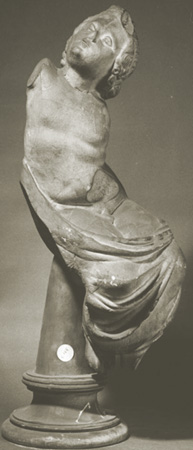
Ploutos of Eirene and Ploutos. Dresden
Roman period statue fragment depicting a baby boy held in the arms of an adult. Copied from an original of the early fourth century BC, possibly from the statue of Eirene (Peace) with Ploutos (Wealth) made by Kephisodotos for the Athenian Agora.
Marble
Statue Fragment
Germany, Dresden, Albertinum und Staatliche Kunstsammlungen, Skulpturensammlung, Hermann 107
Roman copy of a statue dated ca. 400-360 BC
Preservation:The statue fragment has broken from a larger statue along its right side. It is missing both arms and both feet. It features a large chip on the lower left abdomen. On the head, the tip of the nose is missing and the hair over the left side of the brow has broken off. These lacunae on the head have been restored. The Ashmolean Cast preserves the statue prior to restorations.
Description:The fragment from a statue depicts a small male child in a seated position, who looks and reaches up to its right. The child is naked except for a mantle draped around the lower legs and pulled upward along the right side of the body. The body tilts upward at the waist; the right shoulder is raised and the left shoulder lowered. The head, turned upward, shows a round unformed face with full hair. The hair over the brow is gathered together and knotted. The rest of the hair falls naturally down from the crown and ends in curls. The hair is kept in place by a small fillet.
Discussion:This fragment, depicting a baby boy, comes from an over life-size statue known in several copies that depicts a young woman holding a baby boy in her left arm together with a cornucopia. The type is traditionally thought to copy an allegorical statue of the mother Eirene (Peace) and boy Ploutos (Wealth) made by Kephisodotos between 374 and 370 BC and erected in the Athenian Agora. The best preserved example of the type is now in Munich (cat. C 167). For a full discussion of the type, see cat. C 167.
Although there are about a dozen examples of the statue type, only four preserve the child held in the left arm of its mother. They are 1) the statue in Munich, 2) a fragment from the Piraeus now in Athens, 3) a fragment of an ancient cast found at Baiae, and 4) this piece in Dresden. The fragment from Piraeus is the most important since it is the only example that preserves a portion of the cornucopia. It and the Dresden fragment, moreover, are the only two to preserve the boy’s head. The better preserved head of the Piraeus sculpture is technically the finer of the two examples. The poor publication of the Dresden Ploutos causes its omission from most of the recent discussions about the Eirene and Ploutos type.
J. Lenaghan
Bibliography:P. Herrmann,
Verzeichnis der Antiken Originalbildwerke der Staatlichen Skulpturensammlung zu Dresden (Berlin 1925) 33 no.107
guide book entryG.M.A. Richter,
Sculpture and Sculptors of the Greeks (4th edition) (New Haven 1970) 198 figs.707-708
only published photographs of objectE. La Rocca,
"Eirene e Ploutos" (JdI 89 1974) 113 no.13
in replica listB. Vierneisel-Schlörb,
Katalog der Skulpturen Band II: Klassische Skulpturen des 5 und 4 Jahrhunderts v. Chr. (Munich 1979) 255 footnote 4
in replica list with bibliographyC. Landwehr,
Die antiken Gypsabgüsse aus Baiae (Berlin 1985) 103-104 no.63 C
notes that hard to assess Dresden Ploutos because heavily restored