Commentary Prepared by Dr. Julia Lenaghan, Ashmolean Museum
C 156
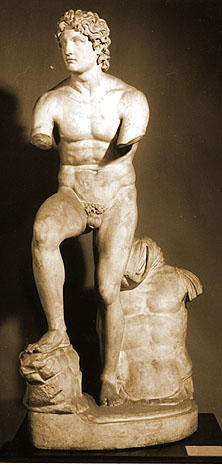
Rondanini Alexander. Munich
Roman period statue of a nude heroic young male. Generally thought to reproduce a statue of ca. 335 BC that depicted Alexander.
Marble
Statue
1.737 m, without plinth 1.687 m
From Italy: there appear to be no more precise details. The statue was acquired in 1764 by Giuseppe Marchese Rondinini (not Rondanini). It stood in Palazzo Rondinini (now the Banca dell’Agricoltura on the Via del Corso) in 1804/1805 and was bought by Wagner from the marchese Zacchia in 1814 for 1300 Scudi.
Germany, Munich, Glyptothek, 298
Second century AD, possibly based on an earlier model (either dated ca.335 BC or ca.125 BC)
Preservation:The statue was restored first under the aegis of Giuseppe Marchese Rondinini and then by Thorvaldsen under the direction of Adolf Furtwängler. In modern times most of these restorations have been removed.
In the Rondinini restoration the left arm was restored holding a scroll and the right arm was raised in an oratorical gesture. The right leg was restored and the restored foot rested on a helmet. The left foot from the instep to the toes was also restored. A shield, lying parallel to the ground and bearing the initials GMR, was placed under the left foot.
The Thorvaldsen restoration removed all the Rondinini restorations (except for the shield which Furtwängler deemed ancient). The right leg and foot were placed on a rock. The right arm reached below the right knee towards the lower leg. The left arm was bent and held a flask supported on the right thigh.
Currently both arms are missing from the upper arm downwards. The entire right leg and right foot are made of plaster. This is not a good restoration since it distorts the turn of the leg and foot. The left foot is missing and the shield of the Rondinini restoration has been removed. The back of the cuirass and the mantle draped over it has a smooth flat surface and features a clamp hole. The cuirass’ leather arm flaps, part of a former restoration, have been removed. A small portion of the crown of the head was worked separately and is missing. (The former restoration of this section has been removed). The penis is also missing.
The Ashmolean cast preserves details of the Thorvaldsen-Furtwängler restoration. It shows the rocky outcrop under the right foot, the shield under the left foot, the leather details of the cuirass, and the top of the head.
Description:The statue depicts a naked young male with abundant tousled hair. His upper body leans forward and his right leg steps up.
The head turns to its right and slightly upwards. The face is full and long. The brow is tall and the lower half protrudes. The eyebrows form a projecting ridge that slants slightly downward at the outer corners. The eyes appear wide open because of the high arch of the upper lid; the lower lid is almost straight. The nose is straight with a minor indentation at the bridge. The mouth is short with round, shapely, parted lips. The chin is round and strong.
The hair at the center of the brow forms an anestole; that is, it stands straight upwards. The rest of the hair tumbles downwards in thick locks in which individual strands are delineated by lightly drilled lines. The hair extends all the way down the nape and covers the upper part of the ears.
The body is caught in an active pose. The shoulders hunch forward and the upper body bends forward at the waist. The arms are lowered by the sides. The forearms seem to have extended away from the body. The left leg is straight and bears the body weight. The right leg appears to have been raised. Flanking the left leg is a cuirass, over the top of which rests a paludamentum.
Discussion:This statue, well known as the “Alexander Rondanini”, actually never belonged to the Rondanini family and perhaps does not represent Alexander the Great. Recent scholarship is unsure of the correct restoration, identification, and date of the statue.
The fragmentary statue, once part of the Rondinini collection, has been restored and unrestored three times. The initial restoration showed the statue as a speaker with its right foot on a helmet, its right arm raised, and its left arm resting on the leg and holding a scroll. The subsequent restoration, carried out by Thorvaldsen and overseen by Furtwängler, depicted the statue as an athlete with an oil jar in its left hand and with the right hand applying oil to the right calf. Both restorations have been removed, leaving the viewer to complete the action by himself. The two most common current solutions imagine the statue as a man holding reins and stepping into a chariot or as a warrior putting on his greaves.
The statue can be dated only on the basis of style. Interestingly different scholars have been placed the statue in all of the following periods: the second half of the fourth century BC, the end of the fourth century BC, the first half of the first century BC, the late second or first century BC, and in the Roman period. It has even been considered a Roman pastiche.
Winckelmann identified the statue as a portrait of Alexander the Great in 1767. Most scholars, who have published opinions on the statue, accept that it represents Alexander. They tend to believe that the statue stylistically belongs to the late fourth century and often they connect it to a passage in Pliny the Elder (NH 34.78). In that passage Pliny notes that Euphranor made statues of Alexander and Philip “in quadrigis” (in four horse chariots). The creation of this group is generally dated for purely hypothetical reasons between the battle of Chaironeia (338 BC) and the death of Philip (336 BC). Even if one were to accept that the pose was appropriate for a man getting into a chariot and that this is what Pliny intended by “in a chariot”, it seems difficult to believe that Euphranor would have created a nude statue of Alexander prior to Philip’s death. Other scholars have opted to connect the statue to other monuments (including the Philippeion at Olympia or the monument in Athens mentioned by Pausanias 1.9.4) created by other artists (Leochares and Lysippos).
In 1975 Schwarzenberg suggested that the statue actually depicted Achilles. Non-contemporary representations of Alexander, which heroicize the glorious historical figure, and representations of Achilles, a young hero with long hair, are obviously difficult to differentiate. Schwarzenberg believed that the motif and the style of the statue belonged to the late Hellenistic period and that the armor, flanking the statue, fit better with a depiction of Achilles that may have evolved from an image of Achilles sitting on his armor. Recently von den Hoff has reintroduced and expanded the argument for the Achilles identification. He points out that mid-fourth century vase painting and gems show Achilles in this pose, putting on his greaves, often in the presence of Thetis; the armor and the hairstyle, he points out, are the identifying traits for Achilles. He believes that the original model of the statue dates to the early Hellenistic period and is a result of the new fourth century iconography for Achilles. Finally, he stresses that Alexander emulated Achilles and may have borrowed from the iconographic markers of Achilles.
Although the statue exists in no copies, there is a terracotta version of the head in Oxford with its left hand on the face in a position of the mourning, clearly not the stance of the Rondinini statue. The terracotta, dated to the first century BC, suggests shows that the head type was known and gives support to the Roman pastiche argument, though equally the terracotta version could be a pastiche. Interestingly a third century AD relief from Antioch on the Orontes (part of the Alsdorf foundation, fig.66 in Palagia) does show a similar figure, same hair and same pose, surrounded by mortal companions, a female divinity, and a seated nude male. The statue’s cuirass and the mantle on top of it have been assumed to be additions by a copyist working from the bronze original.
In conclusion, the secure facts are that the statue is Roman in date, depicts a hero with military paraphernalia strapping on his greaves in a pose firmly established in the ancient visual tradition, and uses a head type reproduced on one other occasion but in a different pose. Whereas the pose and hairstyle may have initially been invented for Achilles, this statue could have represented either Achilles or Alexander. In the Roman visual vocabulary these two figures were essentially the same, and images of them, preserved without context, cannot be differentiated.
J. Lenaghan
Bibliography:T. Hölscher,
Ideal und Wirklichkeit in den Bildnissen Alexanders des Grossen (Heidelberg 1971) 25, 32-36
in discussion of characteristics of Alexander’s portrait, assumes the Rondanini statue is a copy of an Alexander portraitE. Schwarzenberg,
"Zum Alexander Rondanini oder Winckelmann und Alexander" Wandlungen. Studien zur antiken und neueren Kunst (Waldsassen 1975) 163-188
considers the statue based on a late Hellenistic representation of AchillesB. Vierneisel-Schlörb,
Katalog der Skulpturen Band II: Klassische Skulpturen des 5 und 4 Jahrhunderts v. Chr. (Munich 1979) 370-379 no.33
full catalogue entry, inclines toward theory that statue is based on a statue of the young Alexander by EuphranorO. Palagia,
Euphranor (Leiden 1980) 45-48 figs.62-65
believes the statue is assuredly Alexander, considers Euphranor stylistically possible as creator, avoids connection with passage in Pliny because not sure that the statue was a charioteerG. Dontas,
"La grande Artémis du Pirée: Une oeuvre d’Euphranor" (AntK 25 1982) 30-31
considers the statue a late Hellenistic version of an Alexander typeB. S. Ridgway,
Hellenistic Sculpture I: The Styles of ca. 331-200 BC (Bristol 1990) 113-116
summary of arguments with keen dissection of theories connecting to late 4th century statue of AlexanderA. Stewart,
Greek Sculpture. An Exploration (New Haven 1990) 288
presents statue in conjunction with passage from Pliny about Euphranor’s statues of Philip and Alexander, but, notes that it might possibly represent AchillesL. Todisco,
Scultura greca del IV secolo (Milan 1993) 94-95 no.199
presents the view that the statue represents the work of Euphranor (as cited by Pliny) and shows Alexander getting into chariot driven by PhilipR. von den Hoff,
"Der Alexander Rondanini. Mythischer Heros oder heroischer Herrscher?" (MuJb 48 1997) 7-28
re-asserts Schwarzenberg's argument that statue represents Achilles arming himself