Commentary Prepared by Dr. Julia Lenaghan, Ashmolean Museum
C 155
Erbach Alexander. Erbach
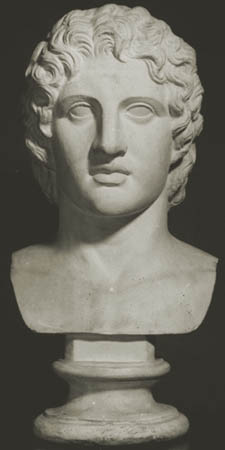
Roman period head probably depicting Alexander. Based on an original model (now known as the Acropolis-Erbach-Berlin type) of the fourth century BC erected in the Greek East. This Roman copy was set up in Hadrian’s Villa at Tivoli.
Marble
Head
H (with modern bust) 52 cm, head from chin to crown 25 cm
From Tivoli. Found in the ruins of Hadrian’s Villa, possibly among the sculpture found by G. Hamilton in the Pantanello and then sold in Germany. Acquired 1791.
Germany, Erbach, Grafliche Sammlung, 642
Hadrianic version of a portrait made ca. 340-320 BC
Preservation:The bust is restored, and so little remains of the neck that it is impossible to determine the turn of the head. Some encrustation on the face and hair.
Description:The head depicts a young man with long, wavy, full hair that frames a smooth face with regular features. The idealized physiognomy and the long mane of hair present a god-like or heroic image.
The face is oval in shape and is widest between the cheekbones. The brow is tall and the lower section of it protrudes. The eyebrows are low even arches above wide eyes. The upper eyelid is carefully defined between an engraved upper line and the flat edge that marks the bottom side of the lid. Both the of these lines continue beyond the intersection with the lower lid. The eye itself is shapely with a finely defined inner tear duct. The surface of the eyeball is flat and slopes inward from top to bottom. Below the lower eyelid the indentation of the eye socket is rendered. The bridge of the nose continues smoothly on the same plane as the forehead and the ridge of the nose is broad and straight. The cheeks are fully and fleshy; they pucker slightly at the outer corners of the mouth. The mouth is small from side to side but with thick, full, slightly parted lips. The vertical groove between the septum and the center of the upper lip is distinct and has sharp edges. The upper lip has a pronounced central dip, and the lower lip seems to be made of two small pillow-like bulges which are joined at the center of the lip. The outer perimeter of the lips is delimited by a sharp raised edge. The lower lip protrudes slightly, creating a narrow dip between the lip and the chin. The chin is U-shaped, projecting, and strong.
The hair consists of long wavy locks, frequently ending in snail curls, that cover the ears and the nape. The locks are more carefully worked around the face, ears, and neck, than at the top or back of the head. At the back of the head the hair falls in two distinct tiers of locks, all ending in snail curls. In general within each lock of hair are two to three fine grooves that denote strands. The hairline arches over the forehead. At the temples the locks almost touch the corners of the eyebrows and over the center of the brow the locks spring up. Over the inner corner of the right eye two locks of hair spring straight upwards; then, the right lock falls to the right and the left lock to the left. A long lock comes forward and onto the brow immediately to the right of these two locks. The locks immediately to the left of the central group are brushed towards the left ear.
Discussion:The Erbach head has been identified as Alexander the Great and is, therefore, referred to as the Erbach Alexander. The head follows a portrait type (the ‘Akropolis-Erbach-Berlin’) that is known in two other replicas.
The replicas are a finely worked head found on the acropolis in Athens (see cat.no. C 154) and a head of lesser quality purchased in Madytos (opposite Çannakale) in 1874. Stylistic details of the head type, for instance, the shape of the face and the relationship of the hair to the face, are typical of the late fourth century. Fittschen compares them to the “Resting Satyr” generally ascribed to Praxiteles (cat.no. C 119-120).
Although the orderly cap of hair clinging to the head is unlike the dishevelled locks in other portraits of Alexander, the cowlick or anastole just to the right of the center of the brow and the long locks that cover the ears are distinctly part of the iconography of Alexander the Great and are distinctly different from the short locks depicted on young athletes and youths. It is principally on the basis of these two details that the head type has been identified as Alexander. Strengthening this identification are the fact that type stylistically appears to belong to the fourth century BC, was copied in the Roman period, and resembles generally in facial structure and features as well as disposition of hair the labelled Azara herm of Alexander (cat. no. C 151), the figure of Alexander in the Alexander mosaic from Pompeii, and the ‘Dresden’ Alexander type (cat.no. C 153). The ‘Acropolis-Erbach-Berlin’ type is thus the third replicated portrait type identified as Alexander (the other two being the ‘Azara’ and ‘Dresden’ types).
None of the identified representations of Alexander correspond exactly. And in comparison to the other types and the figure of Alexander on the Alexander mosaic, the ‘Acropolis-Erbach-Berlin’ type has particularly plain and unemotional facial characteristics. Fittschen suggests that this generic-faced calm Alexander type was especially popular in the middle of the second century AD (the Berlin and the Erbach copies both seem to date to this period, see below) because the idea of a god-like youth was more in vogue than a powerful world ruler.
The type also seems to show a young Alexander, certainly younger than the images portrayed by the Azara herm or the Pompeii mosaic. Scholars have, therefore, attempted to identify the type with a famous original statue and/or a famous sculptor of the reign of Philip. The most commonly made association is with the chryselephantine statue from the Philippeion at Olympia dated ca. 338 BC and made by Leochares. Three facts have drawn scholars to consider the head either similar to or copied from the Olympia portrait : 1) the head type resembles and is possibly from the same monument as the ‘Alcibiades’ head type known in seven copies and identified as Philip, 2) the head type has similarities to sculpture from the Mausoleum at Halicarnassus where Leochares worked, and 3) Leochares made a chryselephantine group of Philip and his family in Olympia. Another possibility is that both head types were copied from a group of Philip and Alexander which was seen by Pausanias in the agora in Athens and probably set up after the battle of Chaironeia in 338 BC. If one, however, considers how many monuments featured Alexander, during the reign of his father, during his own reign, and during the reigns of his successors, one is forced to admit that there is simply not enough evidence to associate any particular monument with any particular portrait type of Alexander.
The Erbach version of the type distinguishes itself from the other two copies of the type in several details. The back of the hair is worked in two careful tiers of locks. The eyebrows, nose, and mouth are rendered with sharp lines; the mouth is even outlined as if it were a bronze work with copper lips. The classicising sharpness of the lines further detracts from the individuality of the sitter; both the Acropolis and Berlin heads convey a more portrait-like character. In addition, the Erbach locks of hair are separate, though not drilled away from each other as in the Berlin head, and the locks have finer and more rounded individual strands than those in the Acropolis copy. These characteristics suggest to Fittschen a Hadrianic date which also fits with the head’s find-site, the Hadrianic villa at Tivoli.
J. Lenaghan
Bibliography:K. Fittschen,
Katalog der antiken Skulpturen in Schloss Erbach (Berlin 1977) 21-25, no. 7, pl. 8
R. R. R. Smith,
Hellenistic Royal Portraits (Oxford 1988) 60-62, 155-156, no. 2A
good succinct presentation of head and typeA. Stewart,
Faces of Power: Alexander’s Image and Hellenistic Politics (Berkeley 1993) 43, 106-112, 421
discussion of the type and motivations for itB. S. Ridgway,
Fourth-Century Styles in Greek Sculpture (London 1997) 249
brief statement with bibliography and assessment of recent opinion