Commentary Prepared by Dr. Julia Lenaghan, Ashmolean Museum
C 154
Acropolis Alexander. Acropolis
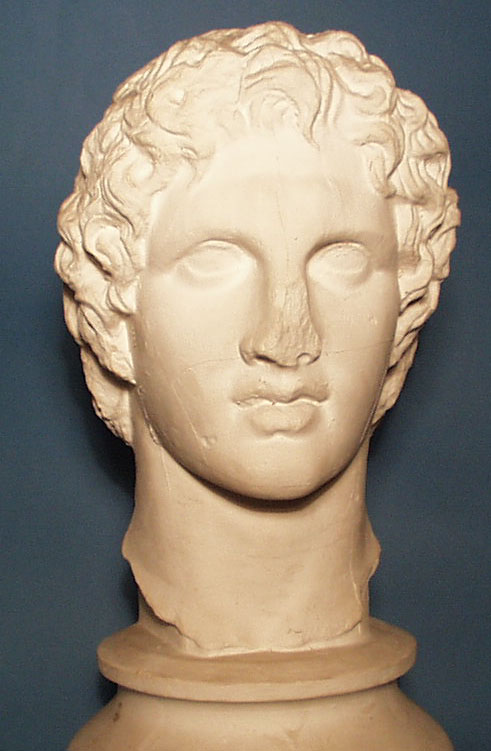
Head probably depicting Alexander following a type known as the ‘Acropolis-Erbach-Berlin’ type. An original model of the fourth century BC or more probably a late Hellenistic or Roman copy.
Marble
Head
35 cm
From the Acropolis at Athens. Found near the Erechtheion in 1886.
Greece, Athens, Akropolis Museum, 1331
Late Hellenistic or Roman copy of an original model dating ca. 340-320 BC
Preservation:The head was possibly worked separately and inserted into a statue; the edge of the neck seems finished. The tip of the nose and some locks of hair, especially those of the cowlick over the inner corner of the right eye, are broken.
Description:The head depicts a young man with long, wavy, full hair that frames a smooth face with regular features. The idealized physiognomy and the long mane of hair present a god-like or heroic image.
The face is oval in shape and is widest between the cheekbones. The brow is tall and the lower section of it protrudes. The eyebrows are low even arches above deep-set eyes. The orbitals (space between the eyebrow and upper eyelid) hang over the upper eyelids which, where visible, are thin and not sharply defined. The surface of the eyeball is flat, and below the lower eyelid the indentation of the eye socket is rendered. The bridge of the nose continues almost smoothly on the same plane as the forehead and the ridge of the nose is broad and straight. The cheeks are fully and fleshy; they pucker at the outer corners of the nostrils and at the outer corners of the mouth. The mouth is small from side to side but with thick slightly parted lips. The groove parting the lips turns up at the corners of the mouth. The vertical indentation between the septum and the center of the upper lip is defined but without sharp edges. This is true also for the lips. The upper lip has a pronounced central dip, and the lower lip is made of two small swellings with a small dip between them at the center of the lip. The lower lip protrudes, and below it is a narrow dip indentation between the lip and the chin. The chin is U-shaped, projecting, and strong.
The hair consists of long wavy locks that cover the ears and the nape. The locks are more carefully worked around the face than at the top or back of the head. There is a slight indentation in the hair that runs around the entire crown of the head just above the ears. At the back of the head the hair falls in two distinct tiers of locks; those above and those below the indentation. In general within each lock of hair are several broad grooves that denote strands. The hairline arches over the forehead. At the temples the locks almost touch the corners of the eyebrows and over the center of the brow the locks spring up. Over the inner corner of the right eye two locks of hair spring straight upwards. A long lock comes forward and onto the brow immediately to the right of these two locks. The locks immediately to the left of the central group are brushed towards the left ear.
Discussion:The Acropolis head has been identified as Alexander the Great. There are two other copies of this same portrait type which is known as the ‘Acropolis-Erbach-Berlin’ type (cf. cat.no. C 155) and is one of three fourth century BC portrait types identified as Alexander. Although it is clear on stylistic grounds that this portrait type belongs to the late fourth century, it remains unclear when the Acropolis head was made.
The two other copies of the type are a well-preserved head found at Hadrian’s Villa in Tivoli (cat.no. C 155) and a head of lesser quality purchased from Madytos across from modern Çannakale in 1874. For more discussion on the head type, see cat. no. C 155. It is principally the anastole (locks that spring directly upward near the center of the brow), the fact that the hair covers the ears, and the multiple copies that permit for the identification of the portrait type as Alexander.
Many scholars believe that the Acropolis version of the type is a work of the fourth century, either the original model on which the Erbach and Berlin versions were based or a copy made immediately after the original model. This belief is rooted in the workshop similarities that Ashmole detected between it and the ‘Demeter of Cnidus’ as well as friezes from the Mausoleum. All of these objects Ashmole ascribed to Leochares, an opinion already expressed as early as 1900. Leochares was known to have worked on the Mausoleum; his signature is attested on bases on the acropolis in Athens; and he worked on two projects involving portraits of Alexander—the Philippeion at Olympia and a posthumous monument at Delphi. Thus, various proposals have emerged. For instance, the Acropolis head represents a dedication made after the battle of Chaironea in 338 BC by Leochares and possibly based on the Philippeion portrait or that it represents a marble copy, made just after the original, of a bronze group set up in the Athenian agora. Stewart’s exploration of the possibilities and motivations for the marble copy are confusing and unconvincing.
Fittschen and many following him believe the Acropolis head represents a Hellenistic copy of a fourth century original. First, the Acropolis head only summarily renders the locks at the back of the head whereas the Erbach copy of the type (cat. no. C 155) depicts these locks with greater care. Thus, the Erbach head does not draw directly on the Acropolis head. Moreover, according to Fittschen, the technique used in the Acropolis head to separate individual locks with grooves is not a fourth century BC technique. He places the head around 100 BC and considers it to be a very early copy of the type. Stewart protests that there would be no historical reason in the second and first century BC for such a copy and that ‘there are no parallels’. This author, however, does not exclude an early imperial date for the copy.
In comparison with the Erbach head, the Acropolis head shows greater modulations of surfaces both in the hair and in the face; in the hair there is more drill work and this results in chiaroscuro contrasts; the eyes and mouth are more softly modelled; the orbitals hang over the outer corners of the eyelids, giving the sitter a more emotional aspect; and the ridges between the grooves in the hair are sharper. Particularly this latter detail but also the irregular use of the drill and the facial details cause Fittschen to date the head in the late Hellenistic period.
J. Lenaghan
Bibliography:S. Casson,
Catalogue of the Acropolis Museum II (Cambridge 1921) 232-234, no. 1331
considers it to be original on which Erbach head basedB. Ashmole,
"Demeter of Cnidus" (JHS 71 1951) 15-16
makes connection to Leochares that becomes generally acceptedG.M.A. Richter,
Portraits of the Greeks III (London 1965) 255, no. 5d, fig. 1727
brief entry without good discussionM. S. Brouskari,
The Acropolis Museum. A Descriptive Catalogue (Athens 1974) 166-167, no. 1331
catalogue entry that considers it be an original work by Leochares set up after Battle of Chaironeia in 338 BCK. Fittschen,
Katalog der antiken Skulpturen in Schloss Erbach (Berlin 1977) 21-22, no. 7, Beil. 2
kopiekritik that dates the head to the first century BCR. R. R. Smith,
Hellenistic Royal Portraits (Oxford 1988) 60-62, 156, no. 2C
good succinct presentation of head and typeL. Todisco,
Scultura greca del IV secolo (Milan 1993) 106, no. 223
presents traditional opinion that type related to the statue of Leochares in Philippeion and dates ca. 335 BCA. Stewart,
Faces of Power: Alexander’s Image and Hellenistic Politics (Berkeley 1993) 43, 106-112, 421, pl. 1 and fig. 5
confusing discussion of the type and motivations for it, seems to consider the Acropolis head an original of the fourth century BC based on a slightly earlier bronzeB. S. Ridgway,
Fourth-Century Styles in Greek Sculpture (London 1997) 249
brief statement with bibliography and assessment of recent opinionC. Rolley,
La sculpture grecque II. La période classique (Paris 1999) 290, fig. 297
convinced by Ashmole’s comparisons, thinks head is possibly a fourth century copy of the statue by Leochares in the Philippeion at Olympia