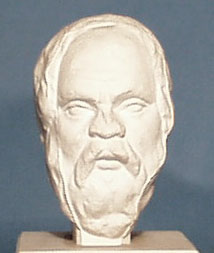
Head of Sokrates.
Commentary Prepared by Dr. Julia Lenaghan, Ashmolean Museum
C 147
Small head of Socrates. Kiel
Roman period portrait of Socrates from a statuette. Based on the Type B model of Socrates generally thought to have been created by Lysippos in ca. 330 BC.
Marble
Head of Statuette
6.2 cm
From the Forchhammer collection. A label attached to the back of the head read "Pergamon 1837".
Germany, Kiel, Akademische Kunstmuseum, B 372
Roman period reduced-scale version of a model dated ca. 330 BC
Preservation:The head has broken from its statuette diagonally near the base of the neck. The break runs from the bottom of the beard upwards to the back of the head. The tip of the nose is broken; the surface is worn; and the hair is only roughly worked out. At the back left side, there is a horizontal shelf, perhaps the result of a break.
Description:The small head depicts a bearded, balding elderly man who turns to the right. The tall brow rises to a bald front portion of the cranium. The brow is traversed by two horizontal furrows and over the base of the nose are two short vertical lines of contraction. The eyebrows arch and the upper lid is carefully defined. The nose is short and broad with flaring nostrils. The naso-labial folds are pronounced. The upper lip is concealed by a thick moustache and the lower lip is a full horizontal form. The beard is a continuation of the locks of hair at the temples. It is heavy and reaches well below the chin; the individual locks are only roughly indicated. The hair of the head covers the back and sides of the head, including the ears. Just as the beard, it is only roughly indicated.
Discussion:Notwithstanding its very small size, the head unmistakeably represents Socrates (b. 469 BC, d. 399 BC). There are two principal ancient portrait models known to represent Socrates and one later variation; these are known as Type A, B, and C. The Kiel head follows Type B; for a full discussion on Types A and B, see cat. nos. C 145, H 14, and C 146.
The Kiel head, allegedly found in Pergamon, was certainly joined to a small statue. An almost complete small statuette of Socrates exists today in the British Museum (cat. no. C 148) and allows one to imagine the sort of image that the Kiel head was part of. It is worthwhile to note that the small-size Kiel portrait head essentially closely follows the original Type B model and that images of Socrates were so popular in the Roman period that they were made on a small, presumably inexpensive, scale for domestic use.
Julia Lenaghan
Bibliography:G.M.A. Richter,
Portraits of the Greeks I (London 1965) 114, no. 21
catalogue entry, Type B portrait of SocratesJ. Raeder,
Antikensammlung in der Kunsthalle zu Kiel (Munich 1987) 84, 86-87
short description of the portraiture of Socrates and general comment on the Kiel head, with photographsP. Zanker,
The Mask of Socrates (Berkeley 1995) 57-60
interpretation of the Type B Socrates portrait