Commentary Prepared by Dr. Julia Lenaghan, Ashmolean Museum
C 132
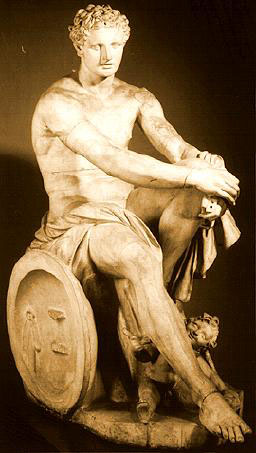
Ares Ludovisi. Palazzo Altemps, Rome
Statue of a seated Mars or Achilles. According to some a Republican work and according to others an Antonine version of a famous late fourth century statue. Probably located in a late Republican Temple in the Campus Martius in Rome
Marble
Statue
1.56 m
Found in Rome. About the statue, which was already in the Ludovisi collection by 1622-23,Pietro Sante Bartoli (b. 1635) wrote "Near the Palace of the Santacroce family, going towards the Campitelli, while they were making a little road, a seated statue of Mars with a Cupid was found". Modern scholars have argued over which Palace of the Santacroce Bartoli intended, that in Piazza Cairoli or that at the intersection of Via in Pubicolis and Via Sta. Maria del Pianto, near Piazza Costaguti.
Italy, Rome, Museo Nazionale Romano, 8602
Either a Hellenistic Creation or a Roman Version of an Original Dated ca. 320 BC
Preservation:The statue was restored by Bernini. The restorations to “Ares” include the nose except for the right nostril, the right hand except for the piece that rests on the left knee, the tips of the thumb and index finger on the left hand, the hilt and a piece of the scabbard of the sword, and the right foot except for the heel. The restored hilt has been removed in the Ashmolean Cast. On Eros, the head, the left arm with the quiver, the right forearm with the bow, and the right foot with part of the leg are all restorations
On left side of Ares there are supposedly unfinished areas. Moreover, on the left shoulder of Ares are the remains of a strut which features a circular hole in the center. Under the left armpit is a cut, larger than a finger, that may be connected to the strut on the left shoulder. Behind the end of the sword is remains of a square strut and there are traces of another on the rock. Areas of the drapery and rock have been reworked. Also the edge of the plinth seems to have been smoothed out by modern restorers. Heavy cleaning has destroyed the original surface.
Description:The statue depicts a clean shaven, short-haired, nude male seated upon a rocky mass with a mantle draped around his hips. The left foot rests on a helmet. A shield, with its inside facing out, rests against the outer side of the rock under the right thigh. On the front side of the rock under the right thigh is a greave. The left hand, with the right hand resting on it, holds a sword, just under the hilt, near the left knee. Behind the right foot, a winged Cupid sits on the ground between the right shin, the helmet, and the rock. The body of the Cupid leans toward its left and the restored head emerges on the left side of the right shin. The Cupid’s left hand rests on a quiver (restoration) and the right hand holds a bow (also restoration).
The head of the male features short tousled locks of hair that begin high on the brow and do not cover the ears. The face is widest between the temples and tapers from there down to the chin. The brow is convex with a significant bulge at the center. The eyebrows slope downward and the eyes are deep set. The cheeks are full and the mouth is small with down-turned corners and parted lips.
Discussion:The “Ares Ludovisi”, found in the early 1600s and restored by Bernini, is a source of controversy for modern scholars. There is consensus neither about its date nor its subject.
The statue was found in the area of the Campus Martius. A copy of the body was found in Pozzuoli (now Naples) and another loose version was discovered in Pergamon (now Berlin). There are several copies and loose versions of the heads, the best of which are in Munich and Vienna (from Apollonia in Albania). Interestingly, two copies of the head are placed on different body types. On the left side of the Ludovisi statue there was probably another figure, generally thought to have been an Eros or an Aphrodite. The stance of the statue recalls the Ares on the Parthenon East frieze and the seated satyr on the Lysikrates monument (ca.335 BC)(cat.no.A 141). The head resembles the “Meleager” statue (cat.no.C 104-106), the body recalls that of the Apoxymenos, the Sandalbinder, and the Alexander Rondanini (cat.nos.C 133, 136, and 156).
The traditional scholarly view is that the statue is an Antonine version of a late fourth century work which depicted Ares. The Antonine copyist is held responsible for the addition of the Eros and possibly some of the arms. The late fourth century work has been variously ascribed to Lysippos, Skopas, Piston, Euphranor, or Silanion. Even if it is not by a known artist, scholars, who follow this argument, stress that the original must be at least by an artist influenced by the styles of these famous late fourth century sculptors. Pliny mentions a temple of Mars set up by Brutus Callaecus in the Campus Martius, the cult statue of which was a seated Mars by Skopas. Given the find location of the statue many have associated it with this statue.
The second theory concerning the statue proposes that it is an eclectic work of the Hellenistic period. This conclusion is reached mainly because the head appears on different statue types and the body position is a copied motif. Moreover, several scholars are convinced that Pliny, who describes a seated statue of Mars and a statue group of Neptune, Achilles, and Thetis in two adjacent temples near the Circus Flaminius in Rome, both by Skopas, is really speaking of a Skopas who worked extensively in Rome in the second century BC.
Filippo Coarelli has recently further embellished this theory. Reassuming the suggestion that the the “Ares Ludovisi” represented Achilles, he now proposes that it was the statue of Achilles from the temple of Neptune and that it was erected on top of the so-called “altar of Domitius Ahenobarbus” along with a seated statue of Thetis and standing statue of Neptune by Cn. Domitius Ahenobarbus, the consul of 122 BC. The “Ares Ludovisi” and the altar were found in the same area and as a combination partially fit Pliny’s description (36.25) of statues of Neptune, Thetis, and Achilles with nereids on dolphins and tritons in a temple of Domitius dedicated to Neptune. Moreover, a small frontal temple on a high podium, like that which appears on coins of another Domitius Ahenobarbus in the year 41 BC, was discovered recently in the area of modern Piazza Costaguti, very close to the old Palazzo of the Santacroce family and to the Circus Flaminius where Pliny locates the Neptune Temple of Cn. Domitius. In accordance with Coarelli’s theory, the statue of “Ares Ludovisi” is now displayed in the Palazzo Altemps in Rome with a seated female statue identified as Thetis.
Julia Lenaghan
Bibliography:F. Coarelli,
"L'ara di Domizio Enobarbo" (DdA 1968) 315-316, 325-337
argues that the "Ares Ludovisi" is a reduced scale copy of a cult statue of Mars in the Temple in the Campus Martius and that the cult statue was a work of the a younger (second century) SkopasW. Helbig (H. von Steuben),
Führer durch die öffentlichen Sammlungen klassischer Altertumer in Rom III (4th edition) (Tübingen 1969) 269-270 no.2345
considers the statue an Antonine copy of an original dated ca.325 BC, the Eros is an addition of the copyistF. Zevi,
"L'identificazione del Tempio di Marte 'in circo' e altre osservazioni" Mélanges offerts à Jacques Heurgon II. L’Italie préromaine et la Rome républicaine (Rome 1976) 1054-1055
considers the statue to be a Hellenistic work of a younger Skopas and to have belonged in the Temple of Mars located in modern Piazza S. Salvatore in CampoA. Stewart,
Skopas of Paros (Park Ridge, NJ 1977) 116-117 pl.48
considers the statue to be based on an original of the last 1/4 of the fourth century BC, the original shows influences of Lysippos and Skopas and might be Skopas or an immediate follower of hisS. Lattimore,
"Ares and the Heads of Heroes" (AJA 83 1979) 71-78 pl.2 fig.1
suggests the Ares Ludovisi is a statue of Achilles by Silanion, lists replicasB. Vierneisel-Schlörb,
Katalog der Skulpturen Band II: Klassische Skulpturen des 5 und 4 Jahrhunderts v. Chr. (Munich 1979) 424-428
accepts that the statue is an Antonine work, considers it based on an original of ca.320 BC, suggests that the original might have been by Lysippos,
Museo Nazionale Romano: Le sculture I, 5 (Rome 1983) 115-121 no.51
full catalogue entry with presentation of all scholarly argumentsE. Simon,
"Ares/Mars" Lexicon Iconographicum Mythologiae Classicae II (Zurich 1984) 514 no.23
catalogue entry, fully presents arguments, considers the statue to be a copy of a fourth century original of AresP. Bruneau,
"Ares" Lexicon Iconographicum Mythologiae Classicae II (Zurich 1984) 481 no.24
catalogue entry, accepts it to be a copy of a statue of Skopas displayed in the Temple of Mars in the Campus Martius in RomeB. S. Ridgway,
Hellenistic Sculpture I: The Styles of ca. 331-200 BC (Bristol 1990) 84-87
presents the arguments, believes that the statue is based on a fourth century original but considers it impossible to identify the subject or artistF. Coarelli,
Il Campo Marzio (Rome 1997) 433-446
shows that the statue came from Piazza Costaguti, believes that it represents Achilles by a younger Skopas from the Temple of Neptune in the Campus Martius