Commentary Prepared by Dr. Julia Lenaghan, Ashmolean Museum
C 130
Hypnos. Madrid
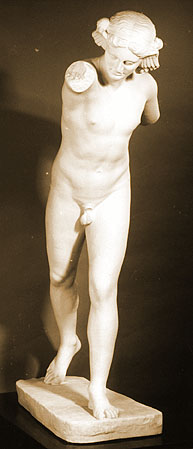
Roman period statue showing Hypnos (Sleep) running with wings on his head and sleep-inducing items in his hands. Based on a popular type, possibly created in the Hellenistic period.
Marble
Statue
1.50 m
Spain, Madrid, Museo del Prado
Roman period copy (possibly Hadrianic) of a Hellenistic (second century) original
Preservation:The right arm is missing from the shoulder down and the left arm from just above the elbow down. The left leg is broken just below the knee and has been repaired. There are chips on the wings at the forehead, in the hair, at the tip of the nose, and on the right eyelid and eyebrow. The wings give the impression of being much shorter than they originally were. The heads of the two lizards on the tree trunk support are missing. [The entire tree trunk is missing in the Ashmolean cast as well as a small portion of the left arm].
Description:The statue depicts a running boy with one arm stretched forward and the other back and with wings on his head. The extended body is supported by a tree-trunk placed behind the left leg. A strut reaches from the support to the back of the right calf.
The left leg in a forward position bears the body weight; the left foot rests flat on the ground. The right leg extends behind the body. With the right heel raised, the toes and ball of the right foot push off the ground. In contrast to the position of the legs, the right arm extended forward and the left arm trailed behind the body. The body itself is soft and fleshy rather than muscular; the thighs, in fact, appear pudgy. There is no pubic hair indicated.
The winged head of the boy looks downward and to the right. The face is broad and rectangular in shape. It has full cheeks and a massive chin with small features. The lips of the mouth are parted.
The hairstyle is elaborate. The hair is long and parted down the centre. A broad flat band, set a few centimetres back the brow, encircles the head and holds the hair in place. The hair around the brow is flipped back. Wings, rather than hair, grow out of the hairline at the temples. On each side one lock of front hair, preceding the wing, is pulled out and looped around the band; it bulges out above the wing. Falling behind and on the back of the wings are corkscrew locks that have escaped from under the band. The rest of the hair is pulled back and gathered together above the flat band at the back of the head. There it is interwoven into a loose projecting bun or roll.
Discussion:The statue in the Prado represents Hypnos or, in Latin, Somnus, Sleep. The young divinity is shown racing over land; his pose is that of a runner and on his head are wings. With his outstretched right arm, he poured a sleep-bringing potion from a horn and in his left hand he held poppies, sleep-inducing flowers.
The statue type was popular in antiquity and is preserved in numerous Roman period copies (at least 20) that were made in various sizes and in various media. These include a fine life-size bronze copy of the head from Civetella d’Arno (Perugia) and now in the British Museum; a small bronze statuette in the Leon Levy-Shelby White collection that shows both the horn turned downward and the poppies; and a life-size bronze head and upper body discovered in 1989 in a Roman villa near Córdoba. The marble version in Madrid, which is without provenance, features a tree-trunk support that is lacking in the bronze copies. The meaning of the lizards on the tree trunk has been debated but they are probably best interpreted as decorative elements intended to enliven the surface of the support. According to Blanco, such decorative elements are typical of the Hadrianic period, the period in which he would date the Madrid marble copy.
For most of the twentieth century, scholars thought that the type, on which these Roman period statues were based, represented a famous original of the fourth century BC. The original model was, therefore, attributed to Praxiteles, Leochares, or Scopas. Blanco, lowering the date of the original to the early third century, suggested the sons of Praxiteles as the creators of the original model.
The only literary mention of a statue of Hypnos is in Pausanias. Pausanias saw two statues of Hypnos at the sanctuary of Asklepios at Sikyon (1.10.2). Although neither of the statues mentioned by Pausanias, the one just a head and the other lulling a lion to sleep, could possibly be connected with the type of the Madrid Hypnos, some scholars have nonetheless connected the original with a sanctuary of Asklepios since Hypnos, sleep, seems to be related to Asklepios’ healing powers. Already in 1898 Klein had suggested logically that the original model was located somewhere in Rome since the type was used on Roman funerary monuments and since all copies of the type have been found in the western provinces (Gaul, Italy, and Spain).
In 1974 P. Zanker suggested that the original model of the statue dated to the second half of the second century BC. He pointed out correctly that the statue’s twisting upper body and extended position of the legs as well as the coiffure which is an elaboration of that of the Apollo Sauroktonos type (cat. nos. C 111-112) seem stylistically to belong to the Hellenistic period. Leibundgut confirms this dating and Klein’s idea that the original was in Rome.
C. Mattusch most recently, however, suggests that there was no original model but that the running Hypnos was a generic type that individual artists and buyers adapted to fit their capacities, costs, and tastes. This is a difficult position to maintain since the head in the British Museum, that of the Prado statue, and the head found in Córdoba are all copies, distinctly and clearly based on the same model. Her point that some of the small-scale versions look younger or chubbier does not actually aid her argument. It merely points out that the original model was life-size, like the Madrid statue, and that when sculptors reduced it, they frequently were unable to retain the correct proportions.
J. Lenaghan
Bibliography:W. Klein,
Praxiteles (Leipzig 1898) 133-157, especially 136 n. 1
detailed discussion with comparison to Apollo Sauroktonos, with replica listA. Blanco,
Catálogo de la Escultura (Madrid 1957) 68-69, no. 89E, pls. 43-45
fullest catalogue entry, considers the statue a copy made in the second quarter of the second century AD and based on an original of the early third century BCP. Zanker,
Klassizistische Statuen (Mainz 1974) 115-116, n. 167
type belongs to the second half of the second century BC because of composition and hairstyleA. Liebundgut,
Die römischen Bronzen der Scwheiz 3: Westschweiz Bern und Wallis (Mainz 1980) 33-34
accepts Zanker’s proposition for the date of the original, suggests original located in RomeC. Lochin,
"Hypnos/Somnus" Lexicon Iconographicum Mythologiae Classicae V (Zurich 1990) 597 and 607, no. 42*
terse entry with bibliography, considers type based on an original of ScopasC. Mattusch,
Classical Bronzes. The Art and Craft of Greek and Roman Statuary. (Ithaca 1996) 151-150, fig. 5.6
believes that no original existed, just a popular generic type repeatedly and loosely redone