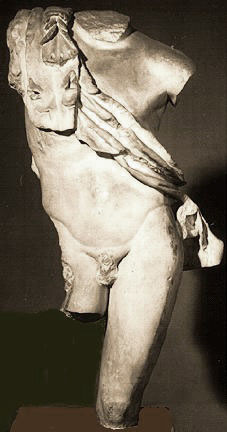
Cast Gallery catalogue number: C120
Torso of a young satyr wearing an animal skin. He once lent with his right arm resting on a tree-trunk.
- Plaster cast: Height: 1.21m.
- Copy of a marble torso.
- The torso:
- is a version of a Greek original of about 340 BC, probably by Praxiteles.
- was found in Rome on the Palatine, during the excavations of Napoleon III.
- is now in Paris, Musée du Louvre, Ma 664.
Detailed Record
Commentary Prepared by Dr. Julia Lenaghan, Ashmolean Museum
C 120
Resting Satyr (Satyr Anapoumenos), possibly based on a work by Praxiteles. Louvre
Roman statue of a youthful satyr at rest wearing a panther skin. It is often thought to be the highest quality rendition of a popular statue type, the original of which may have been made by Praxiteles around 350 BC.
Marble
Statue
1.06 m
From Rome. Found on the Palatine.
France, Paris, Louvre, Ma 664
Roman statue based on an original dated ca. 350 BC.
Preservation:The statue is missing the head which is broken off through the neck, the right arm from the shoulder down, the left arm from just above the elbow down, the left leg from below the knee down, and the right leg from the middle of the thigh downwards. Moreover, the outer side of the preserved portion of the right thigh has broken off from the hip down. The Ashmolean cast preserves none of the left upper arm. In addition, there are breaks in the nebris and the front surface of the genitals has been chipped off. There are also two raised rectangular areas, indicating struts that have broken off. A larger one is located on the outer right side of the rib cage and a smaller one lies under the right breast.
Description:The statue depicts a youthful nude male who wears a nebris (animal skin) diagonally from the right shoulder to the left hip. The weight of the body rests on the left leg and the left hip projects outwards. The right thigh lies against the left thigh. The right shoulder is raised and the left upper arm moves away from the body. The nebris is draped in such a way that the head of the panther rests over the area of the right breast and the paws hang between the shoulder blades
Discussion:The Louvre statue of the Resting Satyr is the thought to be the finest full-scale version of a well known ancient statue type. The type, known as the “Resting Satyr”, “Leaning Satyr”, or “Satyr Anapoumenos”, was extremely popular in the Roman period and may have been originally created in the fourth century BC by Praxiteles. For a full discussion of the type, see cat.no. C 119.
Because of its fragmentary nature, the Louvre statue does not contribute greatly to reconstructions the appearance of the original model. In size it would have been about 1.70 m which is the standard height for full-scale copies of the type. Its round forms and fine handling may be attributed to a gifted copyist.
Julia Lenaghan
Bibliography:,
Encyclopédie Photographique de l'Art III: Le Musée du Louvre: Le sculpture grecque (Paris 1938) 191
brief catalogue entryP. Gercke,
Satirn des Praxiteles (1968 1968) no.15
B. Vierneisel-Schlörb,
Katalog der Skulpturen Band II: Klassische Skulpturen des 5 und 4 Jahrhunderts v. Chr. (Munich 1979) 356-361, especially 357
mentions the Louvre statue in a discussion of the copies of the Resting Satyr type, also a full discussion of the typeE. Bartman,
Ancient Sculptural Copies in Miniature (Leiden 1992) 51-55 and 60 figs.12-13
discussion of the copies of the Resting Satyr type, uses Louvre statue in discussion of different styles of various versions