Commentary Prepared by Dr. Julia Lenaghan, Ashmolean Museum
C 112
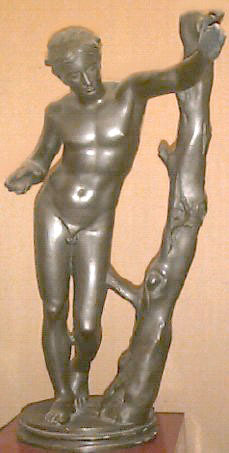
Reduced Version of Praxiteles’ Apollo Sauroktonos. Villa Albani
Roman period statue of a young Apollo watching a lizard that he is about to kill. Generally considered to be a reduced scale copy of a statue made by Praxiteles around 350 BC.
Bronze
Statue
1.07 m with base, 96 cm without base
From Rome. Found in a vineyard below Sta. Balbina at the foot of the Aventine. Cardinal Albani is said to have personally carried it from its findspot to his chariot. In 1778 it was among the statues ordered by Napoleon for exportation to Paris. It, however, was instead returned to the Albani family.
Italy, Rome, Villa Albani, 952
Roman, perhaps early first century, copy of an original dated ca.350 BC
Preservation:The base of the statue is ancient but does not belong to the statue. The tree trunk is modern. There are two nail holes on the trunk from a lost lizard made in silver. The Ashmolean Cast interestingly features the lizard which is no longer part of the Albani statue.
The limbs, head, and body of the statue were worked separately. Seams are visible on the middle of the right thigh, at the beginning of the left thigh, below both shoulders, and in the middle of the throat. According to von Steuben, the eyes have been inlaid in a modern period. Bol disagrees. The nipples were inserted in antiquity. The fillet has vegetal decoration rendered in a grey metal.
Description:The statue depicts a pre-pubescent boy watching a lizard that crawls up the trunk of the tree (which in this case is entirely restoration). The boy stands with his weight over his right leg; his right hip projects in a smooth curve. The left shin trails behind and the heel of the left foot, which is almost in line with the right foot, does not touch the ground. The upper body leans toward the left and the left arm is raised and reaches to its left. The lowered right arm bends at the elbow; the upper arm rests by the side and the forearm projects forward. The hand grasps a no longer extant object. A strut runs from the outer left thigh diagonally downwards to the tree trunk.
The head turns to the left. The face has an oval shape with regular features. The eyebrows and nose form two virtually perpendicular lines. The mouth is small with slightly parted lips, the upper of which dips at the center and the lower of which rises at the center. The chin is broad and projects. The long hair, rendered in distinct thick locks, frames the brow in a triangular manner. It has a central part and is combed backward off the brow. It is held in place by a fillet that runs around the head just above the ears. After passing under the fillet the hair is collected and knotted at the nape of the neck. On both sides of the head over the ears, two locks of hair are pulled out behind the fillet. The fillet itself is decorated with engraved vegetal motifs that are inlaid with silver.
Discussion:The Albani statue is a small-scale version of a statue of Apollo Sauroktonos (“Lizard Slayer”) thought to have been made by Praxiteles in ca.350 BC. There are at least 20 other copies of this type. For a full discussion of the type, see cat.no.C 111.
Even though the Albani statue is bronze which was the original material of Praxiteles’ Sauroktonos, it is generally considered a poor copy both because of its scale and because of the low quality of its modelling. The vegetal decoration of the fillet may or may not be an invention of the copyist. It, however, exists on none of the marble copies. Bol dates the head to the first half of the first century AD for technical and stylistic reasons.
Julia Lenaghan
Bibliography:W. Helbig (H. von Steuben),
Führer durch die öffentlichen Sammlungen klassischer Altertümer in Rom VI (Tübingen 1972) 249-250 no.3275
catalogue entryS. Settis (ed.),
Camposanto Monumentale di Pisa. Le Antichità II (Modena 1984) 165-167
mentions Albani statue in discussion of small-scale versions of the Apollo Sauroktonos(E. Simon),
"Apollon/Apollo" Lexicon Iconographicum Mythologiae Classicae II (Zurich 1984) 378-379 no.53b
entry on the Albani statue and discussion of the Sauroktonos type, considers the tree to be a more important iconographic detail than lizard(A. Linfert),
Forschungen zur Villa Albani: Katalog der antiken Bildwerke I (Berlin 1989) 188-192 no.58 pls.106-109
full catalogue entry