Commentary Prepared by Dr. Julia Lenaghan, Ashmolean Museum
C 110
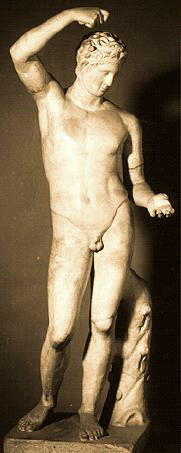
Pouring Satyr, Attributed to Praxiteles. Dresden
Roman period statue of a Satyr who pours from a raised pitcher in his right hand to a drinking vessel in his left hand. Generally considered to be a version of a statue made by Praxiteles around 370 BC.
Marble
Statue
1.49 m
Germany, Dresden, Albertinum und Staatliche Kunstsammlungen, Skulpturensammlung, 100
Roman statue based on an original dated ca.370 BC
Description:The statue depicts a nude young male in the act of pouring. The weight of the body rests over the left leg. The right leg trails slightly behind and the heel of the right foot is raised. The right arm is raised and the forearm is angled toward the left side of the body. The left arm is bent at the elbow and the forearm projects from the body.
The head, featuring short hair, turns towards the left hand. A fillet decorated with leaves runs around the head twice, once across the brow and once nearer to the crown. The hair is short and tousled with distinct locks, some of which escape out from under the fillet across the brow. The ears, uncovered by the hair, are pointed and like those of an animal. The face is oval and the forehead, divided into brow and hair by the fillet, seems excessively high. The eyebrows arch and there is a broad space between them and the upper eyelid. The mouth is small and the chin recedes.
Discussion:The “Pouring Satyr” is generally considered a copy of a work by Praxiteles of the second quarter of the fourth century BC. Recently several American scholars, questioning this attribution, have suggested that it represents a Roman creation.
The motif of an underling pouring a drink generally for his master is common in ancient symposia scenes. The only elements that identify this boy as satyr are the pointy animal ears.
This particular type, used often for fountains in gardens, was popular in the Roman period. It is preserved in at least thirty Roman copies. One should note that the face of the Dresden statue has been much restored (cf. cat.no. C 251) and is better seen in the Palermo statue. Most of the copies have an Italian or western provenance. Strikingly none are from Asia Minor.
The “Pouring Satyr” type was identified by Furtwängler as an early statue by Praxiteles and this identification has mainly been accepted. Both Pliny and Pausanias speak of statues of satyrs made by Praxiteles. Pliny (NH 34.69) notes that a famous (periboetos) statue of a satyr formed part of a group with Dionysos and an image of drunkenness. Pausanias (1.20.1-2) speaks in succession of a statue of a satyr by Praxiteles on the street of Tripods in Athens, of statues of an Eros and a satyr that Praxiteles considered his best works, and of a statue of a satyr and a statue of Dionysos in the Temple of Dionysos; the satyr was a boy holding out a cup and the Dionysos the work of another artist. This latter passage, admittedly unclear, is often accepted to be a reference to the “Pouring Satyr” which is sometimes thought to also to be that “famous satyr” mentioned by Pliny.
Ridgway and Ajootian have argued that the “Pouring Satyr” dates after Praxiteles and the fourth century BC. Ridgway, considering the type to be Hellenistic or Roman, notes that it is too human a satyr for the early fourth century BC and that it resembles the Marathon boy. Ajootian calls it a Roman creation which adopts standard Greek symposium iconography and which is possibly based on two dimensional sculpture of the fourth century BC. She believes that it demonstrates a particularly Roman taste for Dionysian themes.
Julia Lenaghan
Bibliography:P. Herrmann,
Verzeichnis der Antiken Originalbildwerke der Staatlichen Skulpturensammlung zu Dresden (Berlin 1925) p.31 no.100
guide book entryP. Gercke,
Satirn des Praxiteles (1968 1968) pp.1-21 no.2
B. Vierneisel-Schlörb,
Katalog der Skulpturen Band II: Klassische Skulpturen des 5 und 4 Jahrhunderts v. Chr. (Munich 1979) 359-362
discussion of the statues of satyrs attributed to Praxiteles in the literary sources, believes Pausanias in I. 20 is discussing only one statue, the “Pouring Satyr”, which is not the satyr mentioned by PlinyE. Berger,
Der Entwurf des Künstlers: Bildhauerkanon in der Antike und Neuzeit (Basel 1992) pp.128-133 no.28 figs.159-164
notes proportions of the statue as similar to Westmacott Ephebe and Dresden Youth (cat.nos.C 42 and C43)L. Todisco,
Scultura greca del IV secolo (Milan 1993) pp.67-68 no.101
accepts the attribution of the original to Praxiteles and the connection with PraxitelesB. S. Ridgway,
Fourth-Century Styles in Greek Sculpture (London 1997) pp.265-66
questions attribution to Praxiteles, considers the type to be a Roman or Hellenistic creationA. Ajootian,
"Praxiteles", Personal Styles in Greek Sculpture (Cambridge 1998) 110-113
believes that type is a standard motif of the symposium and that the statue type represents a Roman creation, perhaps based on a fourth century relief