Commentary Prepared by Dr. Julia Lenaghan, Ashmolean Museum
C 109
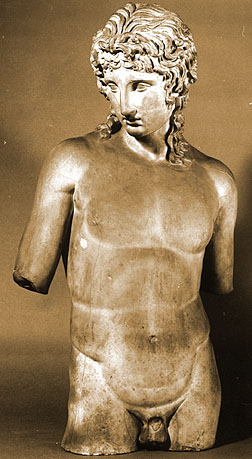
Centocelle Eros. Vatican
Roman period statue of Eros. Probably based on an original of the early fourth century.
Marble
Statue
85 cm
From Rome. Found by Gavin Hamilton under Pope Clement XIV on the Via Labicana in Centocelle.
Italy, Vatican, Galleria delle Statue, 250, inv.769
Preservation:The statue is preserved from the beginning of the thighs upwards. Both arms are missing from just above the elbow down. The preserved ends of the arms have been evened out for restoration. The lower part of the nose and some locks of the hair have been restored. The hair at the back of the head has not been fully worked out. On the back of the torso are two vertical grooves each with a four-corned hole in the upper portion.
Description:The statue depicts a long haired nude youth who turns to the right and looks downward. The body weight rests on the left leg; the left hip projects. Both arms are lowered and the right one moves away from the body further to the right. On the back are grooves for the insertion of additional elements, in this case wings.
The head is distinguished by an elaborate coiffure. The hair is rendered in thick locks many of which end in snail curls that feature drilled centers. The hair falls in three layers. The uppermost layer extends from the top of the head to above the ears; the middle layer from above the ears to below the ears; and the lowermost reaches from behind the ears down the nape and onto the shoulders. Over the center of the brow the hair is knotted together in a Herakles knot. Below the Herakles knot are several small locks which have a center part. On either side of this central part, the locks move in symmetrical patterns. They move away from the part, up, then down, and finally curl into themselves.
The face has an almost oval shape with asymmetrical features. Its widest point is between the cheekbones. The hair leaves very little of the brow uncovered. The lines of the eyebrows continue into the nose, forming the outer lines of the nose. The eyes have a substantial upper lid and there is space between the upper eyelid and the eyebrow. The mouth is particularly small with slightly parted lips. The lower lip projects. The chin is small and round.
Discussion:The Vatican statue of Eros, found in an area of the city of Rome known as Centocelle, gives its name to a series of copies. For stylistic reasons this series is thought to depend on an original of the first half of the fourth century BC. Many scholars consider the original to be a work by Praxiteles.
In 1974 Zanker listed a total of ten full-sized copies of the type and four statuettes that repeated the type. In 1986 Hermary added another five copies. The Vatican statue, though it gives its name to the type, is not the most fully preserved. A first century AD stucco relief from Pompeii, depicting the type, as well as other marble copies, especially a statue in the Farnese Collection of the Naples Museum, allow us to reconstruct a winged Eros, standing about 1.65 m tall, with a bow in the left hand and an arrow in the right hand. The copies vary among themselves and two, a statuette in the Vatican and a statue in the Conservatori, have even been given new attributes, respectively those of Thanatos and Apollo. The Centocelle statue appears more frontally with more accentuated and adult musculature than do other versions. It is said to have a more Polykleitan character than other copies. It has been dated to the late Hadrianic or Antonine period on the basis of technical and stylistic handling, particularly the full rendering of the pectoral section. It is worth noting that most of the datable copies of the type have been assigned to the Hadrianic or Antonine period.
Because it was frequently copied and stylistically relates to the Pouring Satyr (see cat. C 110), Furtwängler thought that the Centocelle type copied a famous Eros made by Praxiteles and discussed by Pausanias (1.20.1) in the same passage as the Pouring Satyr. From Pausasnias (9.27.3), Strabo (9.2.25), and Cicero (VerrII.IV.2.4) we are able to construct a story about this Eros. The statue was supposedly given as a gift by Praxiteles to his mistress Phryne who tricked him into confessing that it was one of his two favorite works. Phyrne dedicated it at Thespiai where there was also a statue of Eros by Lysippos. The Eros of Praxiteles was taken to Rome by a Gaius (possibly Julius Caesar rather than Caligula) , returned to Thespiai by Claudius, and taken back again to Rome by Nero. There it was eventually destroyed in a fire in the Flavian period and a copy was then set up in Thespiai.
Although some scholars consider the type to be a Roman creation, most scholars believe the type to show characteristics of the fourth century BC. There is, however, no real evidence to link it to the Eros of Thespiai. Moreover, those scholars, who consider it to be by Praxiteles, compare it particularly to the Pouring Satyr and the Palatine Eros, neither of which is assuredly by Praxiteles.
Julia Lenaghan
Bibliography:A. Furtwängler,
Masterpieces of Greek Sculpture (Lodon 1895) 314-318
associates the statue with a statue made by Praxiteles and dedicated at ThespiaiW. Amelung,
Die Skulpturen des vaticanischen Museums II (Berlin 1908) 408-413 no.250
catalogue entry, does not see similarities to works by Praxiteles though agrees that it is a second century AD staue based on an original of the fourth century BCW. Helbig (H. von Steuben),
Führer durch die öffentlichen Sammlungen klassicher Altertumer in Rom I(4th ed) (Tübingen 1963) 83 no.116
catalogue entry, believes that the original model dates to the fourth century BC and belongs to the Peloponnesian schoolP. Zanker,
Klassizistische Statuen (Mainz 1974) 108-109 no.11 pl.81.1-2
provides replica list, considers it to be based on a statue of the fourth century BC which has similarities to the Pouring Satyr and Palatine Eros, both cited as by PraxitelesB. Vierneisel-Schlörb,
Katalog der Skulpturen Band II: Klassische Skulpturen des 5 und 4 Jahrhunderts v. Chr. (Munich 1979) 276 footnote 12
gives bibliography and list of opinions, notes that copyists have disguised the true form of the original(A. Hermary),
"Eros" Lexicon Iconographicum Mythologiae Classicae III (Zurich 1986) 862-863 no.79a
as summary statement cites Zanker, adds several other replicas to the listA. Corso,
Prassitele: Fonti epigrafiche e letterarie. Vita e opera I (Rome 1988) 55-58, 66-68, 141-142, 176-178
literary references to and discussion of the Eros of Praxiteles at ThespiaiL. Todisco,
Scultura greca del IV secolo (Milan 1993) 68, 92-93
considers the type to reflect a work possibly by Euphranor, created ca.360-355 BCA. Ajootian,
"Praxiteles", Personal Styles in Greek Sculpture (Cambridge 1998) 113
brief discussion with bibliography