Commentary Prepared by Dr. Julia Lenaghan, Ashmolean Museum
C 107
Lansdowne Herakles. J. Paul Getty Museum
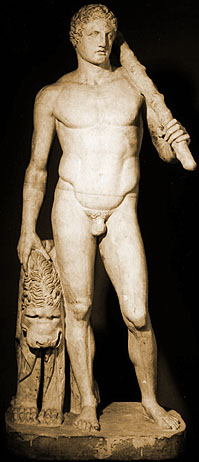
Roman Statue of a nude Herakles who holds a lion skin in the right hand and a club in the left. Possibly based on a fourth century statue.
Marble (Pentelic)
Statue
1.93 m
From Tivoli. Found at Hadrian’s villa in 1790 with a statue of the Diskobolos. The dealer Jenkins sold the Diskobolos (now in the British Museum) to Charles Townley and the Herakles to Lord Lansdowne in 1792 after restorations. In 1951 J. P. Getty purchased the statue at Spink’s in London.
J. Paul Getty Museum, 70.AA.109
Either a Hadrianic Creation or a Hadrianic Version of an Original Dated ca.360 BC
Preservation:The statue was restored in the late 18th c. The Ashmolean cast preserves these restorations. In 1976 it was noticed that the marble was cracking because the internal iron rods were rusting. Thus, the entire statue was taken apart and completely re-restored. Certain 18th century restorations were removed and not replaced during this 20th century restoration. These include the back part of the lion skin, the tip of the nose, both ends of the club, the right thumb, the tip of the left thumb, the second joint of the left index finger, and most of the left pinky finger. In other areas the 18th c marble restorations were replaced with cast shells filled with plastic-like material. These include the missing parts of the right arm and the right wrist, the large chip in the front of the right thigh, the left calf, small chips in the left wrist, the center of the left arm and the left elbow, smaller areas above the back of the right elbow, and areas behind the right knee and leg. The result of the 1976 re-restoration was that the head turns more forcefully to the left.
In addition, the 1976 restoration revealed that the 18th century restoration had tried to de-emphasize the ancient damage, especially on the left side. Areas under the left arm and on the front of the left thighs had been recarved. Both eyes had been recut. The lower lids had been moved downward, the outer corners had been enlarged, and the upper lids has been slightly altered. The ends of the fillet, presumably badly damaged, were removed. The thighs and arms show 18th c. polish.
Description:The statue depicts a clean shaven, short-haired, muscular nude male standing frontally. The weight of the statue rests over the right leg. The right arm hangs down by the side and the right hand holds a lion’s skin, the muzzle of which appears at the height of the knee. The left arm bends at the elbow and the forearm projects outward and upward. The left hand holds on to a club which extends upwards and rests on the left shoulder.
The head turns to its left. The face is round with full cheeks and a strong chin. The forehead is broad and convex with a pronounced central bulge. The eyebrows slope downwards toward the side of the face. Squeezed below the eyebrow, the eyes feature a straight lower lid and a high arching upper lid. The eyes, however, have been tampered with by restorers. The mouth is small with full parted lips, the corners of which turn downward.
The hair is rendered in short unruly locks which spring back off the forehead. The locks acquire volume in the area of the temples. The ears, small and fleshy, are left uncovered by the hair. Over them around the entire head runs a fillet which is knotted at the back of the head.
Discussion:The “Lansdowne Herakles”, because it was found at Hadrian’s villa in Tivoli, is dated to the Hadrianic period. Scholars disagree as to whether this statue of a powerful young Herakles copies an original statue of the fourth century BC or whether it is a Roman period creation.
Although there are no strict replicas of the type, the head is related loosely to numerous other Roman heads of Herakles, which comprise the “Genzano” group (see cat.no.C 218). Raeder cites four of these heads (Naples, Dresden, Florence, and a former art market piece) as copies from the same model and Juri adds one in Thessaloniki. The body of the statue is merely a version of Polykleitos’ Doryphoros (see cat.nos.32-35) A “parastas” relief in Athens and a Kerch style pelike in the Hermitage (dated ca.340-320 BC) both show a similar figure. In the former, however, the figure is reversed and in the latter, the figure lacks the same attributes.
Notwithstanding the lack of replicas, many scholars believe it to be a version of a statue which, they postulate, was made in the second quarter of the fourth century and heavily influenced by Polykleitos. In addition to presenting stylistic arguments, scholars note that Hadrian’s villa featured copies of originals and not pastiches. Frequently, a statue of Herakles made for the gymnasiun in Sikyon by Skopas, mentioned by Pausanias (2.10.1) enters into the discussion. It is shown on 3rd century AD coins and resembles the “Lansdowne Herakles” enough that certain scholars are willing to see the “Lansdowne” as another such work by Skopas.
Other scholars, impressed by the resemblance to the Doryphoros and the numerous loosely related heads, have suggested that the statue is an eclectic Roman invention. Raeder, for instance, believes that the body derives from the Doryphoros and the head derives from a fourth century original.
Julia Lenaghan
Bibliography:S. Lattimore,
"Two Statues of Herakles" (GettyMusJ 2 1975) pp.21-26
considers the statue to be a new creation of the Roman periodA. Stewart,
Skopas of Paros (Park Ridge, NJ 1977) 98-99
considers the statue to be based on a work of Skopas for stylistic reasons, dates the original model to ca.360 BCS. Howard,
The Lansdowne Herakles (Malibu 1978)
good for piece history and conservation, lacking in art historical analysisJ. Raeder,
Die statuarische Ausstattung der Villa Hadriana bei Tivoli (Frankfurt 1983) 53-54
believes the head is a copy of a fourth century original but that the body derives from the DoryphorosO. Palagia,
"Herakles" Lexicon Iconographicum Mythologiae Classicae IV, I (Zurich 1988) 762 and 792 no.659
catalogue entry, considers the statue to copy an original of the second quarter of the fourth century BC which draws on late fifth century Herakles typesE. Juri,
"Neue Kopfreplik des Herakles Lansdowne in Thessaloniki Museum 11516" (AntPl 1988) 31-33 figs.3-11
identifies another copy of the Lansdowne type which is assumed to be a work of the second quarter of the fourth century BCL. Todisco,
Scultura greca del IV secolo (Milan 1993) 101-102 no.201
based on a bronze by Euphranor?, ca.340-330 BC