Commentary Prepared by Dr. Julia Lenaghan, Ashmolean Museum
C 105
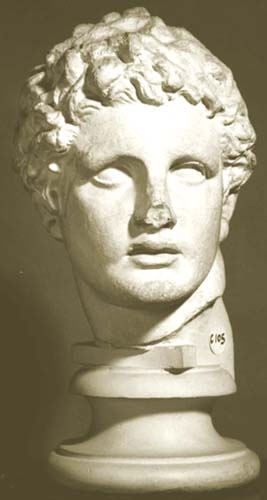
Head in Vatican Meleager type. Villa Medici
Expressive Roman period head depicting a young male hunter. It follows the "Vatican Meleager" type which is based on a model usually dated to the fourth century BC and attributed to the sculptor Skopas.
Marble
Head
29 cm
Italy, Rome, Villa Medici
Roman version of a model dated ca. 330
Preservation:The surface is corroded and heavily weathered. The tip of the nose is missing. The pupil of the right eye was drilled in the modern era but has been stuccoed over.
Description:The head depicts a young clean-shaven male who turns to his left. The modelled brow, heavy hanging eyebrows, and open mouth give the face an expression of pathos.
The face is broad with a high forehead and small features. It reaches its widest point below the eyes at the cheekbones. The brow, completely free of hair, seems extremely tall. It is convex and has significant indentations well above the center of each eyebrow. In addition, there are deepenings, virtually creases, in the area of the temples that are created by the flesh hanging heavily down from above the outer portions of the eyebrows. The eyebrows originate at their inner corners in an arch. Over the middle of the eye, however, they begin to sag downwards, overwhelmed by the heavy bulge of flesh at their outer corners. The outer portion of the upper eyelids is completely covered by this hanging flesh. The eyes are deep set below the eyebrows. The bulge of the eyeball continues below the lower lid, and the flesh deepens under that bulge in correspondence to the eye sockets. The nose is thick and short. The skin dimples around the sides of the nostrils. The mouth has thick open lips, and small diagonal (moving downward and outward) creases form at the outer corners of the mouth. The groove that separates the lips rises, dips, and then rises and falls again. The upper lip has a pronounced triangular dip at the center, and the vertical indentation between the center of the upper lip and the nose is defined. The full lower lip is formed of two small pillows with a dip between them. A shallow groove below the lip indicates the beginning of the chin. The chin is short and broad.
The hair is a rough tousled mass. The short curly locks do not fall on the brow or cover the ears. The locks build on top of each other creating a sense of volume. The individual locks are chunky and not distinctly separated, and within each lock fine engraved lines indicate strands of hair. Over the left eye are two curling locks that run to the right along the hairline. Over the nose and the inner portion of the right eye are locks that rise directly upward and then fall to the right.
Discussion:The Villa Medici head follows a well known type, the so-called “Vatican Meleager” type, which was popular in the Roman period. The type shows a nude young male with a cloak over his shoulders. He stands frontally holding a spear and accompanied by a dog. The type is generally identified as the hunter Meleager and the original model belongs to the late fourth century BC and is commonly attributed to Skopas. For a full discussion on the type and the sculptor, see cat. no. C 104.
The Medici head is one of over thirty extant Roman period copies of the statue body and/or head. It is usually singled out among the copies for its strong emotional quality and rough rendering of the hair. It emphasizes the movement of the brow, the heavily shadowed eyes, and open mouth. Among the copies of the type it bears the closest resemblance to the heads from the pediments of Tegea which were made by Skopas. Scholars, who believe that the “Vatican Meleager” type was created Skopas, thus, conclude that this head most truly reproduces the appearance of the original model. The head, however, does not clearly depict the locks over the brow. Moreover, it is possible that the high emotional pathos of the head may actually be the addition of a Roman copyist and not a true reflection of the original model. Unfortunately little else can be said about the head since there are no details concerning it’s provenance and it is heavily weathered.
Julia Lenaghan
Bibliography:M. Cagiano de Avezedo,
Le antichità di Villa Medici (Rome 1951) 84-85, no. 115, pls. 84-85
catalogue entry, attributes model to Skopas, ca. 340 BCA. Stewart,
Skopas of Paros (Park Ridge, NJ 1977) 106, 143, no. I.13, pls. 44d, 52a-c
entry with bibliography and expression of head discussed in textL. Todisco,
Scultura greca del IV secolo (Milan 1993) 87
emphasizes pathos of head which is cited as characteristic of SkopasC. Rolley,
La sculpture grecque II. La période classique (Paris 1999) 274-275, fig. 278
traditional assessment of type, uses Medici head as evidence for association with Skopas