Commentary Prepared by Dr. Julia Lenaghan, Ashmolean Museum
C 101
"Munich Oil-Pourer". Boston
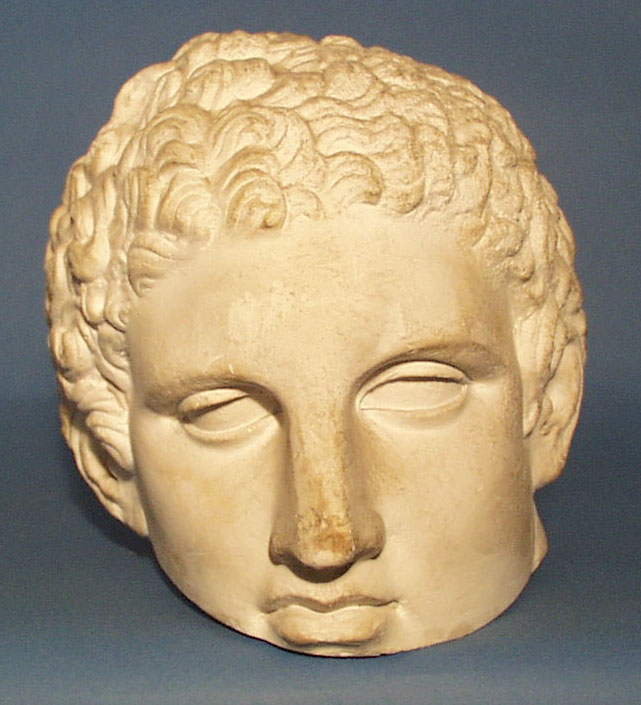
Hellenistic or Roman head depicting a young male athlete. Based on a fourth century statue, known to modern scholars as the "Munich Oil-Pourer", showing an athlete oiling his body.
Marble (Pentelic)
Head
23 cm
From Athens. The head was once part of the E. P. Warren collection.
United States, Boston, Museum of Fine Arts, 04.11
Hellenistic or Roman copy of a fourth century BC model
Preservation:The head is broken horizontally below the mouth. The tip of the nose is chipped and parts of the hair and left side of the face are encrusted.
Description:The head is preserved from its crown to just below the lips. It depicts a short-haired young man. The hair, cut around the ears, has no part and is generally brushed forward. The locks are curly and short; those at the back of the head are slightly longer than those around the brow. The locks, each following a different path, are distinctly defined and separate from each other. Each lock contains several engraved lines that denote individual strands. The surface of the hair is an undulating organic mass. Over the brow, the hairline forms a tidy arch. Most of the central brow locks, beginning above the middle of the right eye, spring upwards and then fall to the left. The right ear has been carefully and deeply drilled out.
The face has a narrow oval form. The forehead is rounded, and the eyebrows are fine sharp lines that are almost horizontal. The eyes are long and set deeply just below the eyebrows. The inner tear ducts are large and separated from the rest of the eyeball by a vertical engraved line. The eyelids are heavy with crisp edges. The nose has a thick flat ridge and a bridge that has a virtually imperceptible indentation. The cheeks are smooth sloping surfaces. The mouth is small from side to side but has full lips. The upper lip has a pronounced central dip and the lower lip protrudes outward, creating a deep indentation above the chin.
Discussion:The Boston head is a finely worked version of the head of the “Munich Oil-Pourer” statue type. That statue type, which shows a young athlete anointing himself with oil, was probably created in the fourth century BC and is discussed fully under the entries for the Munich statue, cat.nos. C 100 and 250. The general motif of the young athlete pouring oil to rub on himself was popular in classical antiquity and is preserved in several different types.
Although there are as many as one statue (Munich) and six recorded torsos of the “Munich Oil-Pourer” type recorded, the Boston head is one of two extant version of the head type—the other being the head on the Munich statue. In comparison to the head of the Munich version, the Boston head is a more virtuouso work; the hair is more carefully rendered, the face fuller and more sensitive, and the eyes larger and more detailed. It seems to transmit the idea of the original model better than the Munich head. It is, therefore, used by scholars who attempt stylistic assessments of the head and facial details. For example, Arnold believes that such deep-set eyes could not possibly belong to the first half of the fourth century. She compares them to the eyes of the Hermes of Olympia and to those of the Sandal-binder.
Because the Boston head is of such high quality, many scholars believe that it must be a copy made in the Hellenistic period. This assumption is unfounded and does disservice to the many fine sculptors working in the Roman period. A good copyist of the Roman period was certainly as capable as a good copyist of the Hellenistic period.
J. Lenaghan
Bibliography:D. Arnold,
Die Polykletnachfolge (Berlin (JdI Erg 25) 1969) 240-245, 272, no. II.2
discussion of Munich Oil-Pourer type, catalogue entry of the Boston that considers it to be Hadrianic version of a late fourth century BC modelC. Vermeule and M. Comstock,
Sculpture in Stone: The Greek, Roman, and Etruscan Collections of the Museum of Fine Arts Boston (Boston 1976) 100, no. 154
catalogue entry that acknowledges head as Hellenistic or Roman version of the Munich Oil-Pourer typeB. Vierneisel-Schlörb,
Katalog der Skulpturen Band II: Klassische Skulpturen des 5 und 4 Jahrhunderts v. Chr. (Munich 1979) 304-308, especially footnote 3
discussion of statue type, considers Boston head to be Hellenistic versionB. S. Ridgway,
Fourth-Century Styles in Greek Sculpture (London 1997) 342-343
brief discussion in English of the statue type, considers type to be based on fourth century model