Commentary Prepared by Dr. Julia Lenaghan, Ashmolean Museum
C 100
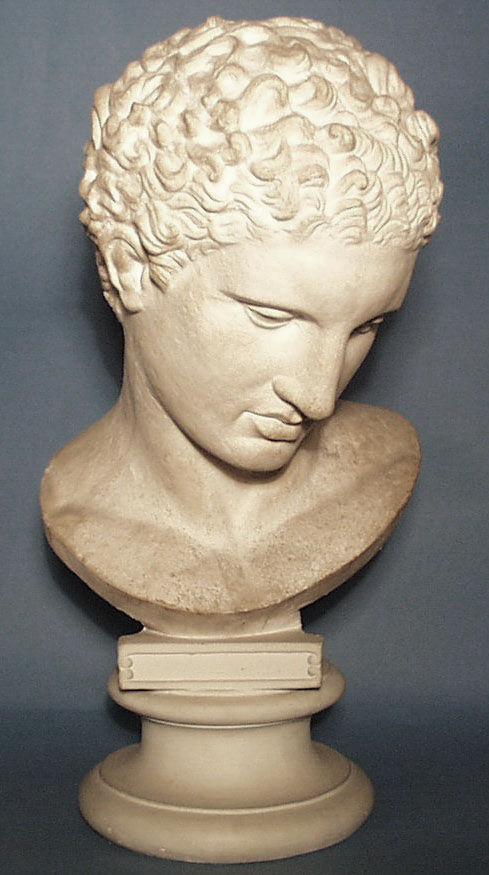
Head of "Munich Oil-pourer" . Munich
Head from a Roman period statue depicting a young male athlete pouring oil to rub over his body, a popular motif in antiquity. The statue is based on a fourth century BC model, now known as the "Munich Oil-Pourer" type.
Marble
Statue
H 1.827 m without plinth, chin to hairline 17.5 cm
From Italy. It was purchased in Rome in 1811 from Thorvaldsen’s friend, Cammuccini, who had much of his collection, including this statue, restored in order to increase its sale value.
Germany, Munich, Glyptothek, 302
Roman (Augustan or Trajanic?) copy of a fourth century statue
Preservation:The entire right arm, the left hand and wrist, part of the right ankle, and the penis were restored. There are chips on the knees, the back, and the tree trunk. The head is entirely intact. The sharp edges of the eyebrows, eyelids, and lips suggest modern reworking. The entire surface of the statue seems to have been acid-washed.
Description:The head shows a short-haired young man who tilts his head down and to its left. The hair is cut around the ears and the base of the skull. It has no part and is brushed forward. The locks are curly and short, though with some variation in length; the locks at the back of the head are longer than those around the brow. Some of the locks, especially about 10 cm back from the hairline, grow upwards and end in snail curls that wind either downwards or upwards. This makes the surface of the hair generally uneven and lumpy. Over the brow, the hairline forms a tidy arch. Most of the central brow locks, beginning above the middle of the right eye, spring upwards and then fall to the left. The right ear has a swollen inner shell that makes it a ‘cauliflower’ ear.
The face has a narrow oval form. The forehead is rounded and features a distinct indentation at the left temple. The eyebrows are fine sharp lines that are almost horizontal. The eyes are small and set just below the eyebrows. The eyelids are heavy. The nose has a thick ridge and a bridge that has a virtually imperceptible indentation. The cheeks are smooth sloping surfaces. There are small, diagonal creases running downwards from the corners of the mouth. The mouth is small from side to side but has full lips. The upper lip has a pronounced central dip and the lower lip protrudes outward, creating a deep indentation above the chin. The chin is broad and rounded.
Discussion:The Munich statue shows a young athlete anointing himself with oil. It is the best preserved example of a type, now known as the Munich Oil-Pourer type, that was probably copied from a statue of the fourth century BC. The general motif of the young athlete pouring oil to rub on himself was popular in classical antiquity and is preserved in other types as well.
The Munich Oil-Pourer stands with its weight on the left leg which bends slightly. The right leg comes forward and turns gently to the right. The torso and the head bend to the left away from raised right arm. The right arm presumably held a small vessel out of which came the oil. The left arm, resting near the body, bends at a 90 degree angle, and the forearm comes across the body; it once received the oil. The body is strong but not heavily muscled. The legs are long, the upper body short, and the head small.
There are seven copies of the Munich Oil-Pourer type. In addition to the Munich statue, these include 1) the head in Boston (cat.no. C 101), 2) a torso found at Side, 3) a torso in Dresden, 4) a torso in the Pitti Palace in Florence, 5) a torso in the Palazzo Mattei in Rome, and 6) a torso in the Giustiniani collection. A torso found in the Antikythera wreck may also belong to the type. Also a Hermes in Dresden seems to use the same body type. The Munich statue is important because it is the only complete version of the type. The Munich version has been dated variously to the Augustan (Arnold) and the Trajanic (Vierneisel-Schlörb) periods.
The type of the Munich Oil-Pourer presents two interesting problems. First is an issue that has concerned scholars for over a century, that is, the date of the original statue from which the Munich Oil-Pourer type derives. Different scholars have placed it at different points in the fourth century; it has been dated 400-390 BC (Süsserott), around 375 BC (Schrader, Wege) , around 365 BC (Dohrn), in the early 350s BC (Vierneisel-Schlörb and Todisco) and 330 BC (Arnold and Linfert). The real problem is that so many of the statues to which the type has been compared, the “Ephesus Scraper” (cat.no. C 102) or the Antikythera youth, are without fixed chronological dates. The “Ephesus Scraper”, for instance, has been placed both around 360 BC and around 310 BC. This same controversy occurs in regard to the Munich Oil-Pourer type. There are scholars who see it as stylistically related to the Praxitelean Pouring Satyr (cat.no. C 110) or “Naukydes’ Diskobolos” (cat.no. C 97-98) and, consequently place the statue in the first half of the fourth century. Other scholars believe that it has greater stylistic affinities to the figures of the Delphi Daochos group (cat.no. B 102-103), Lysippus’ Apoxyomenos (cat.no. C 133) or the Sandal-Binder (cat.no. C 136); they, therefore date the type ca. 330 BC. Interestingly the focus of attention of all the scholars generally falls on the same details: the stance, the proportions, the eyes, and the hair.
Another problem concerning the “Munich Oil-Pourer” type is that there are at least three other types that depict this same pose and the relationship between these types is not entirely clear. These types are known as the “Petworth”, “Pitti” (or Florence), and “Turin-Braccio Nuovo Oil-Pourer” types. The traditional point of view (expressed by Todisco) places all of the original models for these types between 420 BC and 350 BC: that is, the “Petworth”, seen as most closely related to Polykleitos, ca. 420-410 BC; the “Pitti”, most closely related to “Naukydes’ Diskobolos”, ca. 400-375 BC; and the “Turin-Braccio Nuovo”, ca. 375-350 BC. Zanker (Klassizistische Statuen), however, believes the “Petworth” type to be a classicizing creation of ca. 200-150 BC and most scholars have accepted this. Some scholars suggest that the “Turin-Braccio Nuovo” type is also a classicizing version of the general format. The suggestion leaves only the “Pitti” and “Munich Oil-Pourer” types as original creations of the fourth century. Although this seems most acceptable on grounds of style and logical reasoning, there is no way to prove it. Certainly the significant number of Oil-Pourer types and their copies indicates that it was a popular theme that sculptors in different chronological periods attempted to improve.
J. Lenaghan.
Bibliography:D. Arnold,
Die Polykletnachfolge (Berlin (JdI Erg 25) 1969) 240-245, 271-273, no. II.1
discussion that concludes statue type is stylistically similar to ‘Lysippan’ works, considers Munich statue to be an Augustan versionJ. Inan,
Roman Sculpture in Side (Ankara 1975) 72-73, no. 20
publication of newly identified torso of the type, accepts traditional date of ca. 350 for original typeB. Vierneisel-Schlörb,
Katalog der Skulpturen Band II: Klassische Skulpturen des 5 und 4 Jahrhunderts v. Chr. (Munich 1979) 304-308, no.29, figs. 144-153
catalogue entry, considers statue to be a possibly Trajanic copy of an original of the early 350s BCA. Linfert,
"Die Schule des Polyklet" in Polyklet: Der Bildhauer der griechischen Klassik (Mainz am Rhein 1990) 280
following Arnold assigns Munich Oil-Pourer to school of LysippusL. Todisco,
Scultura greca del IV secolo (Milan 1993) 54, no. 63
accepts Vierneisel-Schlörb’s assessmentB. S. Ridgway,
Fourth-Century Styles in Greek Sculpture (London 1997) 342-342
considers Munich type to be based on fourth century model