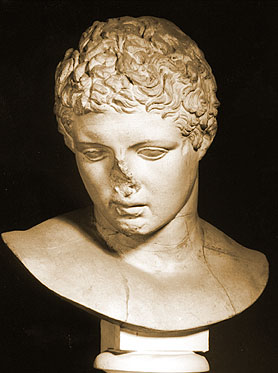
Head of a discus thrower.
Commentary Prepared by Dr. Julia Lenaghan, Ashmolean Museum
C 098
Head of ‘Diskobolos by Naukydes’. Capitoline
First century (possibly Flavian) head belonging to fragmentary statue that depicts an athlete about to throw a discus. Based on a statue probably created ca. 400 BC and attributed to Naukydes.
Marble
Statue
H (total preserved) 1.18 m, head H 22-24 cm
From Rome. Found in 1910 during work on a gas pipe in Via della Bocca della Verità at the intersection of Via Bucimazza. The fragments were built into a late antique wall (just below the modern ground level) in the area of an older portico. Fragments from a cuirassed statue and the ‘Pothos’ of Skopas were found at the same time.
Italy, Rome, Museo Capitolino, 1865
First century statue (Flavian) based on an original dated ca. 400 BC.
Preservation:Six (according to Mariani) or five fragments of the complete statue were found. Together they make up the greater part of the statue from head to knee. The head and throat do not directly join any of the other pieces. On the head and throat fragment, the end of the nose is missing and the lips and chin are chipped. There are small nicks on the brow and ears. The neck is broken diagonally; more of it is preserved on the left side.
Description:The head depicts a clean-shaven young man with a cap of short thick hair and full oval face. The hair, the surface of which is uneven and constantly moving, is cut around the ears and neatly follows the arched upper edge of the brow. In the arch over the brow, the individual locks of hair variously come forward, spring upwards, or are brushed gently back. For instance, the central locks and those immediately to the right of center spring up from the hairline, before falling to the right; the locks over the left eye are brushed forward on the brow; and the locks over the outer corner of the right eye are pushed slightly back. Regardless of the direction that the individual locks take, the even arch of the hairline is maintained. The hair is rendered carefully in undulating locks with finely defined strands around the brow and ears and at the nape of the neck. Towards the top of the skull, the locks are more impressionistically rendered and have greater volume; this gives the dome of the head a tall and round shape.
The forehead is broad and its lower half bulges. The eyebrows are fine, low arching lines. The space of the orbital, the area between the eyebrow and upper lid, is a relatively tall and flat surface. Both the lower and upper eye lids are projecting edges. The eyes themselves have distinctly defined inner tear ducts, and the surface of the eyeball is flat. The cheeks are smooth and long. The mouth features large full lips that are parted. Below the lower lip is an indentation before the projection of the solid but short chin.
The head tucks into the neck and tilts downwards to its right. The relationship between the chin and the neck, especially the lack of depth, and the crease on the right side of the neck, indicate this.
Discussion:The Capitoline statue follows a well known type that shows a young man getting ready to throw a discus. In the early nineteenth century Visconti identified the type as the discus-holder (‘diskobolos’ or ‘diskophoros’) made by the sculptor Naukydes who flourished ca. 400-396 BC. This identification is mainly upheld since the statue is certainly an athlete with a discus and the original model seems for stylistic reasons to have been created around 400 BC. For a full discussion of the type and Naukydes, see cat. no. C 97.
The statue, now in the Capitoline, was found in 1910 in the center of Rome in several large fragments. When it was found in 1910, it was of great importance for the knowledge of the type. It proved decisively that the head on the Vatican statue (cat. no. C 97) was not the head of the original model since the Capitoline head clearly belonged to the discus-holder body with which it was found and because the Capitoline head type was known in other replicas. This head type showed a fuller-faced, younger, and more energetic countenance with unrulier, more dynamic hair. Even though the head and neck fragment could not be attached directly to the body fragments, it seemed clear that the head of the original model looked downwards and to the right. All of these points were confirmed by the find of the head and body fragments of the same type at Perge in 1979.
In regard to the other replicas of the type, the head stands out. It is the most finely and carefully worked; the locks of hair, for instance, attest to this. Bol believes that the body of the Capitoline statue, that of the Louvre version, and that of the Liebieghaus version to be very chronologically and stylistically close; he places all of them in the Flavian period and suggests that, if they did not differ in details such as struts and supports, they could conceivably even have been made in the same workshop.
Julia Lenaghan
Bibliography:L. Mariani,
"Di un altro esemplare dell’atleta ‘diskophoros'" (BullCom 39 1911) 97-119, pls. 6-8
first publication with record of find, establishes that the head on the Vatican statue does not belongD. Mustilli,
Il Museo Mussolini (Rome 1939) 115-116, no. 4, pl. 73
proper catalogue entry with replica listW. Helbig (H. von Steuben),
Führer durch die öffentlichen Sammlungen klassischer Altertumer in Rom II (4th edition) (Tübingen 1966) 535, no. 1759
very brief summary entry that accepts attribution to NaukydesL. Todisco,
Scultura greca del IV secolo (Milan 1993) 53, no. 47
traditional assessment of the statue with bibliography and photographP.C. Bol,
Der antredende Diskobol (Mainz am Rhein 1996) 55-56, 114-115, no. 3, figs. 46-48 and 63
most recent catalogue entry with bibliography,also full discussion of typeB. S. Ridgway,
Fourth-Century Styles in Greek Sculpture (London 1997) 243-244
without knowledge of Bol, considers the type to be an impessive work of the first quarter of the fourth century BC and there to be only one Naukydes