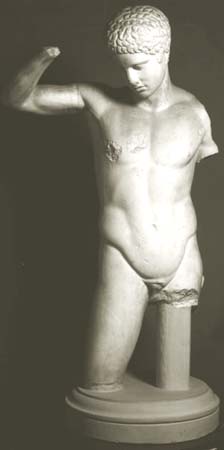
Athlete, probably placing a wreath on his head.
Commentary Prepared by Dr. Julia Lenaghan, Ashmolean Museum
C 096
Barracco Version (Variant or Copy) of the "Westmacott Ephebe". Barracco, Rome
Marble
Statue
98 cm
Acquired in Rome.
Italy, Rome, Museo Barracco, 99
Preservation:The left arm from the middle of the upper arm down, the left leg from the top of the thigh down, the right wrist and hand, and the right leg from just above the knee down are missing. Over the area of the right pectoral are two large break surfaces. The end of the nose is abraded.
Description:The statue depicts a naked youth whose weight rests over his left leg. The left hip is higher than the right hip and projects outward. The left shoulder is, however, lowered and the arms seems to have rested by the side of the body. There is a rectangular break surface, indicating a strut, on the outer side of the upper left thigh; this strut probably supported the left hand. The right shoulder is raised and the right upper arm extends, parallel to the ground, to the right of the body. The right forearm is raised and moves back toward the body; it forms a 45 degree angle with the upper arm. The head is turned to the right and inclined downward. The body is lean but without indication of developed muscle or pubic hair. The linea alba curves gently with both ends (near the neck and near the navel) to the left of center.
The head has a flat cranium and a long full oval face. The cheeks are full and end in a strong square chin. The forehead is high; the eyes are open; and the lips are well defined. The lower lip projects out further than the upper lip.
The hair is rendered in layers of short tufts. These tufts originate at the crown of the head in a vaguely “starfish” pattern. The hair crosses the brow in a triangular path that peaks at the center where there is a part. The ears are uncovered. At the back of the head the hair crosses the nape in a crisp horizontal path.
Discussion:The statue is based on a type known as the “Westmacott Ephebe”, named after a statue in the British Museum (see cat.no.C 42). There is some scholarly debate over whether this statue in the Museo Barracco represents an imperial adaptation of the original Classical model or whether it is actually a better copy of the original model than other copies.
Zanker believed on the basis of several observations that the Barracco statue was a free interpretation of the model. For instance, the head tilts significantly further downward than the standard “Westmacott Ephebe” copies, the body is slimmer, details like the almost grimacing mouth are individual, and above all the configuration and style of rendering of the hair is unique.
Several years later among the casts found at Baiae were fragments of a statue of a youth which seemed to Landwehr to correspond on account of size, stance, and style to the “Westmacott Ephebe”. These fragments constitute a statue which is slimmer and less muscular than the copies of the “Westmacott Ephebe” which are traditionally considered to follow the model tightly. The cast fragments, therefore, correspond better to the Barracco version. Moreover, the fragment of a right hand seemed to fit perfectly the Barracco statue perfectly. This led Landwehr to conclude that the Barracco statue was not an imperial variation but, in fact, a better copy of the original than those copies previously believed to be good copies.
Zanker has dated the Barracco statue to the Neronian to Flavian period primarily on account of the rendering of the hair. Although previous to Zanker’s assessment Arndt had placed it in the first century BC and Lauter in the Antonine period, scholars after Zanker have accepted his dating.
Bibliography:W. Helbig (H. von Steuben),
Führer durch die öffentlichen Sammlungen klassischer Altertumer in Rom II (4th edition) (Tübingen 1966) pp.645-646 no.1895
catalogue entry which still associates the "Westmacott Ephebe" with a statue of Kynsikos at OlympiaP. Zanker,
Klassizistische Statuen (Mainz 1974) pp.22-23 pls.21.4; 22.3-6; 26.2, 5, 9
right arm important for restoration of the "Westmacott Ephebe", dates to the Neronian-Flavian period, and considers it to be an imperial adaptation of the original modelC. Landwehr,
Die antiken Gypsabgüsse aus Baiae (Berlin 1985) p.95 C and pp.99-100
compares cast fragments from Baiae to the copies of the "Westmacott Ephebe", decides that the Barracco copy is closer to the original than the other copies, believes Zanker's assessment to be incorrectA. Linfert,
"Aus Anlass neuer Repliken des Westmacottschen Epheben und des Dresdener Knaben" in Polyklet-Forschungen (Berlin 1993) p.156 no.3
cites statue in complete replica list of the "Westmacott Ephebe" with a note that is "re-styled"B. S. Ridgway,
"Paene ad Exemplum: Polykleitos' Other Works" in Polykleitos, the Doryphoros, and Tradition (Wisconsin 1995) p.179
comments briefly on Landwehr's ideas, notes that the Barracco copy, the smallest of the copies, is still bigger than the Baiae cast