Commentary Prepared by Dr. Julia Lenaghan, Ashmolean Museum
C 093
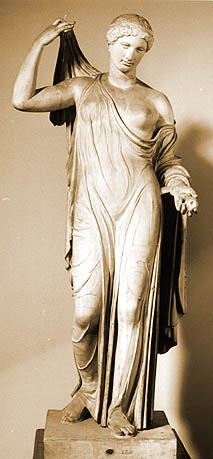
Statue in the Type called "Venus Genetrix", "Louvre-Naples Aphrodite", or "Fréjus". Louvre
Marble
Statue
1.65 m
Though supposedly from Fréjus, the statue probably comes from the Naples area.
France, Paris, Louvre, 525
Roman copy of an original dated to the end of the Fifth Century BC
Preservation:Modern restorations include the neck, the fingers of the right hand (except perhaps for the thumb) and the adjoining part of the himation, the entire left hand, the upper border of the chiton at the front of the body, part of the bottom of the chiton near the left instep, and most of the plinth. The bottom of the himation has been almost entirely broken away. The face and the body have been worked over by a modern restorer.
Description:The statue depicts a female in a transparent inner garment (chiton). The figure, though holding a a heavier garment (himation) which falls behind its back, appears frontally to the viewer in only a chiton. The tunica is of a thin but abundant material which leaves the left breast bare and, clinging to the skin, outlines the shape of the body. It comes together from the sides at the pubic triangle and falls in straight vertical folds down between the legs. The heavier himation, draped behind the back, is held above the right shoulder by the right arm. On the left side of the body, it is wrapped around the left arm from which its excess material falls.
The weight of the statue rests on the left leg; the right leg is bent and slightly backward. The left hip projects. The feet are narrowly spaced and the soles of the sandals but not the straps are depicted. The left arm makes a 90 degree angle; the upper arm is held next to the body and the forearm projects perpendicularly from the body. There is a trace of a strut between the left hip and the left wrist. The right arm is raised and reaches toward the head. The head turns downward toward the outstretched left arm.
The head features long wavy hair that is parted in the center. A flat band runs around the head at the height of the ears. It separates the hair framing the face which is pulled neatly back around the ears from the hair along the central part at the crown of the head. At the back of the head the hair is collected, rolled into itself, and wrapped in a scarf. The individual locks have volume and do not follow always the same path. The lobes of the uncovered ears are flat and have holes for the attachment of earrings.
The face is round, short, and broad. The brow curves outward between the temples. The eyebrows appear to slope downwards. The eyes themselves are narrowly spaced and their outer corners are far from the outer perimeter of the face. Both the upper and lower lids are heavy. In both eyes there is a drill hole at the outer corner. The projecting lips are divided by a thick groove which rises at the outer corners and ends at those corners in noticeable drill holes. The upper lip has a central dip and below the center of the lower lip is an indentation. The chin is round and broad and features a slight dimple in the middle.
Discussion:The statue in the Louvre copies an original bronze statue. There are numerous copies and variations of the type. The copies and variations fall into three rubrics; those which copy the original faithfully, those in which the exposed left breast of the original is covered, and those where a belt is added around the torso. The Louvre statue is generally considered to be the best rendition of the first category, that which includes the true copies, and to have been made in the Augustan period.
Another well known copy is in Naples and for this reason the type is now preferably referred to as the “Louvre-Naples Aphrodite.” It has also been called the “Fréjus” type after the supposed find spot, now considered incorrect, of the Louvre statue. Frequently, however, it is dubbed the “Venus Genetrix” in reference to a statue made by Arkesilaos for the Temple of Gens Iulia in the Forum of Casear in Rome (Pliny NH 35.156). This incorrect association between the “Louvre-Naples” type and the Venus Genetrix statue was the result of Hadrianic coins which featured the type with the legend VENERI GENETRICI. Trajan’s restoration of the Forum of Caesar in AD 113 is thought to have triggered the Hadrianic interest in the statue. Yet, it has been pointed out that this same Venus type appears on coins with legends such as VENERI AUGUSTAE, VENUS FELIX, VENERI VICTRICI, and VENUS. Thus, the type is best called the “Louvre-Naples” type.
The original statue from which the type derives certainly represented Aphrodite. The transparent chiton, the uncovered left breast, and coins with the legend Venus and a depiction of the type assure this identification. In addition, the act of taking the himation off has been associated with marriage. Furthermore, although the hands of the Louvre are restoration, terracotta and coin renditions of the type show the left hand putting forward of a apple or pomegranate. This gesture and the fruit without doubt suggest fertility.
There is no complete modern replica list of the type. It, however, exists in numerous copies on different scales and in different media. In addition, the variation of the type in which the left breast was covered was frequently used for portrait statues during the Empire. The number of renditions of the type leads one to assume that it was a famous statue by a famous artist in a well-known place. This assumption has led to attributions that range from Pheidias to Praxiteles. Recently many accept Fuch’s proposal that the original was a work by Kallimachos. Since, however, we have no secure preserved works by this artist for comparison, we have no reason whatsoever to accept such an unfounded attribution.
The original statue is generally thought to have been located in Athens, since 1) small scale copies of the type were found on the Akropolis, 2) two Athenian reliefs show similarly depicted Nymphs, 3) the motif appears in Attic vase painting at the end of the fifth century, and 4) there seems to be a late fifth century replica of the type in Athens. Some, however, argue that it may have come from elsewhere in Greece and point to Severan coins from Trezene which feature the type.
For stylistic reasons all scholars are generally agreed that the statue dates to the last two decades of the fifth century. All also accept that it features a fundamentally Polykleitan structure with an ornamental surface decoration. This has led to disputes about its peloponnesian as opposed to attic character. For instance, Karanastassis is adamant that the work does not compare well to any sculpture in Athens. Fuchs’ attribution to Kallimachos is mainly based on a similarity that he sees between the statue type and meanads and Kalathiskos dancers in relief on two round bases. Harrison in class has compared the vertical folds bunched between the legs and the stance of the figure to the “Sciarra-Lansdowne-Berlin Amazon” type.
The type was without question beloved in the Roman period and given the evidence for it in Athens, one assumes that the original stood in Athens. Stylistic and, therefore, less secure arguments concerning its Attic or Peloponnesian workmanship, such as that of Karanastassis, or its author, such as that of Fuchs, are entirely unprovable and not useful. Whatever the workmanship, the statue was likely erected in the last quarter of the fifth century in Athens and it set a standard for all later statues of Aphrodite.
Bibliography:W. Klein,
Praxiteles (Leipzig 1898) pp.53-55
establishes a tripartite categorization of the type which is still usefulW. Fuchs,
"Zum Aphrodite-Typus Louvre-Neapel und seinen neuattischen Umbildungen" Neue Beiträge zur klassischen altertumswissenschaft. Festschrift zum 60. Geburtstag von Bernhard Schweitzer (Stuttgart 1954) pp.206-217
assigns work to Kallimachos and dates ca.415 BCE. La Rocca,
"Una testa femminile nel Museo Nuovo dei Conservatori e l'Afrodite Louvre Napoli" (AnnAtSc 50-51 1972) pp.430-441
discusses type in conjunction with small head in Conservatori, suggests that it would be wise to avoid attribution to virtually unknown KallimachosA. Delivorrias,
"Aphrodite" Lexicon Iconographicum Mythologiae Classicae II (Zurich 1984) pp.34-35 no.225
discussion of type with bibliographyP. Karanastassis,
"Untersuchungen zur kaiserzeitlichen Plastik in Griechenland: Kopien, Varianten, und Umbildungen nach Aphroditen-Typen des 5 Jhs. v. Chr" (AM 101 1986) pp.211-216 pls.46.1, 47.1, 48.1-2
argues against the attribution to Kallimachos and that the statue was an Attic work