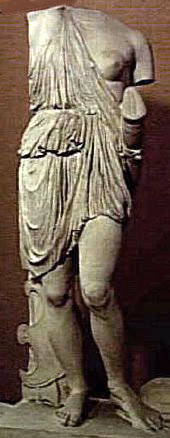
Commentary Prepared by Dr. Julia Lenaghan, Ashmolean Museum
C 089
Mattei Amazon. Vatican
Marble
Statue
2.11 m
From Italy. Found in Rome on the Caelian hill in Rome. The statue was in the Mattei collection from 1614 until it was purchased by the Vatican.
Italy, Vatican, Galleria delle Statue, 748
Preservation:The head in the “Capitoline” (or “Sosikles” type) does not belong with the body and has been removed from the cast. The neck area is all restoration. Other restorations include both of the lower legs from knee to ankle, the upper area of the support, the arms, and the crest of the helmet. This latter element has also been removed in the cast.
Description:The statue depicts a wounded woman dressed in a short chiton. The left breast is exposed and she carries a quiver.
The chiton is fastened only on the right shoulder. Because it is not pinned on the left shoulder, the upper border of the chiton falls diagonally across the body from the right shoulder to the left hip. At the left hip it provides almost a cushion on which a quiver rests. The chiton is belted twice. One belt, visible especially on the right side, wraps around the waist. Although the second belt, perhaps below the first, is not visible, its presence is assured by the kolpos (material that blouses over a belt) which crosses the body just below the hips on the right side. Below the kolpos the remaining material of the chiton hangs down to the knee of the right leg. On the left side, the end of the chiton has been pulled up and tucked under the first belt. Thus, on the left side the chiton reaches only the middle of the thigh and part of the kolpos is concealed. The chiton is rendered with closely packed folds that have little volume and are without strong paths. The kolpos, for instance, is so flat that one does not realize that it is essentially a fold and not an end of material. Moreover, where the pulled up bottom border conceals the kolpos, there is no indication of superimposed layers of material. The folds over the legs, with the exception of the large looping folds on the right leg, all waver.
The statue stands with its weight over the right leg; the right foot rests flat on the ground. Behind the right leg is support which features an axe and a pelta-shaped shield (both are restorations). The bent left leg is slightly raised and a pace in front of the right. The left foot turns outwards to the left. Only the ball of the foot and the toes touch the ground. On the left ankle is a strap with a buckle. On the ground near the left foot is a helmet.
The right arm of the statue was raised and the left lowered. They can be reconstructed on the basis of other statues in the type. The right upper arm reached upwards and the forearm moved slightly back and to the side. The left arm, both upper and forearm, were lowered but moved away from the body.
Discussion:This statue depicts an amazon. It belongs to a type named the “Mattei Amazon” after this statue. The type is known in a total of nine statues (Capitoline, the Vatican statue under discussion here, Petworth, a small scale basalt statue in Turin, Trier, Tivoli, a small scale statue in Palazzo Corsini in Florence, fragments from the Athenian Agora, and fragments of a cast in Baiae). Three other representations are also important to the discussion of the type although they cannot be definitively connected with the type. A relief pillar from the Villa of Herodes Atticus in Loukou is thought by most scholars to be based on the type. A gem, which was drawn by Natter in the 17th century, appears to feature the type; it, however, is now lost. Finally, a relief head from Ephesos, whence came several other relief depictions of the Amazons, features the same head type as that on the Petworth “Mattei Amazon.” Yet there is much debate as to whether the Petworth head originally joined that statue (see below.) In comparison with the other examples, the Mattei statue is neither of the finest quality nor the most fully preserved. Its is, therefore, generally not discussed for its individual merits.
The reconstruction of the original statue encounters two problems. The first concerns the action of the arms and the second the head. Weber initially reconstructed the statue with a long bow held between the hands. This has been mainly dismissed since the hands are too far apart for even the largest bow and, the Natter gem shows the type with a spear. A lance or spear or any cylindrical pole-like object is almost certainly correct. Since the Tivoli statue shows a wound on the upper left thigh, scholars have generally thought that the statue is support itself by means of the pole-like object. Yet, none of these scholars seems to have explored why only the Tivoli statue shows the wound, why the wounded leg would be in front of the good leg if the statue were using the pole as a crutch, and why the upper body does not fall even slightly forward. Harrison has suggested that the original was actually poling a boat. This interpretation at least accounts for the advanced non-weight (wounded?) leg and the upward and backward motion of the upper body.
The head type of the original statue also remains a mystery. Only the Petworth copy preserves a head and that head, according to many scholars, did not belong originally on the body. It is a head type that resembles in face and hairstyle the head types of the “Sciarra/Lansdowne/Berlin Amazon” and the “Capitoline Amazon”; it is known in a small-scale copy from Ephesos which is now in the Milles collection; and it belongs stylistically to the first quarter of the fourth century BCE. Initially Michaelis thought the Petworth head belonged to the body; Furtwangler, however, argued that the head was of a different marble and the neck muscles did not correspond; Weber then reverted to Michaelis initial assessment; and finally Bol reasserts Furtwangler’s position. That there is so much confusion suggests either that a restorer before 1750 did a remarkable job or that the head does belong. In favor of this latter point are the organic break line, the size of the head which is larger than the other Amazon types and corresponds to the “Mattei” body type which is also larger than the other Amazon types, the Milles copy from Ephesos where a similar small copy of the “Capitoline” head type was found, and the fact that Furtwangler’s observations may have been influenced by his argument. He thought that this amazon must be Pheidian and must belong with the Amazon head type that he deemed to be Pheidian (see cat. C 90). This combination of head and body, however, has been definitively rejected.
Floren has recently reintroduced an argument made previously by Arndt. Arndt, who, like Furtwangler, thought the original head must have turned to the left, proposed that another head type, the “Abbati-Petworth” type, was really the original head type. This type is known in five replicas (Petworth, formerly at the art dealer Abbati in Rome, Trier, New York, Palazzo Riccardi in Florence); Floren also connects it to a fragment of a cast at Baiae. The head features short curly hair and a fillet that wraps around the head twice. According to Floren, it is definitively a female head because of the Venus rings on the neck and that it is securely fifth century and has many similarities to works of Pheidias. Ironically part of his argument that the head must have turned to the left derives in part from the Natter gem. Yet the Natter gem certainly does not show a curly-headed type.
Another flaw in Floren’s argument concerns the Loukou pillar. This pillar relief portrays an amazon in a short chiton with the left breast bared. The weight is on the right leg and the right arm appears to be raised. Thus, scholars (Weber and Bol) have assumed that it reproduces the “Mattei” type. Yet, Harrison has astutely pointed out that the drapery, not only stylistically but also in the way it is worn, as well as the stance differs from the “Mattei” type. Thus, either the relief is based on a different model (as Harrison would have it, see cat. C 90) or the relief is a loose variant of the type. It is best omitted from any attempt to reconstruct the “Mattei” type. Floren, however, mentions it as further evidence for the left turn of the head. This certainly does not help his argument since the head represented in the pillar has long hair combed back from a central part and in no way relates to the “Petworth-Abbati” head type.
The “Mattei Amazon” type itself is rarely ever discussed without considering two related and more common amazon statue types, the “Sciarra/Lansdowne/Berlin” (cat. C 86) and the “Capitoline” or “Sosikles” types (cat. C 87) as well as the “Herculaneum Amazon” head type (cat. C 90). The discussion of these statues of Amazons begins with a passage in Pliny the Elder (NH 34.19.53) which reads as follows:
The most celebrated [artists of all time] came into competition with each other, even though born in different eras, because they had made statues of the Amazons. When these were dedicated in the Temple of Diana at Ephesos, it was agreed that the most skillful one be chosen by vote of those who were present. It emerged that this would be the one that each artist judged second to his own. The first was that of Polykleitos, the second that of Pheidias, the third Kresilas’, the fourth Kydonis’, and the fifth Phradmon’s.
Since the “Mattei”, “Sciarra/Lansdowne/Berlin”, and “Capitoline” types represent three often copied Greek statues of amazons, scholars have without hesitation related them to the first three artists mentioned by Pliny. For these scholars, the only question was really which type should be attributed to Polykleitos, Pheidias, and Kresilas. For more on this see cat. C 86.
The “Mattei Amazon” type has generally been assigned without ado to Pheidias. The basis for this was a comment made in Lucian’s Eikones 4; the speaker lists among statues of Pheidias, an Amazon ????????????????????????? (an Amazon leaning on a small spear). The “Capitoline Amazon”, even after proper reconstruction showed that it leaned on a spear, was never considered even potentially Pheidian since it blatantly featured a Polykleitan stance and contrapposto.
Only Weber, Ridgway, and Harrison have diverged from the opinion. Weber assigns the “Mattei” type to Kresilas on the basis of other works that are only tentatively to be associated with that artist, to whom the only securely attributable work is the portrait of Perikles. Ridgway rules out Pheidias because she considers the type to belong the end of the fourth century on account primarily of its active three-dimensionality. She believes that Alexander the Great set it up when he captured Ephesos in 334 BC. Harrison, like Ridgway, follows Michaelis, in believing that the statue type post-dates the mid fifth century. She concludes that the type has much in common with the pedimental and other sculpture from the area of the Temple of Asklepios at Epidauros. The high raised right arm and the long flat diagonal line from the right shoulder to the left hip appear on the acroteria, the pedimental figures of the Amazons, as well as the “Hygieia” and the Leda. The cast at Baiae, which gives the best possible idea of the original style of the drapery, appears with the same naturalistic rendering as seen in Epidauros. Harrison finally points out that the head on the Petworth “Mattei” copy also appropriately shows trends of the early fourth century. She would thus date the type to about 370 BC and consider the “Petworth-Milles” head type to be the original head type.
In conclusion, the “Mattei Amazon” type is the less frequently copied than the “Capitoline” or the “Sciarra/Lansdowne/Berlin”. What exactly it is doing, supporting itself with a spear or poling a boat, is unclear. The position of the legs and the movement of the upper body seem to argue against the first which would be the conceptually easier interpretation. The original head type and the turn of the head also must remain open issues. The “Petworth-Abbati” head solution is aesthetically undesirable and there are no parallel examples in sculpture of such a short curly haired amazon. The “Petworth-Milles” type appears appropriate but may not belong. Apart from the fact that Pliny lists three artists and we have three amazon types, there appears no good reason to assign the type to any particular artist. In fact, Harrison’s comparisons with the Epidauros sculpture are compelling and if the “Mattei-Milles” head does belong with the type, it would be extremely tempting to date the statue to the early fourth century. This does not completely deny Pliny’s story but merely suggests one reconsider how such a story might have evolved and the effects of such famous statues on artists of the following generations.
Bibliography:W. Helbig (H. von Steuben),
Führer durch die öffentlichen Sammlungen klassischer Altertumer in Rom II (4th edition) (Tübingen 1966) pp.92-94 no.126
considers the "Mattei Amazon" type to be PheidianB. S. Ridgway,
"A Story of Five Amazons" (AJA 78 1974) pp.1-117, especially 5-6
likens the "Mattei" type to late fourth century statues and thinks it was a dedication by Alexander the GreatM. Weber,
"Die Amazonen von Ephesos" (JdI 91 1976) pp.56-57, 63-76, 88-89
replica list of the type, considers the type to represent the amazon of KresilasM. Weber,
"Der Kopf der Amazone Mattei: Ein Nachtrag" (JdI 91 1976) pp.175-183
believes the heade of the Petworth "Mattei Amazon" to be the original head of the typeE. Schroter,
"Ein Zeichnungskabinett im Palazzo Mattei di Giove im Rom" Antikensammlungen in 18 Jahrhundert (Berlin 1981) p.38 footnote 17
notes that the Vatican statue was found on the Caelian hill and had been in the Mattei since 1614E. Harrison,
"Two Pheidian Heads: Nike and Amazon" The Eye of Greece: Studies in the Art of Athens (Cambridge 1982) pp.66-76
considers the type to be based on an original of ca.370 BC and to post-date the amazons of Polykleitos and PheidiasM. Weber,
"Die Amazonen von Ephesos II" (JdI 99 1984) pp.108-109
updates replica listR. Bol,
"Die Amazone des Polyklet" Polyklet: Der Bildhauer der griechischen Klassik (Mainz am Rhein 1990) pp.218-222
argues against Weber's reconstruction with a bow and the pertinence of the Petworth head, considers the statue to be of either Pheidias or Kresilas, whoever was youngerJ. Floren,
"Die Amazone des Phidias" Mousikos Aner: Festschrift fur Max Wegner zum 90. Geburtstag (Bonn 1992) pp.119-141
full discussion of the "Mattei" type, considers it Pheidian, argues (as Arndt) that the "Petworth-Abbati" head type is the proper head for the typeW. Fuchs,
Die Skulptur der Griechen (Munich 1993) pp.196-197 no.210
considers the type to be Pheidian and to date ca.440-430 BC