Commentary Prepared by Dr. Julia Lenaghan, Ashmolean Museum
C 087
Sosikles Amazon in the "Sosikles" or "Capitoline" Type. Rome
Marble
Statue
2.02 m
From Italy. It was formerly in the Albani collection.
Italy, Rome, Museo Capitolino, Salone 33 inv.651
Preservation:Restorations include the tip of the nose, part of the lower lip, the right arm, the left forearm and hand, the roll of the drapery under the wound, knicks in the left breast, and the edge of the chiton over the left knee, three toes of the left foot, and the edge of the plinth. Near the bottom of the support the name Sosikles is inscribed in Greek. Below this is an “N” in an inscribed circle.
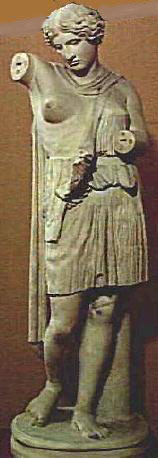
Description:The statue depicts a wounded woman dressed in a short chiton and a heavy mantle. Above her right breast is a wound which is the focal point of the action.
The chiton, which had been fastened on both shoulders, has been unclasped on the right shoulder. The material that had covered the back on the right side has fallen down over the belt; the corner that had been fastened on the back of the right shoulder is visible on the outer side of the right thigh. The part that had covered the front has also fallen downward toward the area of the left hand. The chiton is belted twice; a broad belt is visible on the left side under the left forearm and a second belt, perhaps below the first, is not visible since the material blouses over it and forms a kolpos. This kolpos crosses the body between the hips; it dips slightly downward on the right side. Below the kolpos the material hangs down to the end of the thigh. The chiton is rendered with closely packed, lightly engraved, wavy lines; this gives it the appearance of being a fine crinkly material.
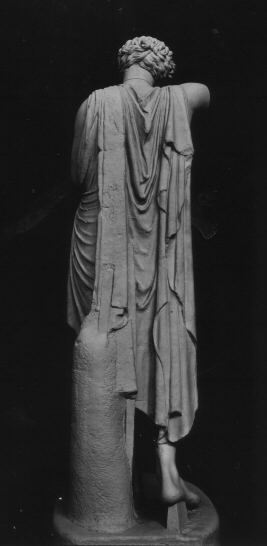
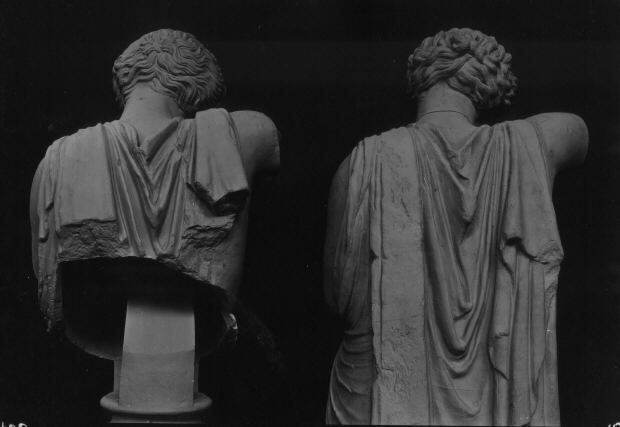
In addition to the chiton, a heavy mantle is worn. It is wrapped around the neck like a cape and then falls down the back of the statue. On the left side it is pulled forward and upward and is tucked under the left elbow. On the right side it hangs down until the middle of the shin. Viewed from the back, it has a distinct and decorative effect. Between the shoulder blades it falls in deep parallel V shaped folds and over each shoulder it falls in a flatter more vertical unit.
The statue stands with its weight over the left leg; the left foot rests flat on the ground. Behind the left leg is a roughly carved support. The upper part of the right leg advances in front of the left leg; the lower right leg trails behind the left leg. The right foot turns slightly outwards and the heel is raised. The left arm is lowered and bent at a 90 degree angle. The upper arm is pressed tightly against the body; the left forearm, not preserved in this statue, would have reached across the body. The right arm was raised and in the hand an upright spear was probably held. On this spear the amazon rested the weight of the wounded body.
The head tilts downward and to the right in order to examine the wound. The hair of the lowered head is particularly visible. It is rendered in long thick independent locks that are intricately intertwined. They originate at the top of the head in a starfish pattern which yields to a vague central part. The hair around the face falls downwards and is pushed to the sides. It covers the ears and is somehow rolled upward and then knotted at the back of the head so that it does not fall down. A few wisps, especially visible on the left side of the neck, escape below the hairline.
The head has a flattish top and a full oval face. The brow is horizontal and the eyebrows are lightly arched and do not slope downwards. The eyes are long and have pronounced tearducts. The upper lid is heavy and its lower line continues beyond the intersection with the lower lid. The mouth is broad and the lips are bow-shaped. The lips are parted by a groove which dips at the center and the sides. This gives the upper lip a central hang. The lower lip is full and pouty. The chin is solid and square.
Discussion:This statue clearly depicts a wounded amazon. It belongs to a type called the “Capitoline” or “Sosikles Amazon” on account of this statue signed by Sosikles and in the Capitoline collection. The statue represents the most fully preserved marble copy of the type; it is not, however, the most beautifully worked of the numerous copies. The type is, in fact, known in a total of 31 reproductions which includes nine statues (five with head, four without), fourteen individual heads (including one herm and one small bronze head), one relief, and seven engraved gems.
This particular statue is rarely discussed on its own merits and almost always discussed as a type in conjunction with two related and almost equally well represented amazon statue types, the “Sciarra/Lansdowne/Berlin” (cat. C 86) and the “Mattei” types (cat. C 89). In addition, there is another amazon head type, the “Herculaneum Amazon” (cat. C 90), as well as another two possible amazon statue types to be considered.
Central always to any discussion of these statues of Amazons is a passage in Pliny the Elder (NH 34.19.53). It reads as follows:
The most celebrated [artists of all time] came into competition with each other, even though born in different eras, because they had made statues of the Amazons. When these were dedicated in the Temple of Diana at Ephesos, it was agreed that the most skillful one be chosen by vote of those who were present. It emerged that this would be the one that each artist judged second to his own. The first was that of Polykleitos, the second that of Pheidias, the third Kresilas’, the fourth Kydonis’, and the fifth Phradmon.
Since three different Amazon statue types have been preserved in many copies, scholars have without hesitation related them to the first three artists mentioned by Pliny. For these scholars, the only question was really which type should be attributed to Polykleitos, Pheidias, and Kresilas. For more on this see cat. C 86.
The type of the Capitoline Amazon has almost always been assigned to Polykleitos. The stance of the statue is closely related to the Doryphoros; the legs are a mirror reverse of that statue. The relaxed arm is on the same side as the weight leg and the working arm is over the relaxed leg. Similarly the working arm holds a spear. As von Steuben has pointed out, the resemblance of the statues is particularly striking in profile views. The “Capitoline Amazon” features the same four-sided aspect of the Doryphoros; each viewing angle is separate from the other. Moreover, the “Capitoline Amazon” follows the pattern of the Westmacott athlete exactly.
In terms of the head and hair the “Capitoline Amazon” is also similar to works assigned to Polykleitos, particularly the “Diskophoros”, the “Diadoumenos”, and the “Westmacott Athlete”. They all feature the broad large faces, flat crowns, squarish backs of the neck, eyes, and solid chins. In addition, the hair which originates in a starfish at the crown and forms a voluminous cap-like entity of thick interwoven locks is similar to all.
Not all scholars are convinced, however, of the Polykleitan attribution. Weber attempts to associate the type with the Parthenon sculpture and, therefore, to assign it to Pheidias. She compares the head to the head of Hera from the East Pediment and to the Nemesis head, the arm motif to the figure on Parthenon South Metop 19 or Iris of the East Frieze, and the mantle to Parthenon Metope S 27. This identification with Pheidias has not found any favor among scholars, mainly given the greater similarities to Polykleitos.
More scholars, Bol and Borbein, indirectly argue against the Polykleitan attribution but assigning the “Sciarra/Lansdowne/Berlin” type to Polykleitos. Their arguments have already been introduced in cat. C 87. Borbein’s is particularly methodologically unsound since its premise is that the “Capitoline Amazon” is too Polykleitan to be by Polykleitos. Bol’s argument that the “Sciarra/Lansdowne/Berlin” type shows greater similarities to Polykleitos’ Doryphoros are unconvincing, particularly in light of von Steuben’s comparisons of the “Capitoline Amazon” to the Doryphoros and her own failure to address the head. Von Steuben’s point that there are numerous gems featuring the “Capitoline” type and none of the “Sciarra/Lansdowne/Berlin” type also deserves some consideration. Finally, although it is not entirely an objective argument, it seems difficult to believe that the “Sciarra/Lansdowne/Berlin” type would have been considered, as the Polykleitan amazon was, “probatissima arteficum” whereas the motion and poise focused around the wound as well as the elegant complicated drapery of the “Capitoline” type might have been.
Bibliography:W. Helbig (H. von Steuben),
Führer durch die öffentlichen Sammlungen klassischer Altertumer in Rom II (4th edition) (Tübingen 1966) pp.197-199 no.1393
considers the type to represent the amazon of PolykleitosM. Weber,
"Die Amazonen von Ephesos" (JdI 91 1976) pp.46-56, 83-86
replica list of the type, considers the type to be PheidianM. Weber,
"Die Amazonen von Ephesos II" (JdI 99 1984) pp.93-107
updates the replica list, reconsiders the position of the right forearmR. Bol,
"Die Amazone des Polyklet" Polyklet: Der Bildhauer der griechischen Klassik (Mainz am Rhein 1990) pp.213-216, 222-236
considers the “Capitoline Amazon” but then opts for the “Sciarra/Lansdowne/Berlin Amazon” type as the amazon of PolykleitosH. von Steuben,
"Die Amazone des Polyklet" Polyklet-Forschungen (Berlin 1993) pp.73-102
believes the "Capitoline Amazon" type to be PolykleitanW. Fuchs,
Die Skulptur der Griechen (Munich 1993) pp.198-199 no.211
considers the "Capitoline Amazon" to be the amazon made by PolykleitosH. von Steuben,
"Noch einmal die Amazone des Polyklet" Griechische Klassik (Nurnberg 1994) pp.275-282
believes that the “Capitoline Amazon” type is so similar to the Doryphoros that it must be PolykleitanA. Borbein,
"Polykleitos" Personal Styles in Greek Sculpture (Cambridge 1996) pp.82-83
believes the "Capitoline Amazon" type follows the Polykleitan schema too closely to be by Polykleitos