Commentary Prepared by Dr. Julia Lenaghan, Ashmolean Museum
C 083
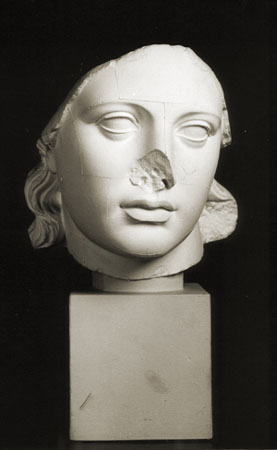
Polykleitan Head of Athena. Dresden
Marble
Head
From Italy. The piece was bought in 1728 from the Albani collection.
Germany, Dresden, Albertinum und Staatliche Kunstsammlungen, Skulpturensammlung, Hermann 57
Preservation:The head is broken through the neck. The tip of the nose and the front part of the curl behind the left ear have broken off. The upper portion of the head, from the hairline up, was a separately worked piece that is now missing. The preserved upper surface is flat and slants diagonally downwards from front to back. Near the back is a rectangular dowel hole. On the left side there is a band of anathyrosis around a roughly picked area. On the right side the entire surface has been smoothed. It is not clear what of the working in this area is ancient and what is renaissance or post renaissance since in the 18th century the head had a restored helmet.
Description:The head, which turns to its left, shows a smooth young face. Because of the long hair that trails down the nape of the neck, the head was undoubtedly female.
The face has a broad oval form. The brow is tall and slightly rounded. The eyebrows arch and the eyes are wide set, oval in shape, and have defined tear ducts. The upper eyelid is formed by two lines both of which continue beyond the intersection with the lower lid. Flesh overhangs the deeply engraved upper line of the upper lid. The lower lid is also defined by two lines, one of which is created by the projecting crisp rim. The corners of the lips tuck into the fleshy cheeks. Below the lower lid is a modelled surface. The nose has a broad ridge. Directly below the nose and above the central dip of the upper lip is a depression. The lips themselves are wide, full, and shapely. They are parted by a substantial groove which rises, falls, rises, and fall. This creates the central overhang of the upper lip. Below the lower lip is a distinct depression before the chin; the lower projects forward in a shelf-like manner. The chin is solid and round.
The hair once had a central part and was combed back off the brow. It did not, however, cover the ears which are still preserved. Behind the ears it fell down the back of the neck.
Discussion:The head had been attached to a nude male body and had worn a helmet. In 1750 it appeared in the Dresden lists as a statue of Alexander the Great. The body, to which the head was once attached, has been recognized as a depiction of Dionysos and now features a plaster head of Antinous. Already in antiquity, however, the Dresden head probably featured a separately worked helmet. This would identify the head as a depiction of Athena.
There are seemingly no known copies of the head which has affinities to works assigned to Polykleitos such as the “Hermes” and the “Doryphoros”. Thus, it is difficult to judge whether it is a copy of an original of the fifth century or whether it is an imperial creation based loosely on fifth century models. The pseudo-metallic rendering of the eyes with the sharply defined lower lid and tear ducts as well as the fleshy modelled cheeks are generally considered indications of the Hadrianic manufacture. In these details the head is very much like the Boston (see cat. C 40) example of Polykleitos’ “Hermes”.
Bibliography:P. Herrmann,
Verzeichnis der Antiken Originalbildwerke der Staatlichen Skulpturensammlung zu Dresden (Berlin 1925) p.23 no.57
catalogue entryK. Zimmerman, ed.,
Die Dresdener Antiken und Winckelmann (Berlin 1977) p.17 and Anlage 2, pl.32 fig.31 c
mentioned in discussion of pieces acquired from the Albani collection