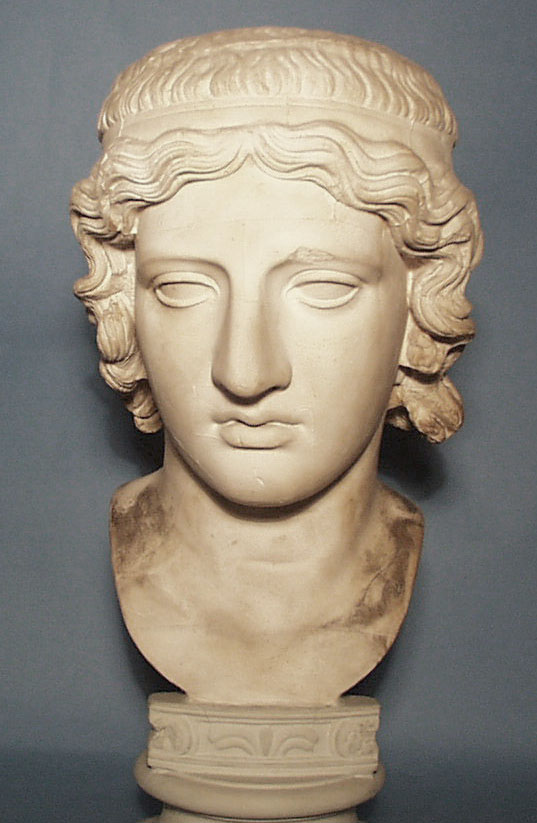
Head of a woman.
Commentary Prepared by Dr. Julia Lenaghan, Ashmolean Museum
C 082
The "Argive Hera". London
Marble
Head
28 cm
United Kingdom, London, British Museum, 1792
Preservation:The head has been broken through directly under the chin. The neck, the nose except for the top of the bridge and half of the left nostril, and the ends of the curls of the foremost locks on both the left and the right side have been restored. The fillet from ear to ear and a band of hair directly above it have also been restored. This suggests that the head once had an attached crown.
Description:The head portrays a short-haired, smooth-faced young person. The hair is divided into two sections by a flat fillet which runs around the head above the ears. The upper section of the hair is rendered as a mass which stands slightly off the skull and into which wavy lines are engraved. These lines define large locks. Below the fillet, the hair is parted at the center and combed off the face. The locks at the front move from the part in a wavy path to the region of the temples at which point they fall straight down. They reach the middle of the cheek. Behind these front locks are two similar wavy locks that cover the ears. On the back of the head from ear to ear are five locks. These are corkscrew locks which reach the base of the neck.
The face is oval and the brow is smooth and slightly rounded. The eyebrows slope downwards. The eyes are long and heavily lidded. The projecting upper lid is formed by two lines, the upper of which is deeply engraved. Both of these lines continue past the intersection with the lower lid. The lower lid has a crisp flat rim. The lips are very round and shapely. They are separated by a broad groove which rises falls, rises, and falls, thereby giving the upper lip a central dip. Between the upper lip and the nose is delineated oval depression. The lower lip comes out like a shelf from the chin below it. The chin itself is rounded and is lightly defined in frontal view as a raised circular area.
Discussion:The head, which is known, in no replicas was associated by Waldstein to coins from Argos that depicted Hera. Some of the coins even featured a Pi and an Omicron which were taken to refer to Polykleitos and Polykleitos is known from many sources (eg. Pausanias 2.17.4 and Strabo 8 ) to have made a seated chryselephantine statue of Hera for the Heraion at Argos. Some coins depict the full statue and others show only the head which features the crown decorated with images of the Graces and Seasons that Pausanias specifically mentions. The British Museum head does recall the simplified physiognomy and the short hair around the face, which are depicted on the coins. In addition, the restored zone at the front of the head between the ears of the British Museum head and the less finely worked top of the head suggest that the head wore an inserted crown that concealed the area behind it.
Thus, Waldstein’s proposal was initially accepted. Anti, reviewing it in 1920, noted that the head could not be a true copy of the Polykleitan work because of its size and the fact that casts could not be made of chyrselephantine statues. He did concede that the head did resemble the coins and that the head was similar stylistically to other works of Polykleitos.
Two reevaluations of the argument have since been presented. The first concerns the scholarly debate over which Polykleitos, the elder or the younger, the ancient authors meant. Thus, for instance, Linfert in his dissertation in 1966 assigns the head as well as the Hera herself to Polykleitos the younger. He does this on the basis of stylistic comparison; he did not see the resemblance of the British Museum head to works of the elder Polykleitos but rather saw a tight resemblance to the “Hera Barberini/Borghese” type which he considered to be a work of the younger Polykleitos. Finally, he associated the head with a seated body type in Boston; together they represented the Argive statue of Hera by the younger Polykleitos.
Delivorrias in a recent article [A. Delivorrias, “Polykleitos and the Allure of Feminine Beauty” Polykleitos, the Doryphoros, and Tradition (Wisconsin 1995) pp.200-217 especially footnote 9] complains both of the lack of scholarly attention given to the female statues made by Polykleitos and of the trend to reassign statues, noting especially that of Hera, to the younger Polykleitos. Yet, he does not make any mention whatsoever of the British Museum head. This may in part reflect an apparently more accepted opinion which is presented by Zanker. Zanker, as Linfert had already, notes the sentimental aspect of the face which strongly betrays late Hadrianic-Early Antonine taste. He, furthermore, pointed out the striking resemblance of the head’s facial structure and the hair to the “Naples-Copenhagen” youth type as well as a head in Munich. Since Zanker considers both the “Naples-Copenhagen” type and the head in Munich to be classicizing works, he doubts that the British Museum head truly represents a fifth century work.
This does indeed seem to be more likely. First, there are no other reproductions of the British Museum head type. Second, there many classicizing works (for instance, the “Ostia-Leptis Magna Apollo” type, or even the “Spinario”) with a hairstyle similar to that of the British Museum head and the over sentimental expression of the head.
Bibliography:C. Waldstein,
"The Argive Hera of Polycleitus" (JHS 21 1901) pp.30-44 pls.2-3
considers the head to represent the chyrselephantine statue of Hera at Argos made by PolykleitosC. Anti,
"Monumenti policletei" (MonAnt 26 1920) pp.639-644
considers it likely that British Museum head recalls Polykleitos' Hera for ArgosE. Paribeni,
"Volti, teste, e parrucche" (Atti Magna Grecia NS 2 1958) p.65 pl.21
thinks head might represent ApolloA. Linfert,
Von Polyklet zu Lysipp (1966) pp.9-10
assigns the head to Polykleitos IIC. Vermeule,
Polykleitos (Boston 1969) pp.39 ff
P. Zanker,
Klassizistische Statuen (Mainz 1974)