Cast Gallery catalogue number: C078
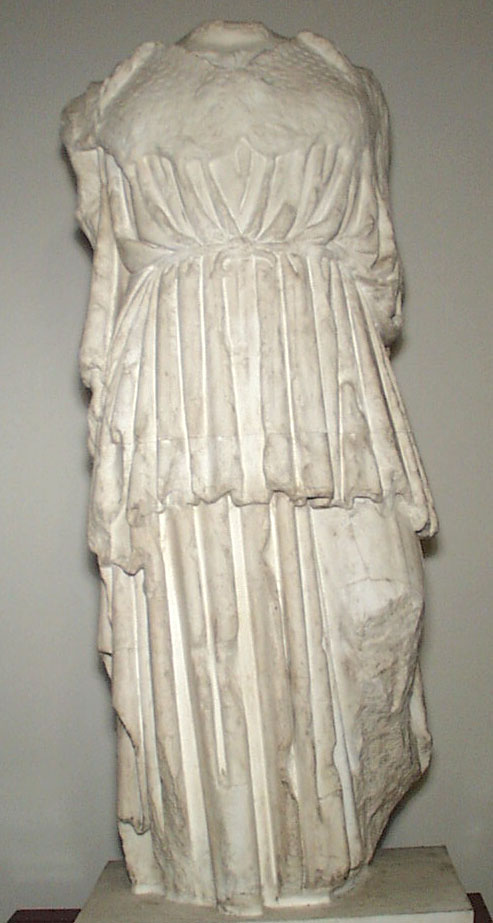
Torso of Athena.
- Plaster cast: Height: unavailable.
- Copy of a marble statue.
- The statue:
Detailed Record
Commentary Prepared by Dr. Julia Lenaghan, Ashmolean Museum
C 078
Torso Representing the Athena Parthenos. Athens, Akropolis
Marble
Statue
1.57 m
From Athens. Found near the Propylaea (on the Akropolis) in 1860.
Greece, Athens, Akropolis Museum, 1362
Preservation:The head, neck, both arms, the lower shins, and feet are missing. The front portion of the left leg, between the knee and the shin, is broken off. The surface is damaged; for instance, the gorgon’s head at the center of the aegis is almost entirely defaced. According to Casson, crosses have been scratched on the back.
Description:The preserved torso of this statue depicts a female who wears an “Attic” peplos and an aegis. The peplos is one piece of material that is folded downwards at the top. The crease of this fold becomes the upper border of the garment which is wrapped around the body. The upper border of the front is fastened to that of the back at each shoulder. The two lateral edges of the peplos come together along the right side. The bottom border of the folded area (or apoptygma) crosses the body horizontally at the level of the thighs. Under the breasts and around the apoptygma, the peplos is belted; the knot of the cord is visible at the center of the body. Some of the material of the apoptygma, particularly on the left side blouses over the belt. Below the belt the material of the peplos hangs in heavy vertical folds.
Over the shoulders and the breasts an aegis is worn. It features rows of uniform scales rendered in “U” shaped engraved lines. At the center of the aegis is a gorgon’s head. On the each side of the back of the aegis and on the right shoulder are coils intended to represent snakes. Visible on both shoulders are long tresses of hair. The hair at the back has been bound together and hangs in a rectangular mass.
The figure faces front with its weight over its right leg. The left leg is bent and the left knee appears to have pushed forward. Neither shoulder is raised and the beginning of the neck faces forward.
Discussion:The torso is recognizable as a fragment of a human-sized reproduction of the Athena Parthenos. The original Athena Parthenos was a ca. 12 m high chryselephantine statue of Athena made by Pheidias and dedicated in the Parthenon in about 438 BC.
Although no exact copies are preserved of this huge original made from precious materials, there are two important literary descriptions of the statue which have allowed scholars to recognize the image in various archaeological finds. The two most important ancient descriptions of the statue are by Pliny the Elder (N.H. 36.18) in the first century AD and by Pausanias (1.24.5) in the mid second century AD. Pausanias gives a full description of the general impression of the statue and Pliny, in addition to general comments, particularly notes the decorative friezes of the statue. Since 1860 when Lenormant identified a statuette from Athens (now known as the Lenormant statuette, cat. C 78) as a reproduction of the Athena Parthenos. numerous other small-scale reproductions in a variety of media that range from terracotta to gem stones to marble have been identified.
This particular torso accords well in terms of the peplos, aegis, stance, and hair of the Athena Parthenos with what is preserved in other reproductions. The date of this fragmentary statue is not at all clear. Casson suggests that it was made not long after Pheidias and Leipen falls him almost verbatim. The validity of the assessment is difficult to judge.
Bibliography:S. Casson,
Catalogue of the Acropolis Museum II (Cambridge 1921) pp.260-261 no.1362
catalogue entry, dates the statue shortly after PheidiasN. Leipen,
Athena Parthenos (Toronto 1971) p.6 no.17 fig.11
complete catalogue entry with discussion and reconstruction of the Athena Parthenos