Commentary Prepared by Dr. Julia Lenaghan, Ashmolean Museum
C 076
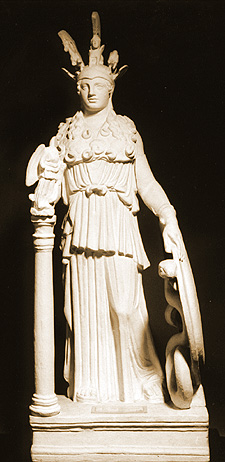
Varvakeion Statuette (Representing Athena Parthenos). Athens
Marble
Statuette
1.045 m including base, figure alone is 0.94 m
From Athens. Found in December 1880 behind the Varvakion Gymnasion. It lay face down in a vaulted brick room which formed part of a Roman house.
Greece, Athens, National Museum, 129
Preservation:The fingers of the right hand are broken. The middle, ring, and little finger have been restored in marble and the top part of the thumb in plaster. The index finger was restored in antiquity. The right forearm was broken diagonally at the wrist and also at the elbow. The head of Nike held in the right hand is missing and there is a small dowel hole in the neck which suggests a repair. The right arm of the Nike and the left wing are also broken. There also breaks and restorations on the animals of the helmet. On the horse on the left side of the helmet, the head, upper part of the wing, and the left front leg are restored. On the horse on the right side the front legs are restored but the hoofs are ancient. The lower shins of the back legs along with part of the crest are restored in plaster. The left wing of the sphinx is broken, and the crest over the sphinx is broken into many pieces.
Traces of color, primarily red, brown, and yellow, are visible on all areas but the bare skin. The yellow seems to have been used as an undercoating for gold. Paint is particularly well preserved in the eyes; the black eyelashes, the red outline of the iris, and the black pupils. Also the gorgoneion head on the outside of the shield retains paint.
Description:The statuette depicts a female who wears an “Attic” peplos, an aegis, and a helmet and who holds a Nike and a shield. The peplos is one piece of material that is folded downwards at the top. The crease of this fold becomes the upper border which is fastened together at each shoulder. Along the right side the two lateral edges of the peplos come together. The bottom border of the folded area (or apoptygma) crosses the body horizontally at the level of the thighs. Under the breasts and around the apoptygma, the peplos is belted; the knot of the cord is visible at the center of the body.
Over the shoulders and the breasts an aegis is worn. It features rows of scales (rendered in “U” shaped engraved lines) and along its outer border and at its neckline the projecting coils of small snakes. At the center of the aegis, framed on all four corners by coiled snakes, is a short-haired Medusa head.
The helmet of the figure has an undecorated band that runs around the entire perimeter of the helmet. At the front it dips down and forms a point over the nose. Behind the ears it makes a right angle and in a vertical line continues to the nape of the neck. At the base of the neck, it makes another right angle and crosses the base of the neck in a horizontal line. Attached at the right angle over the ears are the curved ear flaps which have been raised and project diagonally out from the helmet. On the bowl of the helmet are two winged pegasi that flank a central sphinx. These animals support crests, the ends of which reach to the shoulders and between the shoulder blades. In addition, the statue wears a double soled sandals and snake bracelets on both wrists.
The figure faces front with its weight over its right leg. The left foot does not rest entirely on the ground; its outer side is raised. The right arm is lowered and bent. The upper arm remains alongside the body and the forearm projects directly forward. The back of the right palm rests on a column which appears to have two similarly sized capitals and a plinth on top of them. In the open right palm stands a winged Nike who is turned diagonally to its left. Its left foot is forward and both arms are lowered .
The left arm of the statuette remains along the left side of the body and is only slightly bent at the elbow. The forearm moves a few degrees forward and to the left of the body. It rests on the upper edge of a large round convex shield. On the inside of the shield is the arm band as well as a flat border area around the perimeter. In the center of the shield’s exterior side is a Gorgon head with short hair and wings. Between the shield, which tilts inwards and the left leg, which also moving inwards, is a large semi-coiled snake. Its head appears facing outwards just under the left hand of the statuette and on the level with a strut that attaches the shield to the thigh of the statuette.
The head of the statuette faces front. The broad brow, widely spaced cheekbones, full cheeks, solid chin, and thick neck give the face a squarish shape. The eyes are wide and open, the nose has a broad ridge, and the lips are parted and shapely. The helmet comes down low on the brow. Curly tufts of hair appear out from under it between outer corners of the eyes and the ears which are completely visible and defined. Four long wavy tresses escape from under the neck guard and lie over the aegis, two on each side of the neck. A wavy mass of hair, also emerging from under the neck guard, lies between the shoulder blades. The ends of the crests of the helmet are attached here by means of small struts.
The back of the statue is less carefully worked than the front of the statue. The figure stands on a plinth which is molded on the upper and lower front borders.
Discussion:
Since its discovery in 1880, the statuette has been recognized as the best preserved and truest rendition of the Athena Parthenos. The original Athena Parthenos was a ca. 12 m high chryselephantine statue of Athena made by Pheidias and dedicated in around 438 BC in the Parthenon.
Although no exact copies are preserved of this huge original made from precious materials, there are two important literary descriptions of the statue which have allowed scholars to recognize the image in various archaeological finds. The two most important ancient descriptions of the statue are by Pliny the Elder (N.H. 36.18) in the first century AD and by Pausanias (1.24.5) in the mid second century AD. Pausanias gives a full description of the general impression of the statue and Pliny, in addition to general comments, particularly notes the decorative friezes of the statue. A passage in Plutarch (Per.31) is also useful with caution for its description of Athena’s shield. Using mainly Pausanias’ description, Lenormant in 1860 identified a statuette from Athens (now known as the Lenormant statuette) as a reproduction of the Athena Parthenos. Since that time, numerous other small-scale reproductions in a variety of media that range from terracotta to gem stones to marble have been identified.
The Varvakeion statuette was dated initially by Lange to the first century AD. Furtwangler then pushed the date forward to the Hadrianic period. This has been generally accepted because the statuette so closely resembles the reliefs from Piraeus (dated to the Hadrianic period) that it might even come from the same workshop and because of the renewed interest in the Athena Parthenos in that period (it appears on coins, for instance).
The statuette, which is approximately a twelfth of the size of the original, preserves more completely than any other extant image the details of the original model. The reliability and value of the statuette are attested by several facts. All of the details that it does show correspond to details depicted in other less complete reproductions. It is a fine work. Despite its small size, the statuette is detailed and it was created by a technically skillful craftsman. It is entirely carved from one block of marble and features no additions in metal. Moreover, the statuette appears to have been treasured in antiquity; it features ancient repairs, was found carefully concealed and protected in a late antique house, and remains in a state of excellent preservation.
Thus, the importance of the statuette for the modern period is that it provides the basis for the reconstruction of the Athena Parthenos. Most particularly it shows the Nike and the right hand of Athena supported by a column. This detail is controversial since some find it to be aesthetically inappropriate. Nonetheless, the column’s appearance on this statue as well as the appearance of either the column or some other support on reliefs and in other minor arts has led most scholars to conclude that it probably was part of the original. The column balances the composition and gives Athena stability. Moreover, such supports are known to have existed in the Classical period . The double capital effect of the Varvakeion statuette has been reasonably explained by the assumption that painted on the lower portion would have been acanthus leaves and on the upper volutes and palmettes; in the original model one should imagine that these features were added in metal.
The statuette, however, is not without flaws. It does lack several of features of the original model whose presence are assured by either the literary tradition or other archaeological finds. These include the spear; the frieze on the base that depicted Pandora and twenty gods; the Amazonomachy relief on the exterior of the shield; the painted Gigantomachy on the interior of the shield; the Centauromachy depicted on the sandals; the griffins on the ear flaps of the helmet; and the protomes over the visor as well as other decorative relief on the helmet.
Bibliography:W-H. Schuchhardt,
"Athena Parthenos" (AntPl 2 1963) pp.31-46 pls.20-31
full descriptionN. Leipen,
Athena Parthenos (Toronto 1971) pp.3-4 no.2 figs.2-3
complete catalogue entry with more general discussion and reconstruction of the Athena Parthenos(P. Demargne),
"Athena" Lexicon Iconigraphicum Mythologiae Classicae II (Zurich 1984) pp.977 no.220 and 1031
Roman small scale copy of Athena Parthenos, probably Hadrianic(F. Canciani),
"Athena/Minerva" Lexicon Iconographicum Mythologiae Classicae II (Zurich 1984) pp.1084-1085 no.142b