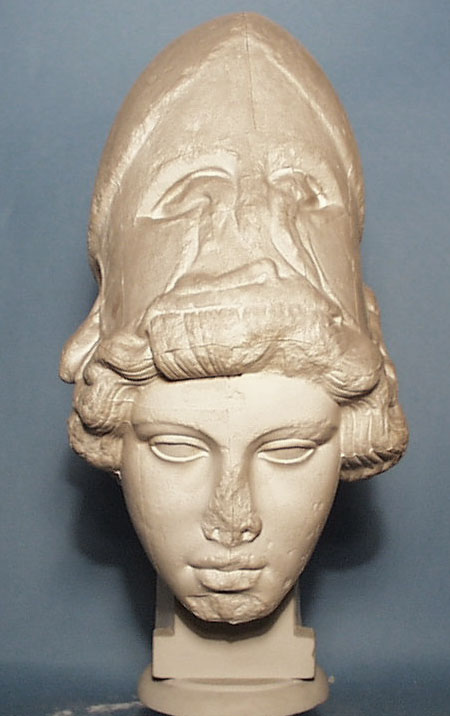
Cast Gallery catalogue number: C073
Head of Athena (copy of Myron's group of Athena and Marsyas).
See also C071.
- Plaster cast: Height: 45 cm.
- Copy of a head from a marble statue.
- The statue:
- is a version of part of a bronze group made about 450-440 BC. by the sculptor Myron of Eleutherai.
- was found in Apulia.
- was purchased by Dresden from Rome in 1899.
- is now in Dresden, Staatliche, Kunstsammlungen, Albertinum, 48.
Detailed Record
Commentary Prepared by Dr. Julia Lenaghan, Ashmolean Museum
C 073
Copy of the Head of the Athena of Myron's Athena and Marsyas Group. Dresden
Marble (Pentelic)
Head
32.7 cm
The head is allegedly from Apulia. It has been in Dresden since 1899.
Germany, Dresden, Albertinum und Staatliche Kunstsammlungen, Skulpturensammlung, ZV 1761
Preservation:The head is broken through the throat under the chin. The lower half of the nose is missing. A section of hair over the left side of the brow has broken off. The chin, the lips, and the left brow are damaged. The surface for the support of the crest has been worked away and there is a drill hole in the middle.
Description:The head depicts a female who wears a Corinthian helmet. The helmet is pushed off the head so that the face is visible. The face has a slim oval shape with long cheeks. The brow is flat and smooth. The eyebrows arch into it. The eyes are long and narrow. The upper eyelid projects sharply and is delineated above by a deeply engraved line. The lips are bow-shaped and full. The chin is sharp.
The hair is combed off the face. Above the eyes over the brow the hair is pulled loosely but directly back. From the corners of the eyes to the ears, the locks are wavy and intertwined. These locks drop down in front of the ear but are then pulled upwards so that on the right side the entire ear and on the left side most of the ear are visible. Behind the ears the hair appears out from under the helmet. It is then rolled over itself and tucked back under the helmet.
The helmet , as already noted, is pushed up on to the head. The eye holes rest at the level of the crown; the ear slots are above the ears, and the bulbous domed area sits unfilled above the head.
Discussion:This head type is known in four other copies (Frankfurt, Athens, Vatican Storerooms, and Antiquario Forense). The Frankfurt example (see cat. C 71) is preserved with its original body which is also known in several copies (again see cat. C 71).
The statue type from which the head came depicted Athena and was part of statue group that consisted of Athena and Marsyas. This statue group, associated with a passage from Pliny the Elder (N.H. 34.57) and Pausanias (1.24.1) , appears to have been made by Myron ca.450 and to have been erected on the Akropolis at Athens. For more on this, see cat. C 71.
The Dresden head of Athena has been dated by Daltrop on one occasion to the Trajanic period on account of its technique. On another occasion Daltrop notes that the head differs from other copies because it is more severely and more crisply worked. Protzmann (in the Die Antiken im Albertinum) dates it the early imperial period on account of its non-overlapping eyelids.
Bibliography:B. and K. Schauenburg,
"Torso der Myronischen Athena Hamburg" (AntPl 12 1973) p.52 no.10 figs.31-34
catalogue entryG. Daltrop,
Il gruppo minoriano di Atene e Marsia nei Musei Vaticani (Vatican City 1980) p.21 pls.34.3 and 35.3
head features sharp edges and severe modellingG. Daltrop and P.C. Bol,
Athena des Myron (Frankfurt 1983) pp.25 and 75 no.10
dates it to the Trajanic period on account of its technique(H. Protzmann),
Die Antiken im Albertinum: Staatliche Kunstsammlungen Dresden, Skupturensammlung (Mainz am Rhein 1993) p.17 no.3
catalogue entry, considers it to be early imperial work