Commentary Prepared by Dr. Julia Lenaghan, Ashmolean Museum
C 071
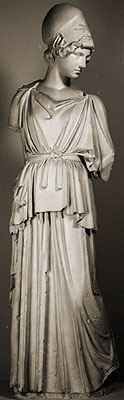
Copy of the Athena of Myron's Athena and Marsyas Group. Frankfurt
Marble
Statue
1.73 m with plinth, 1.67 without plinth
From Rome. Found on the Pincio at no.32 Via Gregoriana in 1884. This was the location in antiquity of the gardens of Lucullus.
Germany, Frankfurt, Liebieghaus, 195
Preservation:Part of the back of the left shoulder is missing and has been restored. The crest of helmet, originally in bronze, and the front part of the left foot including the toes, originally worked separately, are missing. The left arm is missing the forearm and the right arm is broken in the middle of the upper arm; in both of these there a square dowel holes. A fragment of the right forearm and the right hand were found with the statue and are preserved, though not attached. There are small damages at the hems and in the folds. The folds over right side of belt are particularly broken. There is encrustation on the back side.
Description:The statue depicts a female figure who wears a Corinthian helmet and a peplos. The helmet is pushed off the head so that the face is visible. The peplos is one piece of material with the upper area folded down; it is wrapped around the body. The two lateral edges of this one folded piece of material come together on the right side of the body. The crease of the fold serves as the upper border, the front and back of which are fastened together at the shoulders. The folded over area or apoptygma reaches down slightly below the hips. At the waist a belt is tied around the peplos and the apoptygma; it is knotted at the center. Below the apoptygma the rest of the peplos falls in mainly vertical folds to the feet.
The body faces forward and the weight is over the right leg. The left leg is bent and the foot, extended to the left, does not rest upon the ground. The figure appears to be sliding from its left to its right. The left arm is lowered and the forearm extended to the left of the body. The right shoulder is higher than the left shoulder, and the right upper arm rests by the side of the body. In the right hand a cylindrical item was held, either a spear or an aulos, a musical pipe.
The head turns entirely to its left shoulder so that the viewer who stands directly in front of the torso sees principally the right profile. Viewed, however, from the front, the face has a slim oval shape. The brow is flat and smooth. The eyebrows arch into it. The eyes are regular and the nose is fine and straight. The lips are bow-shaped and the chin is pointed.
The hair is combed off the face. Above the eyes over the brow the hair is pulled loosely but directly back. At the corners of the brow are intertwining wavy locks of hair. These locks drop down in front of the ear but are then pulled upwards so that the entire right ear and most of the left ear are visible. Behind the ears the hair appears out from under the helmet. It is then rolled over itself and tucked back under the helmet.
The helmet , as already noted, is pushed up on to the head. The eye holes rest at the level of the crown; the ear slots are above the ears, and the bulbous domed area sits unfilled above the head.
Discussion:The statue type is known in a total of twelve copies. These include this complete statue in Frankfurt, seven torsos (Boboli Gardens, Florence; Hamburg from Tivoli; the Prado, Madrid; the Louvre, Paris; Reggio Calabria; Massimo Lancellotti from the Esquiline; Toulouse from Chiragan), and four heads (Athens from the Akropolis; Dresden; Vatican Storerooms; Antiquario Forense, Rome). Because of the helmet, the subject of the statue is certainly Athena.
Two scanty literary references have been for over a century spoken of in conjunction with this Athena statue. Pliny the Elder in his Natural Histories (N.H. 34.57) mentions statues made by the sculptor Myron of Athena and Marsyas admiring the flutes. Pausanias (1.24.1) reports having seen on the Athenian Akropolis a statue group that depicted Athena striking Marsyas for having picked up the flutes that she discarded. Both passages has been assumed, since 1830, to be referring to the same statues. In addition, similar depictions of Athena and Marsyas appear on a red-figure oinochoe in Berlin that is dated ca. 450-445 (LIMC II p.1014 no.618), on imperial coins from Athens, and in the relief decoration of a neo-Attic marble krater. This has led to the identification of a statue of a recoiling Marsyas (known in several copies, the best of which is in the Vatican Museum) as the Marsyas of the group mentioned by Pliny and Pausanias. In 1907, using the same evidence again, B. Sauer connected this Athena type with the group. When Sauer made this assessment, the Frankfurt copy was not yet known. Its publication only added further support to his theory.
No doubt has been expressed that this Athena type and the Marsyas type do not form a single statue group. This is understandable since the two appear together in this pose in smaller-scale media. Nor have any scholars expressed doubt about associating the two literary passages with the same sculpture group and assigning the group to Myron. The group seems reasonably to belong in the fifth century. The Marsyas (discussed more fully in cat. C 71) is similar to the figures on the metopes of the Parthenon. Moreover, Myron is known to have been the sculptor of the Diskobolos which is conceived with a fundamentally similar design; the statue is flat and should be viewed frontally as if it were a relief. Furthermore, the face of the Diskobolos is thin and fine like that of the Athena.
The only areas of controversy concerning the statue group are the exact placement of the figures in relationship to each other, the position of Athena’s arms, and the location of the flutes. The issue revolves around whether Athena held a spear or the flutes, what would have been the direction of the spear, and what did she do or hold in the other hand. The Esquiline copy of Marsyas seems to suggest that the flutes lay on the ground.
The Frankfurt Athena has been dated by the Schauenbergs to the Augustan period. He makes this judgement on the basis of the similarity of the statue’s folds to the Cherchel Demeter (dated to the period of Juba ca.25 BC-AD 25) and to a “Large Herculaneum” type statue from Andros. Regardless of whether these comparisons are the best, this date has been accepted.
Bibliography:B. and K. Schauenburg,
"Torso der Myronischen Athena Hamburg" (AntPl 12 1973) p.50 no.1 and p.52 figs.4-10, 40
catalogue entry, dates the Frankfurt statue to the Augustan periodF. Eckstein and H. Beck,
Antike Plastik im Liebieghaus (Frankfurt 1973) pls.4-5
catalogue entryM. Robertson,
A History of Greek Art (Cambridge 1975) pp.341-343
relates the group to the Diskobolos, another work of MyronG. Daltrop and P.C. Bol,
Athena des Myron (Frankfurt 1983) pp.20-25 and 74 no.1
full discussion of the statue(G. Colonna),
"Athena/Menerva" Lexicon Iconigraphicum Mythologiae Classicae II (Zurich 1984) p.1105 no.423
Athena and Marsyas of Myron with bibliography(P. Demargne),
"Athena" Lexicon Iconigraphicum Mythologiae Classicae II (Zurich 1984) p.1015 no.623 and p.1039
Athena and Marsyas of Myron with bibliography