Commentary Prepared by Dr. Julia Lenaghan, Ashmolean Museum
C 070
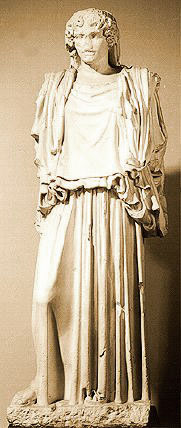
Composite Cast of the "Cherchel Demeter". Cherchel
Marble
Statue and Head
Statue without plinth 1.80 m; head 28.5 cm
From Caesarea Mauretaniae (Cherchel). Found near the “Porte d’Alger”, amid buildings which date to the time of Juba II. The head was found in 1851. The body represented in the cast was found in 1858 and another body of the same type was found in 1879; this latter body joins the head.
Algeria, Cherchel, Musee de Cherchel, 8 and S 88
Preservation:Head: . The head has broken through the neck and the mantle in the area of the neck. The face is missing its nose and lips and much of its surface is damaged. The eyelids, the brows, and the right cheek are battered.
Statue: Both of the forearms are missing. On both upper arms near the elbow, square dowel holes are visible; the lower arms were worked separately. Some folds, and the toes are battered. On the front of the plinth there is a rectangular cutting between the feet; behind the right heel is a circular cutting; and on the right side there are two rectangular cuttings. These seem to be holes for the clamps that secured the plinth on its base. The modern restoration of the cast of the non-pertinent head on this body loses the original inclination of the head to the right shoulder. In this reconstruction the head appears to be frontal or slightly tilted to the left.
Description:The statue depicts a woman who wears an “Argive” peplos with a small shawl or kredemnon over the head. The peplos is one large piece of material, the lateral sides of which have been sewn together. The upper area of the peplos is folded down with the result that the crease of the fold becomes the top edge. The top edges, pulled up from the back and the front, are fastened at the shoulders. The viewer, thus, sees, the folded area or apoptygma, the edge of which crosses the body horizontally at the waist. Because the width of the peplos is greater than the width of the body, the material of apoptygma bunches together on the sides of the body where it hangs down further. The frontal area of the apoptygma is a marked by a slightly arching fold which runs between the nipples and two vertical (one on each side) folds that fall from the nipples.
Below the apoptygma appears a voluminous band of material. This is the kolpos or material which has bloused out and over a belt which is concealed by the apoptygma. The kolpos, again because of the width of the peplos, hangs down more copiously at the sides of the body. Below the kolpos, the peplos falls in thick folds which reach the ground. On the left side these folds are vertical and on the right side, the folds bend in accordance with the knee which pushes through the peplos..
Over the back of the head is a short mantle which covers the shoulders and most of the back. On the sides of the front of the body, its corners fall down to the waist. At the back of the body the bottom border runs parallel to the bottom edge of the apoptygma and just a centimeter or two above it.
The statue stands with the weight on the left leg which is hidden by the folds of the peplos. Only the first three toes of the left foot appear out from under the peplos. The right leg is bent and both it and the right foot turn outwards. The right knee comes forward. The right foot rests on top of the sole of a sandal. Bunched together parts of the sandal straps are visible underneath the outer side of the big toe as well as underneath the outer side of the littlest toe both at its beginning and its end the. Either the remainder of the straps were painted or the foot is intended to be resting on them. Both upper arms are lowered and rest at the side. The position of the forearms is not preserved.
The head covered by the mantle features two distinct zones of hair. Framing the face are long thick curly locks which originate at a central part, fall along the side of the face, and then are pulled back. These substantial locks continue for about 10 centimeters from the face; they completely cover the ears. At the center of the brow there is a central part. The two locks on either side of this are symmetrical. They fall initially downwards and then in crimped “S” curves are pulled to the sides. Above this section of unruly hair are more ordered locks which are virtually impossible to see from the ground. Again originating at a central part, they fall in only slightly wavy strands to the sides of the head. They are rendered with engraved lines and seem, therefore, to cling more tightly to the head than the locks which frame the face.
The face has a broad and short shape. The cheek bones and the eyes are widely spaced and this breadth continues in the lower face which, in addition, features a short chin. Much of the wide brow is left uncovered by the hair. The eyebrows are almost horizontal. The upper and lower eyelids are arched lines that are the mirror reflections of each other. This creates wide open eyes. In the left eye the line of the tear duct is clear. The mouth is broad from side to side. The lower lip was once full; its lower border was raised at the center. The chin began directly under it.
Discussion:The “Cherchel Demeter” type exists in a total of three copies. Two correspond closely to each other. They are the complete statue in Cherchel and a headless statue found together with it (here under discussion). In addition to these two examples from Caesarea Mauretaniae (Cherchel), there is a statue in Berlin from Rome that loosely copies the type. In it the fold patterns are rendered in a less austere and more fluid manner. The head is also less harsh; the face has been made longer and more harmonious and the hair is more tidily organized.
Because of the context in which it was found, the Cherchel statue can be dated to the period of Juba,whose rule in Mauretania extended from 25 BC to 23 AD. The hair over the brow resembles in form and technique the hairstyle of Agrippina Maior. The statue which the Cherchel example copies is generally placed in between 450 BC and 440 BC. The overall appearance of the complete copy in Cherchel has been compared to the metopes and pediments of Olympia, which seem to be a little less advanced, and to the metopes of the Parthenon, which seem contemporary. Fuchs considers the original to have been made by someone in the circle of Pheidias, and Dorig more specifically attributes it to Kalamis. Dorig justifiably sees similarities between the face of the Cherchel statue and the face of the Tiber Apollo. In contrast to the established opinion, Ridgway presents the idea that the type may be based on a Roman creation; she makes several observations. For instance, she believes the Tiber Apollo to be a Roman invention; the fold patterns over the apoptygma are those which appear also in the Roman period bronze peplophoroi from Herculaneum; a marble version of the “Tiber Apollo” was found in Cherchel; and the cult of Demeter/Ceres was particularly strong in North Africa.
The subject of the statue, and hence the name of the type, is generally believed to be Demeter. This identification is based primarily on the statue’s resemblance to the Demeter figure depicted on the Great Eleusinian relief. Peschlow-Bindokat sees no reason why the subject might not be Aphrodite, Hera, Hestia, or Leto. She argues that the relief should not be used as the principal means of identification since the statue does not correspond strictly (the relief shows Demeter with her head uncovered and with short hair). Moreover, she finds it odd that there would be two examples of the same statue in the same context. Apparently Blumel was also skeptical of the identification. Dorig, Preller, Studniczka, and Vierneisel Schlorb, in turn, argue that the statue represents the Aphrodite of Kalamis which was seen by Pausanias on his way to the Akropolis. Harrison believes that the statue must represent Hera since only the front bangs are cut short. This is bridal iconography. Demeter, in contrast, cuts all of her hair. Also the extra garment over the head is not usually associated with Demeter. Finally, the Argive peplos has a strong connection with Hera. Among the related Roman derivatives of the type is a similarly dressed and posed statue in the Pamphili Doria collection (R. Calza, Antichita della Villa Doria Pamphili no.3 pl.5) that holds its veil out with its left hand in the manner of a bride and seems to be a statue of Hera.
For the discussion of the subject it would be useful to have a detailed report of the context in which, and the other sculpture with which, the two Cherchel statues were found. Clearly the statues were made to be pendants and to represent the same subject. Also it might be worth noting that the concepts which the Greek Hera (protectress of matrimony and women) stood for were better represented in the Roman period by Ceres. Thus, one might consider the possibility that the Romans would adopt a Greek statue of Hera, rename it Ceres, and still not have changed its fundamental iconography.
Bibliography:P. Gauckler,
Musees de l'Algerie et de la Tunisie: Musee de Cherchel (Paris 1895) pp.102-104 pl.5
general information on statueM. Ruhland,
Die eleusinischen Gottinen (Strassbourg 1901) pp.12-14
replica list, identifies the statue type as Demeter on the basis of the Great Eleusinian ReliefM. Leglay,
La Sculpture antique du Musee Stephane Gsell (Algiers 1957) pp.10-13
catalogue entryJ. Dorig,
"Kalamis-Studien" (JdI 80 1965) pp.241-250, 264-265
identifies the statue as the Aphrodite of KalamisA. Peschlow-Bindokat,
"Demeter und Persephone in der attischen Kunst" (JdI 87 1972) pp.129-130
doubts the identification of the statue type as DemeterB. S. Ridgway,
Fifth Century Styles in Greek Sculpture (Princeton 1981) p.186 no.5
presentation of most important issues concerning the statue stype, entertains the idea that the type may be a Roman inventionA. Delivorrias,
"Aphrodite" Lexicon Iconographicum Mythologiae Classicae II (Zurich 1984) p.22 no.140
most consider the type to be Demeter, others believe it to be Aphrodite(L. Beschi),
"Demeter" Lexicon Iconographicum Mythologiae Classicae IV (Zurich 1988) p.852 no.54
type is based on an original of ca. 450 and though uncertain, the subject is probably Demeter(A. Kossatz-Deissmann),
"Hera" Lexicon Iconographicum Mythologiae Classicae IV (Zurich 1988) p.671 no.100
type ca.450W. Fuchs,
Die Skulptur der Griechen (Munich 1993) pp.194-195 nos.207-208
original of type created by sculptor in the circle of Pheidias and datable ca.440C. Landwehr,
Die romischen Skulpturen von Caesarea Mauretaniae I (Berlin 1993) pp.52-55 nos.35-36 pls.48-53
thorough descriptive catalogue entry