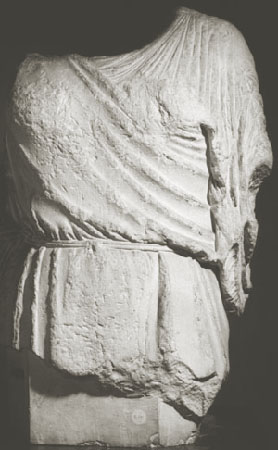
Female torso.
Commentary Prepared by Dr. Julia Lenaghan, Ashmolean Museum
C 069
Torso Fragment in the "Corinth Persephone" Type. Vatican
Marble
Statue Fragment
Over life-size
Probably found in Italy since it is part of the Vatican Collection
Italy, Vatican, Giardino della Pigna, 28
Preservation:The statue is preserved from the shoulders to the hips. The neck area has been hollowed out in order to receive an insert head. The right shoulder has broken off and the right arm is entirely missing. The left upper arm is preserved and there is a trace of where the forearm was dowelled onto it. The surface is worn.
Description:The statue depicts a female figure who wears two garments and a belt around the waist. Closer to the body, the statue wears an inner garment, chiton, that appears to be made of a thin material. Visible around the left shoulder and below the armpit it is rendered in numerous folds. Over the chiton is a heavier garment which has only a few broad folds. The mantle is fastened only on the right shoulder with the result that its upper edge crosses diagonally from the right shoulder to the left armpit. At the waist the mantle is girded by a cord; under the cord the mantle falls as if it were a pleated skirt. The pleats on the right side are more tightly packed together and are heavier. Finally, on the right side of the body, the two lateral edges of the mantle come together.
Discussion:The “Corinth Persephone” body type is known in six copies of varying degrees of preservation; in fact, two of the fragments may come from the same statue. The six copies are a headless statue in Corinth (the best preserved example of the type); the Vatican fragment (under discussion here); an upper body fragment now lost which had been in the Antiquario Communale del Celio in Rome; a fragment of the plinth, feet, and lower shins in the Colosseum which may be from the same statue as that formerly in the Antiquario Communale; thirteen cast fragments from Baiae; and a small-scale copy fin the Museo Nazionale Romano (formerly in the Venetian collection at Palazzo Mocenigo). After its two most complete versions the type is sometimes referred to as the “Corinth-Mocenigo” statue.
The complete versions of the statue allow us to reconstruct the rest of the Vatican statue. It would have stood with its weight over the right leg and foot of the relaxed left leg would have turned outwards. The right arm would have been lowered with the forearm coming slightly forward. The left arm, bent at the elbow, formed a 90 degree angle with the forearm projecting directly outward from the body. The inner chiton would have been visible from the shins to the feet and on the arms where its buttons would even have been visible. The mantle, it turns out, would have been folded downwards; the line, visible in the Vatican statue, from the left waist to the right shoulder represents the crease of the fold. The folded area reaches the level of the knees. It hangs slightly lower on the right side. The surface of the statue is marked by contrast between the broad flat geometric folds of the heavier mantle and the closely packed crinkly folds of the chiton.
The Baiae cast fragments are presumably taken directly or indirectly via another cast from the original statue and are, thus, the best point of comparison. The Vatican fragment shows a relatively good awareness of the details of the original but renders the mantle stiffly and without its appropriate size. It also eliminates much of the pronounced contrast between the mantles and chiton. According to Landwehr this type of copying is characteristic of the Flavian period.
The original model has aspects of the Severe style. Its flat surface areas and its simple geometry have been compared to the Aspasia/Sosandra and, consequently, placed in the same time frame. It should, however, be pointed out that the manner of dress, especially the long-sleeved chiton and the peplos fastened only on one shoulder, is slightly unusual and nothing similar is attested in dated monuments before the Parthenon metopes. Landwehr compares the statue to the Athena Lemnia. The statue is assigned either to 470-460 or circa 450. This latter date appears in the most recent publications (Landwehr and LIMC).
Contrary to this general opinion, Ridgway considers the type to be classicizing and to be an invention of the Roman period. She notes that it resembles the Cherchel/Tralles karyatids and a figure on an attic sarcophagus of Antonine, that the sandals are of a Hellenistic type, and that the dress is unusual. Her opinion also seems to be influenced by the statue found together with the “Corinth Persephone” at Corinth which follows a decidely non-classical prototype.
The discussion of the subject of the original statue revolves around the Corinth and the Mocenigo examples. The Corinth statue was found in the sanctuary of Demeter and Persephone at Corinth with another statue; it would seem logical that it represented either Demeter or Persephone. A copy of the other Corinth statue was found with its head on the Esquiline Hill in Rome (now in the Conservatori Museum). This head type, which features short-hair, is known in other replicas and is deemed on account of the short hair to be Demeter. Paribeni, who believes the “Corinth Persephone” type to have represented Persephone and who attempts to associate the long haired “Budapest-Barracco” head type (see discussion under cat. no. C 61), points out the Antiquario Communale “Corinth Persephone” fragment was also likely to have been found on the Esquiline. Thus, in two separate locations, Corinth and the Esquiline, one has the same pair of statues.
There has also been and there remains serious doubt about whether the two statues found in Corinth were actually intended as a pair. Thus, both Corinth statues might have represented Demeter. The Mocenigo copy of the “Corinth Persephone” features a horse’s head protome near the feet. This, however, has been shown to be equally appropriate for Demeter or Persephone. With the horse protome as an essential key to his argument, Homann-Wedeking, suggested that the statue type was copied from the statue of Demeter Melaina made by Onatas for the Phigalians and mentioned by Pausanias (8.42.7); Pausanias describes the statue which Onatas’ replaced as seated and featuring a horse’s head. The objections to Homann-Wedeking’s identification are that Pausanias’ description does not give any detail of Onatas’ statue, and, moreover, there is nothing particular to connect the statue to Onatas’ Demeter apart from its tenuous identification as Demeter and the horse’s head which appears elsewhere in conjunction with Demeter.
Along with the fragments of the statue type found in Baiae were fragments of a torch. Because the subject of the statue seems likely to have been Persephone (or Demeter), the torch has been associated with this statue. In addition, the figure of Persephone on the Great Eleusinian Reliefs holds a similar torch. Yet, Guntner in LIMC is incorrect in asserting that the Baiae torch makes the Persephone identification secure; the torch in no way excludes the identification of the statue with Demeter.
The Demeter identification is to be excluded more on the basis of the second statue from Corinth which certainly shows Demeter, the possibility that the type of dress shown on the “Corinth Persephone” type is bridal, and that Persephone appears in vase painting dressed in a manner similar to but not exactly the same as that of the statue.
As noted above and under C 61, Paribeni has attempted to connect a head type, the “Budapest-Barracco” type, with the statue. It is almost certainly a head of Persephone. The type has not been entirely accepted as joining since the Mocenigo statuette features locks on the shoulders that would not correspond to the “Budapest-Barracco” type. Judging by the statuette of the Hestia Giustiniani, one might suspect that such statuettes are not always exact copies. Berger (AntK 17 1974 p.135 footnote 123) has suggested that the original head might rather be an unpublished head with a crown in the Conservatori collection (Helbig 4th edition II p.442 no.1647).
Bibliography:W. Amelung,
Die Skulpturen des vaticanischen Museums I (Berlin 1903) pp.825-826 no.29 pl.91
brief catalogue entry without measurements or provenanceE. Homann-Wedeking,
"Zu Meisterwerken des strengen Stils" (RM 55 1940) pp.208-214
suggests that the "Corinth Persephone" type represents the Demeter Melaina of OnatasB. S. Ridgway,
The Severe Style in Greek Sculpture (Princeton 1970) pp.71-72
summarizes the academic discussion of the "Corinth Persephone" statue typeB. S. Ridgway,
"Sculpture from Corinth" (Hesperia 50 1981) pp.439-440 especially footnote 72
considers the prototype to be classicizing on the basis of the sandals, comparisons to other classicizing works, and the dressC. Landwehr,
Die antiken Gypsabgüsse aus Baiae (Berlin 1985) pp.47-48, 54-56
discussion of the type and copy critique, suggests that the type represents Persephone but does not exclude Demeter(G. Guntner),
"Persephone" Lexicon Iconographicum Mythologiae Classicae VIII (Zurich 1997) pp.957 no.1 and 977
comments that the Baiae cast ensures that the type represented Persephone