Commentary Prepared by Dr. Julia Lenaghan, Ashmolean Museum
C 063
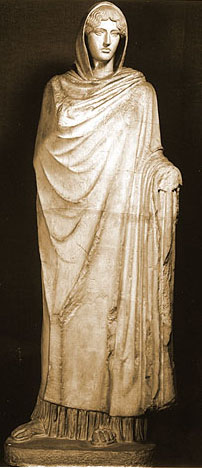
Statue in the "Aspasia/Sosandra" Type, Composed of Separate Head and Body. Berlin
Marble
Statue
1.97 m
From Aquino in Italy.
Germany, Berlin, Staatliche Museen, Antikesammlung, 167
Preservation:Head: The nose and parts of the drapery alongside and above the face are restored. Body: The statue is broken through at the knees. The join has been filled with plaster. The left hand is missing and the drapery hanging from it has been restored. Part of the left foot and the big and second toes of the right foot are plaster restorations. The front part of the plinth has been restored in marble. The back corner of the drapery which hangs down behind the left shoulder has broken off. The surface is abraded over the right hand. The statue seems to have stood out of doors for a long period since the head, shoulders, and outstretched left hand are particularly weathered.
Description:Head: The head is enshrouded by the himation. Below the hood created by the himation, the hair appears over the brow. It is parted in the center and, arranged in symmetrical waves, it is pulled toward the back. A lump at the back of the head under the himation indicates that it was pulled into a bun just below the crown of the head. The hair on the brow provides a symmetrical frame. It forms a peak at the part and has two corresponding upswings over the center of the eyes. It then touches the outer corner of each eyebrow. The hair is rendered in thick locks which are separated from each other by broad grooves. Within the locks are shallower and narrower grooves to delineate strands.
The face has a harmonious oval contour. The smooth flat cheeks merge together in a solid U-shaped chin. The brow is tall and features almost horizontal eyebrows. Below the eyebrows are wide eyes which are framed by sharply defined and deeply cut lids. The lips are shapely. The upper lip has a central overhang and the lower lip is full and pouting.
Body: The statue stands with its weight over the left leg. The right arm folds over the body so that the right hand rests near the right breast. The left arm rests by the side of the body but is bent at a 90 degree angle. Thus, the left forearm projects out from the body. The statue is draped in a himation, which covers the body from the head to the lower shin, and a chiton, which appears below the bottom hem of the himation and extends to the ground. The feet wear sandals. The chiton a has numerous vertical folds which suggests a fine material. The himation has few folds and appears to be of a heavier material.
The heavy himation, which is wrapped around the entire body with its end thrown over the left shoulder, conceals the rounded human forms beneath it. The himation appears as a broad uniform surface traversed by sparse geometric folds which inorganically mark features of the human anatomy. For instance, the right arm is indicated by angular folds which drop from the right shoulder to the breast area and then rise to the left shoulder. The pattern is repeated on a larger scale to indicate the bent right knee; folds drop to the knee from the right arm to the knee and then from the knee rise to the left shoulder. The straightness of the left leg is indicated by the straight fold which falls from the left shoulder to just above the left foot. On the back of the statue there are virtually no folds. The bottom hem of the himation encircles the shins of the statue and appears as if it were the bottom edge of an unclosed cylinder. The himation gives the statue a simple geometric aspect.
Discussion:Both the head type and the body type are well known. In total there are thirty replicas of they type; twenty-nine are listed by Guerrini and another was recently found in Aphrodisias (Smith fig.9). Thirteen of the replicas are heads, ten are full-scale statues, six are statuettes, one is a relief, and one is reworked into a portrait head. Only one of the full-scale statues, however, preserves a head. This is the statue found in Baiae in 1953. Amelung, however, already in 1900 had realized that the head and body type derived from the same statue. To prove this hypothesis, he had a composite cast of the Berlin head and the Berlin body made. This is the cast which is now in the Ashmolean Cast Gallery.
The statue type is generally referred to as “Aspasia” or “Sosandra”. The name “Aspasia”, that of Pericles’ learned mistress, was given by Bernoulli because of the general date implied by the head’s style. Though universally dismissed as a serious attribution, the name is still used. The name “Sosandra”, introduced and explained fully by Orlandini, derives from a passage in Lucian in which Lucian compares the mistress of Lucius Verus to numerous statues (Lucian,Eikones.6). He speaks of the simplicity, the propriety, and the mantle which are like those of the “Sosandra”, a statue he attributes to Kalamis and locates on the path to the Athenian Acropolis. Pausanias (I.23.2) also speaks of a statue of Kalamis on the path to the Acropolis. He, however, calls it a statue of Aphrodite. Thus, the statue type under discussion here is sometimes referred to as “Aphrodite Sosandra”.
Other identifications have included Demeter (Fuchs most recently), which has attracted little attention, and Europa, which appears to be the most likely. The argument for Europa, which is supported and espoused by Robertson and Harrison, is based on three similarly represented figures all of which can be securely identified as Europa: 1) A statuette of the type in the Metropolitan Museum of New York (Richter, 1954 pp.25-26 no.30 pl.29), which is inscribed Europa; 2) on an attic red-figure calyx krater in Adolphseck (Robertson pl.60 c); 3) a Roman sarcophagus in Cliveden (Harrison pl.33a) which depicts the story of Theseus. Moreover, the covered head and thoroughly enveloping garment would be appropriate for a bride, i.e. Europa, about to depart from her paternal home. In addition, at least three replicas of the type were found on Crete (cf. Guerrini). This frequent appearance in Crete might be explained by the biography of Europa who was taken to Crete by Zeus and who gave birth to Zeus’ children, among whom was Minos, in Crete.
There is no doubt, regardless of the subject of the statue, that the original statue dated to the Early Classical period. The simplicity, the geometric aspect, and the facial features all support this. The statue has often been compared to the Omphalos Apollo and the Hestia Giustiniani, to which its original must have been contemporary.
The date of the statue copy in Berlin is given readily by the portrait head which it preserves. The portrait head is Antonine and thus, the statue is Antonine; (Blumel’s assertion that the head has been reworked is probably incorrect). The date of the copy of the head in Berlin is generally given as Hadrianic and the work is thought to show signs of the Hadrianic neo-classicism.
Bibliography:W. Amelung,
"Weibliche Gewandstatue des funften Jahrhunderts" (RM 15 1900) pp.191-197
first realized that the head type and the body type derived from the same originalJ.J. Bernoulli,
Griechische Ikonographie I (Munich 1901) p.115
gives the type the name AspasiaC. Blümel,
Staatliche Museen zu Berlin. Katalog der Sammlung antiker Skulpturen: Römische Kopien Griechischer Skulpturen des funften Jahrhunderts v. Chr (Berlin 1931) pp.27-29 K 167 pls.53-54 fig.4
catalogue entryV. Poulsen,
"Der Strenge Stil: Studien zur Geschichte der Griechischen Plastik 480-450" (ActaA 7 1937) pp.598 and 605 Epilogue notes 23 and 39
P. Orlandini,
Calamide: Le fonti, riscostruzione della personalita di Calamide attraverso le fonti, il problema della Sosandra (Bologna 1950) pp.90 ff
dates original to ca.465, assigns it to Kalamis, locates it on Athenian Acropolis according to Lucian and Pausanias, conflates Lucian's Sosandra and Pausanias' Aphrodite of KalamisW. Helbig (H. von Steuben),
Führer durch die öffentlichen Sammlungen klassischer Altertumer in Rom II (4th edition) (Tübingen 1966) pp.45-46 no.1197
dates ca.460B. S. Ridgway,
The Severe Style in Greek Sculpture (Princeton 1970) pp.65-69
evaluates research on typeL. Guerrini,
"Copie romane del tipo 'Aspasia/Sosandra' da Creta" (CronArch 13 1974) pp.227-234
latest replica list with 29 entries, avoids discussion of subject of original statueM. Robertson,
A History of Greek Art (Cambridge 1975) pp.193-194
probably EuropaE. Harrison,
"The Portland Vase: Thinking it Over" In Memoriam Otto Brendel (Mainz am Rhein 1976) p.140 pl.33a
cites the Cliveden sarcophagus as further evidence that the "Aspasia-Sosandra" type represented EuropaA. Delivorrias,
"Aphrodite" Lexicon Iconographicum Mythologiae Classicae II (Zurich 1984) pp.23-24 no.148
summarizes the arguments concerning the original subject of the "Aspasia-Sosandra" type in section on Aphrodite,
"Europe" Lexicon Icongoraphicum Mythologiae Classicae IV (Zurich 1988) p.76 no.1
restates argument that the original subject of the type was EuropeW. Fuchs,
Die Skulptur der Griechen (Munich 1993) p.186
dates to ca.460, by a Peloponnesian artist, probably DemeterR.R.R. Smith,
"Archaeological Research at Aphrodisias 1989-1992" Aphrodisias Papers 3, JRA Supplement 20 (1996); K.T.Erim, "The Satyr and Young Dionysus Group from Aphrodisias" in Melanges A.M.Mansel (Ankara 1974) pp.767-75 (Michigan 1996) p.19 fig.9
latest replica of the typeMarble
Head
29.5 cm
The provenance is unknown
Germany, Berlin, Staatliche Museen, Antikesammlung, K 166
Bibliography:W. Amelung,
"Weibliche Gewandstatue des funften Jahrhunderts" (RM 15 1900) pp.181-197 pls.3-4
first realized that the head type and the body type derived from the same originalJ.J. Bernoulli,
Griechische Ikonographie I (Munich 1901) p.115
gives the type the name AspasiaC. Blümel,
Staatliche Museen zu Berlin. Katalog der Sammlung antiker Skulpturen: Römische Kopien Griechischer Skulpturen des funften Jahrhunderts v. Chr (Berlin 1931) p.27 K 166 pls.51-52
catalogue entry, considers the Berlin head to be finest example of the type, dates ca.120 CEV. Poulsen,
"Der Strenge Stil: Studien zur Geschichte der Griechischen Plastik 480-450" (ActaA 7 1937) pp.598 and 605 Epilogue notes 23 and 39
P. Orlandini,
Calamide: Le fonti, riscostruzione della personalita di Calamide attraverso le fonti, il problema della Sosandra (Bologna 1950) pp.90 ff
dates original to ca.465, assigns it to Kalamis, locates it on Athenian Acropolis according to Lucian and Pausanias, conflates Lucian's Sosandra and Pausanias' Aphrodite of KalamisW. Helbig (H. von Steuben),
Führer durch die öffentlichen Sammlungen klassischer Altertumer in Rom II (4th edition) (Tübingen 1966) pp.45-46 no.1197
dates ca. 460B. S. Ridgway,
The Severe Style in Greek Sculpture (Princeton 1970) pp.65-69
evaluates research on typeL. Guerrini,
"Copie romane del tipo 'Aspasia/Sosandra' da Creta" (CronArch 13 1974) pp.227-234
latest replica list with 29 entriesM. Robertson,
A History of Greek Art (Cambridge 1975) pp.192-193
probably EuropaW. Fuchs,
Die Skulptur der Griechen (Munich 1993) p.186
dates to ca.460, by a Peloponnesian artist, probably Demeter