Commentary Prepared by Dr. Julia Lenaghan, Ashmolean Museum
C 056
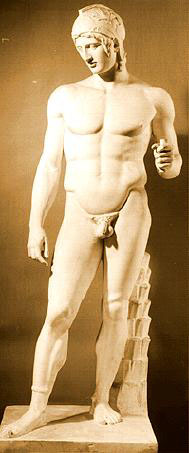
Ares Borghese. Louvre
Marble
Statue
2.112 m
Brought to Paris from the Borghese Collection in 1808. Thus, probably found in Italy.
France, Paris, Louvre, 866
Preservation:The restorations, which were done in the eighteenth century by Agostino Penna, include the tip of the nose, the fingers of the right hand, the left forearm, the penis, the toes of the right foot, the big toe of the left foot, the top of the palm tree support, and the strut connecting the right wrist to the right thigh. The crest of the helmet was also once restored but has now been removed. There are breaks at the right elbow, the right wrist, above the left biceps (the join here is filled with plaster), below the right knee, at the right ankle, and below the left knee. Various (three or four?) holes, on the outer left thigh , on the outer side of the left torso, and on the outside of the left gluteus, have been filled. A hole above the ankle band on the inside of the leg has been filled with lead.
Description:The statue depicts a naked male who is clean-shaven and wears an Attic helmet. It stands with its weight on the left leg; the left is, thus, slightly higher than the right hip. The right leg is a pace in front of the left leg and is almost straight. The right foot is flat on the ground and points to the right, forming a 45 degree angle with the frontally facing left foot. The torso faces front. The lowered right arm rests along the side of the body. The left upper arm is pulled backward; the left forearm is not preserved. Yet several holes in the area between the abdomen and the thigh on the outer left side of the body indicate that the left arm held an attribute. The head turns to the right and looks downward.
The body features fully developed musculature. The shoulders are particularly broad and the butthocks are heavy. The area around the neck, shoulders, and clavicle as well as the area between the upper abdominal muscles and the illiac furrow are carefully delineated. The right ankle features a raised band which is about two centimeters wide. On the inside of the leg just above this band is a downwardly drilled hole. The band may be either a fetter or an anklet such as is worn by heros, youths, soldiers, and women on vase painting.
On the head is a pseudo-Attic helmet; it has a semi-spherical bowl, a neck guard, no cheek pieces, and a visor that follows the front line of the bowl. The bowl of this statue’s helmet is decorated on each side with a griffin in raised relief and between the griffins on the front of the helmet is a palmette. Running down the center of the bowl would have been a crest, the raised support for which is still extant. The visor of the helmet is divided into two parts which are separated by raised edges. The lower section of the visor is decorated with two “Laconian” dogs that face each other. The upper and more narrow forehead piece is undecorated but ends in volutes.
Below the helmet emerge straggling, not distinctly defined, locks of hair of various lengths. At the center of the brow the hair appears to have a part; the hair is short here and combed from the part to the sides. Between the temples and the ears, the hair is long and reaches down toward the jaw line. Below these whiskers the surface is abraded. The ears are uncovered by the hair which emerges again under the neck guard. The long hair on the nape is combed forward almost horizontally.
The face long smooth oval shape. The brow swells slightly in the middle of the forehead. The eyebrows are sharply defined and hood large eyes. The arched upper and lower lids of the eyes are mirror reflections. The bridge of the nose is broad and flat. The mouth is wide and the lips are slightly parted. The lower lip is fuller and more fleshy than the upper lip. The chin has a solid “U” shape.
Discussion:The statue, known as the “Ares Borghese”, is the best preserved copy of a type which is known in twenty-one replicas (including this statue) and in about eight portrait statues. Strikingly all but four of the replicas and the portrait statues have an Italian (and perhaps Roman provenance). The five that do not come from Leptis Magna, Side, Antalya, Antioch on the Orontes, and Sophia. The statue from the Borghese collection, now in the Louvre, has been dated to the Hadrianic period because of the rendering of the eyes and hair.
Three facts assure us that the type was intended to represent Ares-Mars. First, the statue wears a helmet which is decorated with dogs and griffins. Dogs were sacred to Ares and represented his capacities as guardian, defender, and avenger. Griffins are connected to both Nemesis and Apollo; Ares at times has the same avenging capacity as Nemesis. Second, the statue probably held a shield and perhaps a spear. The marks left by large struts on the left side of the body, the position of the left upper arm, and a strut on the Side example indicate that the left arm was bent and held a shield. The additional holes on the left side and the Leptis Magna example which holds a spear suggest that a spear was also held. (Several portrait statues and the non-pertinent torso of the Dresden example have sword belts that run from the left shoulder to the right hip. These, however, appear to be copyists additions.) Third, frequently the type is used as a portrait statue which is paired with a portrait statue of a woman in the Venus of Capua type. The helmet, the shield, and the pairing with Venus seem justifiably to identify the subject of the “Ares Borghese” type as Ares-Mars.
The body and the face appear stylistically to belong to the fifth century. The body has been compared both to the so-called “Diskobolos of Naukydes”, which it resembles in stance, and to the “Doryphoros” of Polykleitos. The similarity to the Doryphoros is undeniable. The physical structure and proportions of the body as well as the position of the head and arms are very similar. The main difference lies in the choice of weight leg and the forward position of the free leg. In addition, as pointed out by Hartswick, the size and shape of the head is also remarkably close.
The late fifth century style of the statue type has led most scholars to accept a proposal made by Conze in 1869 which connected this statue of Ares to the only extant literary reference to a fifth century statue of Ares. The reference belongs to Pausanias (1.8.4) who saw two statues of Aphrodites, a statue of Athena, and a statue of Ares, made by Alkamenes, in the Temple of Ares in the Athenian Agora. In addition to the fact that the type is the only preserved, potentially fifth century, statue of Ares and was well known, two other details are used to support the hypothetical connection. The sanctuary of Ares was moved into the Agora by Augustus; this would explain the popularity of the type, which is undocumented before the Augustan period, in the imperial era. Furthermore, Pausanias is unclear as to whether the statue of Athena was also by Alkamenes. That the “Ares Borghese” type opens to its right suggests that it formed part of group. Slightly south of the Ares temple in the Agora a large original torso of Athena has been found and is associated by Delivorrias and Vierneisel Schlorb with the statue of Athena Areia. Its stance is appropriately the mirror reflection of that of the “Ares Borghese.”
Although the attribution of the “Ares Borghese” type to Alkamenes may be considered speculative, no scholar had doubted that the original “Ares Borghese” belonged to the fifth century until K. Hartstwick. Hartswick found elements of both the helmet and the hairstyle as well as the whiskers depicted in some copies of the type to be unusual for the fifth century. Basing his conclusions on a study of helmets by P. Dintis, Hartswick states that the helmet cannot date before the late Hellenistic period. Yet, the basic helmet type is attested in fifth century painting. For instance, it is worn by Ares on a calyx krater in New York [G.M. Richter and L. Hall, Red Figure Athenian Vases in the Metropolitan Museum of Art (London 1936) pp.160-161 pl.126 no.127] and called by Richter “Thracian”. The differences between the helmet on the vase and that worn by the statue are that the visor projects and there are cheek pieces on the vase depiction. In both of these areas on the statue straggly undifferentiated locks hang limply down. This unusual hairstyle is generally explained as an allusion to Ares’ Thracian origins (most recently, Simon). Hartswick, however, noting that it is similar to the hairstyle of the so-called Eros Soranzo as well as a fourth century terracotta from Italy, believes it to be Italic. He also asserts that the side burns and whiskers, though they appear on young men in 5th century vases, are more typical of Julio-Claudian portraiture.
Hartswick also claims out that the volutes of the helmet date after the second century BCE. These volutes, however, are not terribly dissimilar to those on the “Thracian” helmet depicted on the Met calyx krater. In addition, although the griffins of the helmet are generally explained with a comparison to the helmet of Athena Parthenos and the dogs are cited as particular to Ares (cf. Simon), Hartswick claims that the griffins are a Roman and particularly Augustan motif and that dogs also are more popular in the Roman period. This seems an odd assertion given the appearance of griffins in fifth century art (cf. a neck amphora in the Metropolitan Museum in New York). Hartswick does, however, introduce a Roman bronze parade helmet dated to the end of the first or second century CE which is strikingly similar in form and decoration to the helmet of the Ares statue; it has the exact same decoration as the helmet, no cheek pieces, and visor which follows the line of the helmet’s bowl.
Hartswick would like to interpret the original statue of the “Ares Borghese” type as a Roman creation which adapted a fifth century Greek statue of a hero. The Roman additions to the statue would include the helmet, the hair, and the side burns. This adaptation he believes to have occurred in conjunction with Augustus’ promotion of his grandson, Gaius Caesar, who was called the “New Ares.”
Hartswick’s argument is not, however, convincing since the helmet decoration, side burns, and even the not fully grown in whiskers appear in vase painting in the fifth century. It is also unlikely that in the Roman period a sculptor would have created a statue of Ares, which became so thoroughly connected to Ares, from a statue of another subject. If the original statue had been of another subject, we would expect that it would somewhere be represented in its original form. Furthermore, the use of the statue type with the Venus of Capua type for portraits suggests that in the Roman world it had, like the Venus of Capua, a similar “famous earlier statue” connotation. It seems best, therefore, to conclude that the statue type was a fifth century type that probably represented Ares.
Moreover, among the copies the variation in the helmet decoration and in the presence of whiskers indicates that these were areas in which a copyist might make small interventions. One might even speculate that the original statue did feature cheek pieces and a projecting visor which have been omitted from the simplified or rather up-dated copies. The omission of these elements would reveal an undeveloped pattern for the hair that may have been mainly concealed in the original.
Bibliography:B. Freyer,
"Zum Kultbild und zum Skulpturenschmuck des Arestempels auf der Agora in Athen" (JdI 77 1962) pp.211-226
notes traces of struts on the outer side of the left thigh and gluteus-- used as evidence for a spear that went from the ground behind the statue to the left hand to the space in front of the statue; considers the anklet part of the original statueW-H. Schuchhardt,
Alkamenes (Berlin 1977) pp.33-37 figs.34-35
believes it to be the Ares of Alkamenes though notes difficulties in finding stylistic similarities to other works by AlkamenesB. Vierneisel-Schlörb,
Katalog der Skulpturen Band II: Klassische Skulpturen des 5 und 4 Jahrhunderts v. Chr. (Munich 1979) pp.178-185
considers the Louvre statue to be a Hadrianic work and to be a copy of a statue of Ares by Alkamenes which was marbleE. Simon,
"Ares/Mars" Lexicon Iconographicum Mythologiae Classicae II (Zurich 1984) pp.512-513 no.21
notes generally considered Ares of Alkamenes, considers hair to be a Thracian aspect, notes helmet decoration like that of Athena Parthenos with additional dogs which were sacred to AresK. Hartswick,
"Ares Borghese Reconsidered" (RA 1990) pp.227-72, 272-284
gives latest replica list, believes the statue to be a Roman invention connected to Mars Ultor and the promotion of Gaius Caesar, but that it is based on a fifth century Greek statue of another subject.W. Fuchs,
Die Skulptur der Griechen (Munich 1993) pp.95-96 no.86
considers type to be a copy of Alkamenes statue, dates it between 421-417 BC