Commentary Prepared by Dr. Julia Lenaghan, Ashmolean Museum
C 055
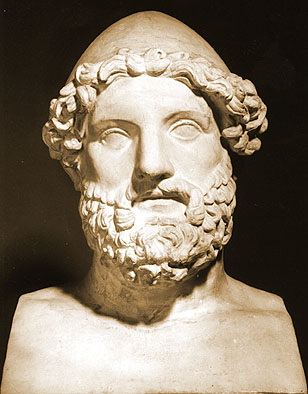
Herm of Hephaistos, Copied from Statue of Alkamenes. Vatican
Marble
Herm
55 cm
From Rome. Found in 1885 in Piazza di Spagna.
Italy, Vatican, Museo Chiaramonti, 86 inv.1211
Preservation:The locks above and near the left eye, part of the right ear lobe, the nose, the front left edge of the pilos, the front left side of the bust, and patches on the right breast and the front part of the right shoulder are restorations. In addition, the right lower eyelid and several locks of hair are damaged.
Description:The herm bust portrays a bearded man who wears a pilos and tilts toward the right. The pilos, the smooth conical cap, sits on the head a few centimeters above the ears. The hair, which appears below the pilos, falls in short unruly locks. These locks have a small central part over the nose; leave the ears uncovered; curl upward over the bottom edge of the pilos; and build up in mass between the temples and the ears. In front of the ears the locks are particularly curly and at the back they are summarily rendered. The hair crosses the brow in a gentle arch.
The face has a broad oval shape and is slightly asymmetrical; the left side is broader and the features on the left side are set above those of the right side. The lower part of the tall brow bulges and the eyebrows beneath it seem flat. The cheek bones and the eyes are wide set. The open regularly-shaped eyes do not feature convex eyeballs. The bridge of the nose is broad.
The beard conceals most of the lower face. It begins below the cheek bones and is rendered in tiers of locks. These locks vary in length; the locks of the top tier are shorter and straighter than those of the lower tier. Again there is a slight discrepancy between the right and left side of the face. On the left side the locks of hair are more carefully rendered; they are longer and have greater volume and curl. Below the lower lip the beard does not immediately begin but rather leaves a small uncovered space. Where the beard does begin below the lip it has a distinct central part. The moustache, which covers the upper lip, also has a central part. Below the corner of the lips the moustache joins the beard; at this point on each side it features two large locks which curl inwards.
The bust itself extends only to the middle of the sternum. On both sides it has rectangular holes for the addition of separately worked parts. At the back it is not fully finished.
Discussion:IIn 1863 Brunn recognized Hephaistos to be the subject of this herm bust. Furtwangler then associated it with a statue, mentioned by Cicero (Nat.D. 1.30) and Valerius Maximus (8.11), of Hephaistos made by Alkamenes. Since Alkamenes was a pupil of Pheidias and the features and structure of the head appear to date to the end of the fifth century, the connection of the herm bust to the statue of Alkamenes has been universally accepted.
In another likely association, Alkamenes’ statue of Hephaistos is connected to the cult statue of Hephaistos which was paired with a cult statue of Athena in the Hephaisteion in Athens. These statues were seen by Pausanias (1.14.6). As evidence for the cult statues of the Hephaisteion we have, in addition, inscriptions on which the expenses for the statues were recorded. They date the initial undertaking of the statues to 421/420 BCE and continue into 416/415 BCE; the statues may or may not have been finished by this date. In any case, these years correspond to the expected date of a cult statue by Alkamenes. Thus, though certainly not provable, most scholars believe that Alkamenes made the cult statue of Hephaistos, begun in 421 BCE, for the Hephaisteion in Athens.
Judging from, above all, representations of Hephaistos on Roman clay lamps found in Athens, a marble torso-also from Athens, Roman reliefs (especially from the Column in Mainz), a small Roman statue from Ostia, about fifty bronze statuettes, a gem in Berlin, as well as coins, various scholars have attempted to reconstruct the statue. Because none of the above cited representations copy each other exactly, although they give the same general details, scholars are agreed on certain aspects of the Hephaistos statue’s appearance and contest others. The statue probably wore a pilos and an exomis that reached to the knees and did not cover the right shoulder; this is what is attested in the Roman period representations. The fact that the first securely dated image of Hephaistos wearing an exomis is ca. 400 BC (a fragment of a bell krater from Olynthos now in Thessaloniki) does not necessarily have a significant bearing on the cult statue, though it should be noted that ca. 420 BC Hephaistos appears in vase painting generally dressed in a decorated short chiton. Relatively uncontested among the reconstructions are that the statue held a hammer in the lowered right arm, rested its weight on the right leg, and turned its head to the right. The position of the left arm, raised or lowered, and the attribute held in the left hand, torch or forceps, remain unclear.
The head of the Vatican herm bust is agreed to be based on this statue of Hephaistos because it turns to the right, wears a pilos, has the appropriate hairstyle, and is over-life size. It is, however, impossible to judge how closely it follows the original model.
Bibliography:W. Amelung,
Die Skulpturen des vaticanischen Museums I (Berlin 1903) pp.584-585 no.420 pl.61
catalogue entryS. Papaspyridi-Karusu,
"Alkamenes und das Hephaisteion" (AM 69/70 1954) pp.69-70 Beilage 32.3
considers Vatican herm bust to represent Hephaistos of Alkamenes which was in the Hephaisteion, believes Empidockles' Lamp depicts whole statueW. Helbig (H. von Steuben),
Führer durch die öffentlichen Sammlungen klassicher Altertumer in Rom I(4th ed) (Tübingen 1963) pp.230-231 no.293
E. Harrison,
"Alkamenes' Sculptures for the Hephaisteion" (AJA 81 1977) pp.146-150
believes that the Vatican herm bust represents Hephaistos of Alkamenes which was in the Hephaisteion with a statue of Athena (Athena Velletri type). Thinks that with left arm raised Hephaistos held a torch.F. Brommer,
Hephaistos (Mainz am Rhein 1978) pp.75-90, 238 pl.46.1
believes Vatican herm bust represents Hephaistos of Alkamenes which was the cult statue in the Hephaisteion, thinks the Berlin gem correctly depicts the cult statues, i.e. Hephaistos on the right and holding forceps in lowered left hand.,
Bildniskatalog der Skulpturen des vaticanischen Museums I (Berlin 1995) vol.2 pl.627 and vol.3 p.55