Commentary Prepared by Dr. Julia Lenaghan, Ashmolean Museum
C 053
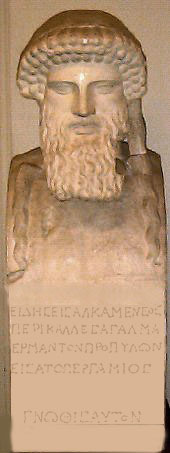
Hermes of the "Pergamon" type, related with Alkamenes. Istanbul
Marble
Herm
1.19 m, head from the end of the beard up 40 cm
From Pergamon. Found on the street leading from the lower Agora to the Gymnasium. It probably fell downward from a house built on the terrace above. Two other herms (one of the the owner of the house) were found in such a house, which belonged to the Roman consul Attalos and was remodelled in the second century AD.
Turkey, Istanbul, Archaeological Museum, 1433
Preservation:The bottom of the herm is broken diagonally from the left side upward to the right side. The break runs through the genitals and the right testicle is missing. At the top of the herm the head has broken off and been reattached; the break, traversing both hair and beard, runs from the left shoulder to the right breast. Under the left cheek a piece of the beard is missing and the free-hanging lock of hair behind the left ear is missing. On the right side a piece of the beard has been reattached and the free-hanging lock of hair is chipped. On both sides near the tip are rectangular holes for insertion.
Description:The herm features a bearded male head and five lines of text. The bearded male has a rectangular face; the hair crosses the brow in a horizontal line and the eyebrows are also horizontal. The nose is broad and the lips are full and well defined but short from side to side. A long beard begins high on the cheeks and continues well below the chin. It is made of layers of straight hairs which bend at their ends and which form a solid mass. It is cut horizontally under the chin.
The hair is long and radiates from the crown of the head. Running above the ears and around the head is a small round band. This keeps the hair, which is not rendered, pressed against the skull. Below the round band and at the front between the ears, the hair comes forward in three tiers of corkscrew curls. Of the lower two tiers only the curled ends are visible. Behind each ear, a large lock of hair falls downwards and comes forward on to the chest, reaching the pectoral zone. The remainder of the hair is loosely gathered and rests on the back of the neck. This hair is only summarily worked since the back of the plinth is unworked.
On the herm itself is the following inscription:
???????s??????????s?
?????????s???????
????????????????????
???????????????s
?vacat)
????????????
Below the last inscribed line is a depiction of male genitalia and curly pubic hair.
Discussion:This Hermes herm type, which is now called the “Pergamon Herm” type exists in three other copies: a herm bust in Berlin (inv.no.107), a herm bust in the Barberini Collection in Rome, and a fragment from the Athenian Agora (S 1900). The Pergamon herm, in comparison with the other copies of the “Pergamon” type is less rigorous and of poorer artistic quality. The back is unfinished; certain details are omitted (for instance, a short corkscrew curl above the ears and the tie which holds the locks that flow onto the nape); the rendering uses sharp incised lines and shows a lack of mastery of volume. The lettering of the inscription has been dated to the second century AD and thus, so has the herm.
The inscription on this herm and a passage in Pausianas have allowed for a great deal of scholarly speculation. The inscription names Alkamenes as the artist of a “Hermes pro pylon”. Pausanias (I.22.8) mentions a Hermes as well as three Graces at the Propylon in Athens which he claims were the works of Sokrates. Thus, many scholars have doubted the accuracy of Pausanias’ attribution or have asserted that Pausianias meant that only the Graces were by Sokrates. They then imagine that Pausanias saw a Hermes created by Alkamenes on the Athenian Akropolis. This original would then be what is reproduced in the “Pergamon” type. The head of the “Pergamon” herm type was therefore compared to the Ares Borghese and Procne, both of which are allegedly by Alkamenes.
There are several potential flaws in this hypothesis. The first is that there is no strong evidence that Alkamenes’ Hermes was on the Athenian Akropolis and that Pausanias’ account is incorrect. In fact, one, judging from this Hermes, Harrison points out that one would expect that the Alkamenes’ Hermes was signed which makes the possibility of an error by Pausanias slight. The main problem, however, with the thesis is that another Hermes of a different type, found in the Baths of Vedius at Ephesos, also bears an inscription that attributes it to Alkamenes. Moreover, there are over twenty replicas of this, the “Ephesos” type herm, in comparison to the four replicas of the “Pergamon” type. Because both types are replicated, there is no doubt that both were based on known original models. There is discussion about what and by whom these models were.
The original of the “Ephesos” type was deemed initially by Harrison in 1965 to have been slightly earlier than that of the “Pergamon” type which she dated between 430 and 410 BC. This date as well as what she considered to be the more refined composition of the “Pergamon” type made it in her opinion more likely that the “Pergamon” type represented a Hermes by Alkamenes. In 1979 Hermary supported half of her argument. He too believed that the “Pergamon” type was closer to the original of Alkamenes, yet he asserted that the original was at the Propylon of the Akropolis in Athens; this latter point Harrison doubted.
This Hermes herm type, which is now called the “Pergamon Herm” type exists in three other copies: a herm bust in Berlin (inv.no.107), a herm bust in the Barberini Collection in Rome, and a fragment from the Athenian Agora (S 1900). The Pergamon herm, in comparison with the other copies of the “Pergamon” type is less rigorous and of poorer artistic quality. The back is unfinished; certain details are omitted (for instance, a short corkscrew curl above the ears and the tie which holds the locks that flow onto the nape); the rendering uses sharp incised lines and shows a lack of mastery of volume. The lettering of the inscription has been dated to the second century AD and thus, so has the herm.
The inscription on this herm and a passage in Pausianas have allowed for a great deal of scholarly speculation. The inscription names Alkamenes as the artist of a “Hermes pro pylon”. Pausanias (I.22.8) mentions a Hermes as well as three Graces at the Propylon in Athens which he claims were the works of Sokrates. Thus, many scholars have doubted the accuracy of Pausanias’ attribution or have asserted that Pausianias meant that only the Graces were by Sokrates. They then imagine that Pausanias saw a Hermes created by Alkamenes on the Athenian Akropolis. This original would then be what is reproduced in the “Pergamon” type. The head of the “Pergamon” herm type was therefore compared to the Ares Borghese and Procne, both of which are allegedly by Alkamenes.
There are several potential flaws in this hypothesis. The first is that there is no strong evidence that Alkamenes’ Hermes herm was on the Athenian Akropolis and that Pausanias’ account is incorrect. In fact, as Harrison points out, one, judging from this Hermes, would expect that the Alkamenes’ Hermes was signed which makes the possibility of an error by Pausanias slight. The main problem, however, with the thesis is that another Hermes of a different type, found in the Baths of Vedius at Ephesos, also bears an inscription that attributes it to Alkamenes. Moreover, there are over twenty replicas of this, the “Ephesos” type herm, in comparison to the four replicas of the “Pergamon” type. Because both types are replicated, there is no doubt that both were based on known original models. There is discussion about what and by whom these models were.
The original of the “Ephesos” type was deemed initially by Harrison in 1965 to have been slightly earlier than that of the “Pergamon” type which she dated between 430 and 410 BC. This date as well as what she considered to be the more refined composition of the “Pergamon” type made it in her opinion more likely that the “Pergamon” type represented a Hermes by Alkamenes. In 1979 Hermary supported part of her argument. He too believed that the “Pergamon” type was closer to the original of Alkamenes, yet he asserted that the original was at the Propylon of the Akropolis in Athens; this latter point Harrison doubted.
Willers did a thorough publication on the “Hermes Propylaios” in 1967 and convinced most of the academic world (including Harrison), that the greater number of copies of the “Ephesos” type and what he interpreted as its unified composition showed that this was the type which correctly reproduced the Hermes of Alkamenes; (Willers and Harrison still dispute the date of the “Ephesos” type, see E. Harrison in Gnomon 53 1981 p.497). Willers believes that the “Pergamon” type was actually an early creation of the imperial neo-Attic school. He gleans this from the corkscrew locks, -a motif that he considers to begin in the fourth century-, and the straight layered locks of the beard which contrast with the locks of hair on the head. He suggests that the inscription of the Hermes found at Pergamon meant merely to evoke the Hermes of Alkamenes and was incorrect in suggesting that the “Pergamon” type was the Hermes of Alkamenes. Vierneisel Schlorb, who in principal accepts his argument, modifies it slightly. Rather than interpreting the “Pergamon” type as based on a Neo-Attic original, she believes its original to be a work of the early fourth century. Siebert in LIMC reflects the generally accepted opinion about the “Pergamon” type Hermes; he simply calls the “Pergamon” type a variant of Alkamenes’ Hermes.
Bibliography:M. Fullerton,
"The Location and Archaism of the Hekate Epiyrgida" (AA 1986 0) pp.669-670
summarizes arguments concerning Hermes PropylaiosF. Winter,
Altertumer von Pergamon VII.1. Die Skulpturen (Berlin 1908) pp.48-53 pl.9
E. Harrison,
The Athenian Agora XI: Archaic and Archaistic Sculpture (Princeton 1965) pp.122-124
believes that the "Pergamon" type Hermes may represent a work of Alkamenes but that there is no proof that this work was what Pausanias mentionsD. Willers,
"Zum Hermes Propylaios des Alkamenes" (JdI 82 1967) pp.75-86, espeically 75-78 figs.49-51
gives replica list of the type, considers the original to be an early Neo-Attic creationA. Hermary,
"A propos de l'Hermes Propylaios de Delos" (BCH 103 1979) p.146
considers the type to represent a Hermes of Alkamenes and that this Hermes was at the Propylon in AthensG. Siebert,
"Hermes" Lexicon Iconographicum Mythologiae Classicae (Zurich 1990) p.298 no.47
considers the type to be a variant of the Hermes of AlkamenesK. Stemmer (ed.),
Standorte: Kontext und Funktion antiken Skulptur (Berlin 1995) pp.187-189 B 48
summary of the research with emphasis on the find location