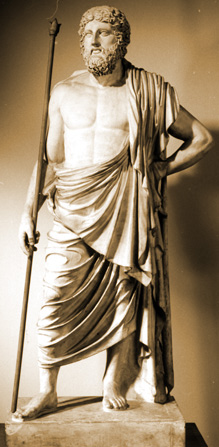
Commentary Prepared by Dr. Julia Lenaghan, Ashmolean Museum
C 049
Dresden Zeus. Dresden
Marble
Statue
From Italy. The statue was bought in 1728 from Cardinal Alessandro Albani. The report that it had been in the temple of Asclepius in Antium (Anzio), however, is false.
Germany, Dresden, Albertinum und Staatliche Kunstsammlungen, Skulpturensammlung, 68
Preservation:The right forearm, the scepter, the left arm from above the bicep to the wrist, the fingers of the left hand, the nose, the upper lip, parts of the eyelids, and parts of the hair are modern restorations
Description:The statue depicts a long-haired bearded male who wears a himation. The weight of the statue is on the left leg next to which, on the left side, falls the material of himation. The right leg is bent and the right foot, which faces to the right, is a step forward. The right arm is lowered; the right upper arm remains next to the body. The left arm was undoubtedly in the position that the restoration shows; that is, the upper arm probably moved to the left and downward and the forearm moved back toward the body. The left hand certainly rests on the hip with its palm facing to the left. The head looks to the right.
The statue wears a himation, two ends of which fall over the left shoulder, one in front and the other in back. The himation was taken from the front of the body and placed over the shoulder. It then was unrolled to cover the entire back of the statue; its upper edge rests between the shoulders. The material of the upper part of the himation is folded downwards. Thus, at the right waist, where the himation comes around to the front of the body, the crease of the fold crosses the body above the navel and disappears, rising in the direction of the left shoulder, under the other corner of the himation which hangs down from the left shoulder. The real upper corner of the himation, falling down from the crease of the fold, moves from the right thigh to the left knee, forming a triangular “apron”. The “apron” is marked by large broad folds which move from the left waist to various points along the downward path of the upper edge of the himation. The bottom edge of the himation, also moving around the front of the body from right to left, crosses the body at the level of the shins. On the front of the body, the drapery folds of the lower area of the himation also pull towards the left side and armpit.
The head of the statue has a flat crown and abundant head and beard hair. The hair falls in long tousled locks which frequently curl at the ends. The hair covers the ears and reaches far down on the neck.. Around the brow, it is combed backwards and at the center of the brow the hair is parted. The beard begins high on the cheeks and its locks are also long and wavy. The beard dominates the facial appearance. The most distinctive features of the face are the brow, the lower portion of which projects, the wide open eyes, and the full well defined lips.
Discussion:The "Dresden Zeus" is the most completely preserved copy of a type which is known other replicas. Paribeni lists a total of ten replicas which are the Dresden statue, a torso in the Louvre, a headless statue in Olympia, and heads in Rome (Museo Nazionale), Munich, Florence, Holkham Hall, at Sutri, formerly in the collection of von Heyl, and depicted in the Monumenta Mattheiana. According to Vierneisel Schlorb, however, only the Rome and Munich heads are true copies and the head formerly in the von Heyl collection is a loose version probably based on the same original. The other heads, she believes, may not even be based on the same original. If she is correct the number of copies of the “Dresden Zeus”, three statues and two heads, is small.
The type was first identified as Asclepius by Furtwangler who associated it with a statue seen by Pausanias in Mantinea by Alkamenes (Pausanias 8.9.1). Others objected to this on the grounds that the face was too proud for Asclepius and that the right arm is not in a position to hold a staff with a snake. Treu proposed Zeus, an identification which is still often upheld. Despinis, noting that the long hair was appropriate only for an underworld god or a hero, suggested that the statue is a copy of the Hades by Agorakritos which was located in a temple near Koroneia in Boetia. This statue, accompanied by a statue of Athena Itonia was described by Strabo (9.2.29) who mentioned its mystical quality. Pausanias, who tells us the artist was Agorakritos, calls the same statue Zeus. Since Zeus could assume chtnonian characteristics and might resemble Hades, this inconsistency does not create a serious problem for the interpretation. Supporting Despinis’ assessment is that the “Dresden Zeus” resembles the Nemesis of Rhamnous in terms of drapery and stance and the Nemesis of Rhamnous was indisputably made by Agorakritos. Moreover, the open stance of the “Dresden Zeus” and the turn of the head suggest that the statue was originally intended to be seen with at least one other statue.
There are, however, two objections to Despinis which need to be addressed. First, Vierneisel Schlorb and Harrison question the sufficiency of a stylistic similarity to the Nemesis of Rhamnous for an attribution to Agorakritos. Vierneisel Schlorb suggests and Harrison is convinced that Alkamenes, the rival of Pheidias and his beloved student Agorakritos, might have been equally responsible for such a statue. The second objection is that the “Milles-Barberini” head type, which exists in two replicas (Milles collection and Naples) and which is similar to that of the “Dresden Zeus”, has already been identified by Andren as the Hades of Agorakritos. There appears to be no compelling reason to accept one of these two types over the other as the Hades of Agorakritos. Moreover, Holscher has related the “Milles-Barberini” type to the eponymous heros on the east frieze of the Parthenon, a comparison which also works for the “Dresden Zeus.” He believes that the “Milles-Barberini” type might have derived from a monument of the eponymous heros in the Athenian Agora which was erected probably between 430-425 BCE. Vierneisel Schlorb objects to this theory because she believes that the “Milles-Barberini” type was probably created before this date. In any case there was also a monument dating to approximately 460 BCE of the eponymous heros set up at Delphi. The question remains does either the “Dresden Zeus” or the “Milles-Barberini” type represent the Hades of Agorakritos or an eponymous hero?
Most recently Harrison, returning to Furtwangler’s original assessment, has argued that the “Dresden Zeus” was a depiction of Asclepius. Her argument depends on three facts. She believes the figure looks like Asclepius. The long hair, the triangular apron-like overfall, and the himation which rests on the back of the left and right shoulders are typical for Asclepius. She cites votive reliefs in which Asclepius wears his himation with the top corner folded down over his thighs. In addition, she points out that the shawl-like himation on the shoulders is worn by old men on Attic reliefs as if to keep the draughts away and that a similar reading would also be appropriate for Asclepius. Furthermore, Asclepius is on occasion shown holding a scepter.
The second fact in Harrison’s argument is that Alkamenes is known to have made a statue of Asclepius and the third is that the “Dresden Zeus” is a link between the Athena Velletri, which shares the stylistic formation of the apron, and the Ares Borghese, which has the same stance. Both the Athena Velletri and the Ares Borghese are reasonably attributed to Alkamenes.
Bibliography:G. Treu,
Die Bildwerke in Stein und Thon (= Olympia III) (Berlin 1895) pp.225-226, especially footnote 4
identifies the subject of the type as ZeusE. Paribeni,
Sculture greche del V secolo (Rome 1953) pp.38-39 under no.57
replica listA. Andren,
"Due copie dello Hades di Agorakritos?" (RendPontAcc 35 1962) pp.27-48
discussion of the "Milles-Barberini" type which is closely related to the Dresden Zeus, identifies the "Milles-Barberini" as the Hades of AgorakritosT. Hölscher,
"Ein Attischer Heros" (AA 1969) pp.410-427
dates the Dresden Zeus to 420 and considers the related "Milles-Barberini" type to represent an eponymous hero of a monument in the Athenian AgoraG. Despinis,
Symbole ste melete tou ergou tou Agorakritou (Athens 1971) pp.133-145
identifies the "Dresden Zeus" as the Hades of AgorakritosB. Vierneisel-Schlörb,
Katalog der Skulpturen Band II: Klassische Skulpturen des 5 und 4 Jahrhunderts v. Chr. (Munich 1979) pp.147-152 under no.13
discussion of the "Dresden Zeus" typeE. Harrison,
"A Classical Maiden from the Athenian Agora" Studies in Athenian Architecture, Sculpture, and Topography Presented to Homer A. Thompson: Hesperia Supplement 20 (Princeton 1982) pp.44-46
believes the subject of the statue to be Asclepius and considers it a work of Alkamenes, dates it after 420.