Commentary Prepared by Dr. Julia Lenaghan, Ashmolean Museum
C 048
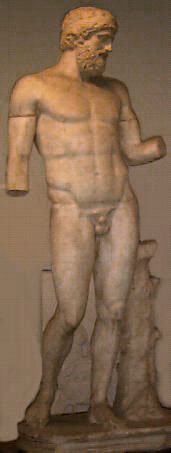
Munich King. Munich
Marble
Statue
2.385 m with plinth, plinth is 15 cm
From Italy. The first mention of the statue was in 1785 in an inventory of the Villa Albani. It remained in the Villa Albani collection until 1815 when it was acquired by Ludwig for the Glyptothek.
Germany, Munich, Glyptothek, 295
Preservation:The figure was thoroughly broken in World War II, after which the old restorations were removed and the statue painstakingly recomposed. The end of the nose, most of both forearms, both hands, the separately worked penis, and most of the testicles are missing. The old restorations on the knees, ankles, the heels, and the lower part of the calves have been replaced with new plaster filling pieces. Other restorations include the end of the big toe and the two outer toes of the right foot, the front half of the middle piece of the tree trunk support, and almost the entire strut from that piece of the tree trunk support to the area of the leg below the knee. Behind the left foot of the figure is a deep rectangular hole which was connected to a plaster patch on the left buttock by a modern metal piece that has been removed. In front of the right foot are two small indentations which lie one behind the other. On the outside of the middle of the right thigh is the remnant of a rectangular strut which has been worked away.
In large areas the surface has traces of chisel marks which indicate that it was not finely polished. In other places, despite modern reworking and acid wash, the original surface is preserved; for instance, the veins in the arm, groin, and feet are delicately worked.
Description:The statue depicts a bearded naked male, standing on an oval plinth. The long sides of the plinth are at the front and back; the shoulders of the statue are in line with the front side of the plinth. The upper and lower outer edges of the plinth are molded.
The weight of the statue is on the left leg which is supported by an abbreviated tree trunk. The right leg is bent and trails behind the left leg. The legs are long and slim without defined muscles. The right arm is lowered and moves slightly away from the right side of the body. At the outer thigh is a trace of a strut which was attached to the right hand or wrist. The left upper arm is also lowered. This arm, however, bends at the elbow and the forearm projected outwards and to the left. The head looks to the left and tilts downwards. Although the left hip is higher than the right hip and the right shoulder is higher than the left shoulder, the torso of the body, especially the abdominal muscles and navel, does not appear to move. In general the torso lacks delineation of the musculature and the skeletal frame, although there is some definition at the sternum on the upper chest.
The head of the statue is covered by a harmonious cap of hair. The locks, defined by drill channels, are short and curly and radiate without any parting from the crown. Running around the entire head above the ears is a smooth flat fillet which is knotted at the center of the back of the head. A few locks of hair fall over the fillet. Below the fillet the hair continues as above the fillet. The hair covers the tops of the ears and crosses the brow in an almost horizontal path. In front of the ears the locks move backward and seem longer, and at the center of brow is a small part. A beard, composed of long wavy locks, frames the face. It is rendered like the hair of the head and forms an even mass. The hairs of the moustache are summarily defined by engraved lines.
The face is oval in shape. The brow has a furrow below which it is convex. The eyes are long and have pronounced tear ducts at their inner corners. The lids are crisply defined but not significantly heavy. The nose is regular and the mouth is open. The lower lip is full and well defined. The upper lip and the chin are hidden by the moustache and beard.
Discussion:There are no other complete copies of the so-called “Munich King”. In scholarly literature two heads, the “Giustiniani” bust in Berlin and the lost “Giacomini” heads, have been considered copies of the King. Only, however, the first, the “Giustiniani” bust in Berlin might even be loosely called a copy. In addition, a bronze statuette in Zagreb and the statuette of Herakles in Boston (here cat. C 24) have been associated with the Munich King; neither of these are, however, copies of the same original.
The Munich statue is dated by Vierneisel Schlorb to the late Hadrianic or Antonine period on account of the drill channels in the hair and beard, the structure of the eyes and mouth, the type of the tree trunk support, and the molded oval plinth. The statue is generally considered an ungainly technically poor sculpture. For instance, although Vierneisel Schlorb acknowledges the large size as contributing to the difficulty of fine workmanship, she nonetheless calls it an inferior work of an unimaginative artist. In particular she considers the head, the lack of relief on the torso, and the rendering of the musculature of poor quality. The alignment of the torso parallel to the front edge of the plinth is also judged to be incorrect and to give the statue an unfortunate stiffness.
On account of these aspects, the “Giustiniani” bust in Berlin has often been considered a better copy—one that is closer to the original—of the same original. The “Giustiniani” bust does vary in several details. It has slightly different facial proportions, more differentiated hair—that is, above the fillet it falls in straight long locks and below the fillet it curls and has more volume. The ears are covered by the hair, the fillet ends reach the shoulders, and the hair of the beard is more imaginative and detailed. Some scholars (Lippold and Dorig above) have even doubted that the Munich King is a copy of an original fifth century work. They have preferred to see it as a classicizing work of the Roman imperial period.
Vierneisel Schlorb is adamant, however, that the Munich King is a copy of a fifth century Greek original and that it is, in fact, a more faithful copy than the “Giustiniani” bust in Berlin which she considers overrated. She points out that much of awkwardness of the Munich King is due to the ineptitude of the Roman copyist whose most significant error is to have aligned the shoulders with the front edge of the plinth. If we look at the King from our left, the statue and particularly the head appear more naturally. The head loses the sentimental position for which it has been criticized. In addition, the head has been said to show a severe old-fashioned rendering of the head and beard which is incongruous with its academic empty look. Vierneisel Schlorb, however, points out that the pubic hair is rendered in exactly the same manner so that it is likely that the hair of the original model was actually done in this manner. In regard to the academic look, she notes that this occurs on many Roman copies.
Various scholars have proposed various subjects for the statue. These include Zeus, Asclepius, Hephaistos, and Themistokles. Since 1956 there have been three significant proposals. H. Walter suggested because the head (mainly the “Giustiniani” and “Giacomini” versions) called to mind the heros on the East frieze of the Parthenon that the statue prehaps represented an eponymous hero who formed part of a monument in the Athenian Agora. The thesis is difficult since we know little about this monument in the Agora and the nudity and fillet are perhaps inappropriate for an eponymous hero.
Dorig, reassuming Walter’s idea that the statue represented a hero, sought to connect it with a now lost fragmentary inscription which read a statue of Iphitos by Kalamis. His theory was based primarily on he saw similarities in the Munich King to the works such as the Tiber Apollo which he considered to be by Kalamis.
Berger, building upon previous research which had noted the similarities between the Boston Herakles and the Munich King and which had associated the Boston Herakles with a dedication at the Heraion on Samos, suggested that the Munich King formed part of this dedication. The dedication, described by Strabo, featured statues of Herakles, Zeus, and Athena made by Myron. All three of the statues were removed to Rome by M. Antony; the Athena and Herakles were subsequently returned by Augustus. Strabo’s description has been confirmed by the discovery of a segmented curved base in Samos which bore colossal statues and which has been convincingly dated to 439 BCE or shortly thereafter. The statue of Zeus, which was never returned to Samos, has been associated with a statue found in the Theater of Marcellus. This statue is very similar to the Munich King and of the same size. The turn of the King has, furthermore, been deemed to be eminently appropriate for his position next to Zeus in the monument. Moreover, a statuette in Zagreb shows a bearded Herakles in a pose like that of the Munich King and holding the apples of the Hesperides in the left hand and a club or bow in the right. Vierneisel Schlorb accepts Berger’s theory, though she believes that the attribute in the right hand did not touch the ground. It is interesting to note that the “Giustiniani” bust and the “Giacomini” bust both feature hairstyles that more greatly resemble the head type assigned by Berger to the Zeus of the Samian dedication.
Bibliography:G. Lippold,
"Zur Arbeitsweise romischer Kopisten" (RM 1917) pp.95-102
discusses the copies of the head of the typeL. Curtius,
Zeus und Hermes (Munich 1931) pp.38-47
discussion of copiesH. Walter,
0 (AM 71 1956) p.175
J. Dorig,
"Kalamis-Studien" (JdI 80 1965) pp.210-220
considers the original of the Munich King to be a work of Kalamis depicting the hero IphitosE. Berger,
"Auszug aus dem Jahresbericht 1979: Skulpturenhalle" (AntK 13 1970) pp.89-90
suggests that the original of the Munich King formed part of a dedication at Samos which included Herakles, Zeus, and Athena.B. Vierneisel-Schlörb,
Katalog der Skulpturen Band II: Klassische Skulpturen des 5 und 4 Jahrhunderts v. Chr. (Munich 1979) pp.117-128 no.11
considers this copy an early Antonine work based on an original by Kresilas