Commentary Prepared by Dr. Julia Lenaghan, Ashmolean Museum
C 041
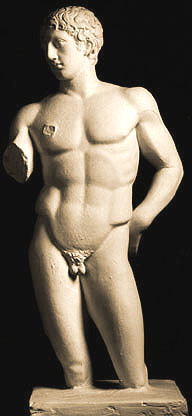
Statuette Based on Polykleitos' "Herakles". Barracco
Marble
Statuette
48 cm
Bought in Rome and thus, probably from Italy.
Italy, Rome, Museo Barracco, 109
Preservation:The statue is missing both legs from below the knees downward, the right arm from below the middle of the upper arm downward, most of the fingers of the left hand, and the penis. On the back of the right thigh is a large even break surface where the support was originally attached. There is a trace of a strut on the upper part of the right pectoral. Half of the nose is restoration.
Description:The statue depicts a naked male who stands with his weight on his right leg. Attached to the back of the right thigh was a support. The left leg is bent and loose and the left hip is lower than the right hip which projects slightly forward. The left shoulder, in contrast, is higher than the right shoulder. The left arm, though lowered, is pulled backward and bends at the elbow. The forearm extends forward and the left hand rests behind the left hip bone. The hand, the top of which rests against the hip, is open and empty. The right arm is also lowered. The upper arm, however, comes forward. The head turns to the right and tilts downwards.
The body is lean with smoothly modelled details. The only distinctly articulated features of the anatomy are the line from the hip to the groin (illiac furrow) and the ribs under the arms.
The head has a flat cranium and a broad circular face. The brow is rectangular; the cheeks are full and end in a solid “U-shaped” chin which recedes. The eyes are wide and the nose is broad. The lips are full and open. The hair is rendered in tiers of summarily rendered touseld locks which originate at the crown of the head. Each lock consists of two or three strands that are delineated by engraved lines. Above the center of the brow is a central parting with two long symmetrical locks on either side. Beyond these two locks (still on the brow) are locks which turn inwards toward the central parting. The locks cover the upper edge of the ears.
Discussion:The Barracco statuette is related to a type known as the “Herakles” of Polykleitos. The name of the type derives from three facts. First, Cicero and Pliny (Cicero, de Oratore II.69 and Pliny NH 34.56) mention a Herakles made by Polykleitos; second, the statue type resembles the “Doryphoros”; and third, the left hand rests behind the back and recalls the similar position of the left hand of the “Herakles Farnese” in which the apples of the Hesperides were held. There are fourteen fragmentary copies (four torsos and ten heads), of the type preserved. None preserve the left hand so that it is impossible to judge whether the left hand did hold the apples of the Hesperides and whether the statue really did represent Herakles. Certainly Cicero seems to be describing another statue.
In addition to the full-scale copies, is a slightly different series of eight statuettes (two statuettes, three torsos, and three heads) which are one third life size. The Barracco statuette (one of the two statuettes) is the only copy of either the full-scale or the smaller-scale series which preserves the head unbroken on the body. A number of details, however, show it to be unreliable for the reconstruction of the original. In comparison to the full-scale copies and, thus, presumably the original, the statuette has a looser more flexible pose in which the shoulders and hips twist against each other rather than appear frontal and flat; the head turns more to the right; the right arm, as the strut indicates, appears to have been pulled further forward and upward; the proportions are altered so that the body is slimmer; and the skeleton and musculature are less pronounced. In general the statuette has a younger, more agile appearance than the full-scale copies. The head has again its own distinctive details (flatter crown, smaller face, parting of the mouth, etc.) but does replicate the hair over the brow, even if slightly simplified.
Zanker dates the rendering of the hair and details such as the eyes to the Claudian through early Flavian period. This has generally been accepted. He, furthermore, points out that the entire series of small-scale replicas date to the late Julio-Claudian to early Flavian period. This leads him to conclude that this adjustment of the type was either a creation of the late Julio-Claudian to early Flavian period or that it was a creation of the Hellenistic period that was popular in the late Julio-Claudian to early Flavian period.
Bibliography:H. von Steuben,
"Kopf des polykletischen Herakles, Rom, Konservatorenpalast, Br.N." (AntPl VII 1967) p.102 fig.9
in list of copies of Polykleitos' "Herakles" typeP. Zanker,
Klassizistische Statuen (Mainz 1974) pp.17-19 no.16 pls.16.4-6; 17.1-3; 18.2, 5, 6; 19.2, 4
considers this variation of the Polykleitos "Herakles" type either a Hellenistic or a Claudian-Flavian invention, in either case this copy is Claudian-FlavianO. Palagia,
"Herakles" Lexicon Iconographicum Mythologiae Classicae IV, I (Zurich 1988) p.758 no.583
brief entry on Polykleitos' Hermes after which Barracco statuette is listedD. Kreikenbom,
Bildwerke nach Polyklet (Berlin 1990) pp.95, 98, 185 no.IV a.1
Neronian-Flavian work, one of eight statuettes based on Polykleitos' "Herakles"