Commentary Prepared by Dr. Julia Lenaghan, Ashmolean Museum
C 040
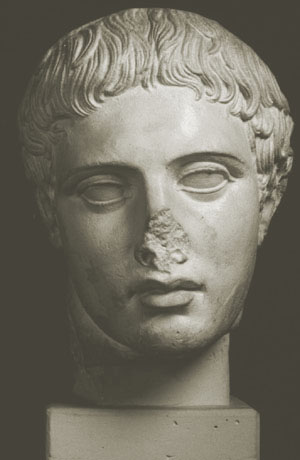
Copy of the head of Polykleitos' "Hermes". Boston
Marble
Head
27 cm
From near Capua.
United States, Boston, Museum of Fine Arts, 98.641
Preservation:The head is broken diagonally through the neck and the end of the nose is broken off. A separately made piece, which was inserted on the top of the skull, is missing. The top of the skull is thus mainly flat and has a square hole for a dowel in the center. It is rough picked with a smooth band around its exterior. There are faint traces of black paint in the eyes that give an indication of the irises and pupils.
Description:The head depicts a youthful male with short hair. The head turns to the right and slightly downwards. It has broad oval shape with fleshy cheeks that converge in a horizontally broad but vertically short prominent chin. The brow is high and rounded with slightly arching eyebrows. The eyes are wide open with distinct tear ducts at the inner corners and are framed by sharp-edged lids. The mouth is small and the lips are full; the upper lip has a rounded bow shape. The corners of the mouth tuck into the softly modelled flesh of the lower face. Below the lower lip the protrusion of the chin is also modelled.
The hair, which originates at the crown in a "starfish" pattern, comes forward in tiers of wavy locks that cling to the head. The channels between the locks are broad and pronounced and the lines delineating the individual strands are crisply engraved. The hair, lying on the brow, follows a semi-circular path which reaches its highest point at the center of the brow. At the center of the brow is a small central parting. Above the outer side of each eye, one or two locks on the brow turn inwards toward the center. Dowelled on to the top of the head was likely a petasos.
Discussion:The Boston head is a copy of a type preserved in a total of eighteen (Floren) heads. The structure of the head, the features of the face, the arrangement of the hair, and the subject of the head type are remarkably similar to those of the “Doryphoros” and “Diskophoros” of Polykleitos. In addition, five of the eighteen heads wear small wings or petasoi on their heads that identify the statue as Hermes.
Thus, the type has been called the “Hermes” of Polykleitos, a work known from a passage in Pliny (NH 34.56). In that passage Pliny tersely notes that statue once stood in Lysimachia. This provides no aid for chronology or original place of erection since we know neither which ancient city named Lysimachia Pliny intends nor if that were the statue’s original placement. In fact, despite the assertion most recently of Floren, we have no definitive proof that the original statue of the so-called “Hermes” type even represented Hermes; for example, the “Diskophoros” of Polykleitos is also occasionally given attributes of Hermes in Roman copies. Yet, because the “Hermes” type is preserved on no occasion as anything other than Hermes, the name “Hermes” remains plausible.
Despite the fact that there are eighteen preserved heads of the type, there are oddly no secure copies of the body. A statue in the Boboli Gardens, Florence, which bears the head type, is generally considered most likely to represent the original body. This statue, (the mantle and baby Dionysos are additions of the copyist), is extremely similar to the “Doryphoros” and thus, introduces the possibility that for the “Hermes” statue, copyists often just used the body of the “Doryphoros.”
The “Hermes” head type, in contrast, is thought (Kriekenbom and Bol) to resemble Polykleitos’ “Diskophoros” more than his “Doryphoros”. In addition, Floren uses the length of the hair and its arrangement as evidence that the original statue post-dated the “Doryphoros” and pre-dated the “Herakles” of Polykleitos.
The Boston head, often considered an excellent copy of the “Hermes” (Vermeule and Vierneisel-Schlorb), has been most recently criticized by Kriekenbom who cites a head in Oslo as the truest copy of the original. In comparison, to the Oslo head the Boston head has a broader face with fuller cheeks, a shorter chin, and wider eyes. The skin, in general, is less taut and the hair has less volume. Kreikenbom considers the Boston head to be rendered in a “pseudo-bronze” style and notes that the increased width of the face recalls the “Doryphoros” rather than the “Diskophoros”.
All scholars agree that the Boston head dates to the early second century, either to the Trajanic or Hadrianic period. The rendering of the hair, the sharpness of the eyelids, and the plasticity of the flesh are generally cited as indications of the date. Vierneisel-Schlorb specifically compares the hair to that of the Louvre Trajan bust and the eyes to those of the colossal Hadrian from Ostia.
Bibliography:H. Lauter,
Zur Chronologie romischer Kopien nach Originalen des V. Jhr. (Bonn 1968) p.93 no.10
lists as neoclassical work of Hadrianic periodC. Vermeule and M. Comstock,
Sculpture in Stone: The Greek, Roman, and Etruscan Collections of the Museum of Fine Arts Boston (Boston 1976) pp.92-94 no.144
catalogue entry, considers head an excellent copyB. Vierneisel-Schlörb,
Katalog der Skulpturen Band II: Klassische Skulpturen des 5 und 4 Jahrhunderts v. Chr. (Munich 1979) pp.71-77, especially 72 no.1
Trajanic-Hadrianic copyP. Bol,
"Hermes" in Polyklet: Die Bildhauer der griechischen Klassik (Mainz am Rhein 1990) pp.118-120
explores issue of body of the head, compares the head type to the "Diskophoros" head(D. Kreikenbom),
Polyklet: Der Bildhauer der griechischen Klassik (Mainz am Rhein 1990) pp.533-534 no.37
notes Trajanic-Hadrianic aspect of head, considers the head overrated as a copyD. Kreikenbom,
Bildwerke nach Polyklet (Berlin 1990) pp.49, 158-159 no.II.8 pls.81b-83
general discussion of head type, Trajanic-Hadrianic copy with classicizing detailsJ. Floren,
"Der Hermes des Polyklet" in Polyklet-Forschungen (H. Beck and P. Bol, eds.) (Berlin 1993) pp.58-59
considers the Boston head among the best copies, believes the type created after the "Doryphoros" and before the "Herakles"B. S. Ridgway,
"Paene ad Exemplum: Polykleitos' Other Works" in Polykleitos, the Doryphoros, and Tradition (Wisconsin 1995) pp.188-189
summarizes research on the "Hermes" type